Resilience and innovation in a changing world: reflections on our Q1 2026 summit
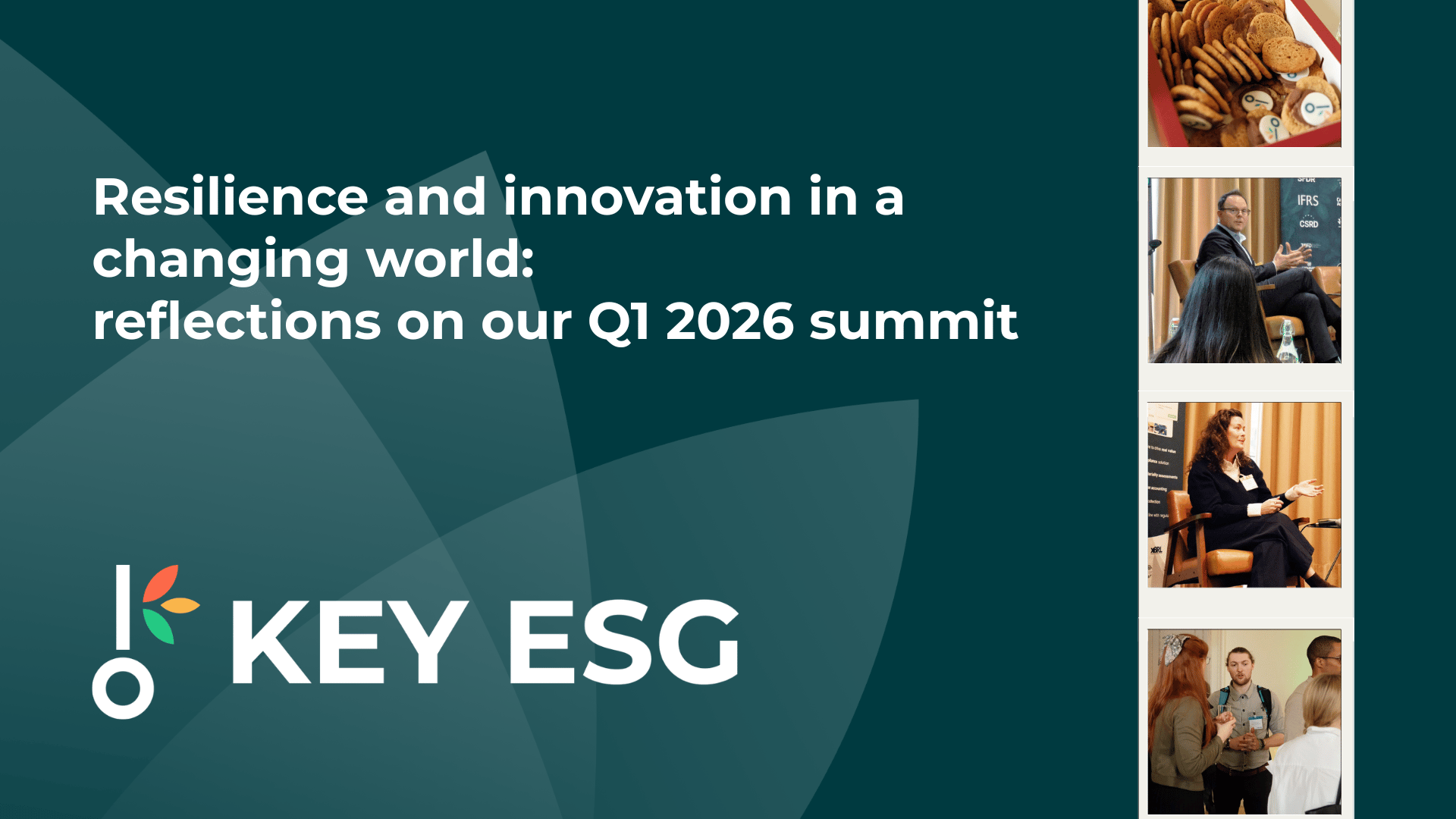
On 12th March, we brought together sustainability, risk, and finance leaders in central London for our Q1 2026 summit. Although we've had several summit events, this was a new format for us, with fewer presentations, more conversation, and a room full of people working through similar challenges.
Here's a look at what we covered.
Resilience in the real world
Watch the video of the session now
We opened with a keynote conversation between KEY ESG co-founder Heleen van Poecke and Jeffrey Oatham, Chief Sustainability Officer at DTEK, Ukraine's largest private energy company. Jeff brought something rare to the room: a sustainability perspective shaped not by theory, but by operating through conflict.
DTEK provides around a fifth of Ukraine's power capacity across coal mines, thermal generation, wind and solar farms, and a consumer-facing energy business. Its stations face drone and missile attacks on a daily basis. Teams work in minus 20 degree conditions, clearing rubble and making emergency repairs while colleagues in Kyiv join calls on battery power after 20 hours without electricity. As Jeff described it, resilience there is simply about showing up, something the whole organisation continues to do.
The war has also changed how DTEK thinks about the energy transition. While decarbonisation remains the long-term goal, the more immediate driver for investing in renewables is security. A coal station can be taken out by a single missile. Doing the equivalent damage to a wind farm would take around forty. Renewables offer a more distributed and harder-to-attack energy system, and that is now the primary argument DTEK makes to policymakers and investors.
Jeff also noted that he actively avoids the word "sustainability" with certain stakeholders, finding that reframing the same goals in terms of energy security or resilience keeps conversations open that might otherwise close. For a room of people navigating their own versions of that challenge, it landed well.
Jeff was also candid about the ESG backlash. His view is that there is a lot of noise, but the underlying case has not changed and the economics of renewables still holds. The physical risks of climate change are still real and becoming more expensive. On the Omnibus, Jeff's read was that the EU is still committed to the 2050 Green Deal, but is looking for a smarter path to get there, one that balances climate ambition with the growth and societal pressures the continent is dealing with right now.
Looking further ahead, Jeff pushed back on the idea that sustainability leaders should aim to work themselves out of a job. His expectation for 20 years from now is leaner, more embedded sustainability teams operating at board level, with a clearer business case across more industries as the pressures of climate change become harder for any organisation to ignore.
He ended by asking the room whether they were optimistic or pessimistic about the future of sustainability. The show of hands was overwhelming positive.
AI in sustainability: what's live, what's coming
Rob Caiger and Hussain Miah from the KEY ESG engineering team gave an honest look at how we're thinking about AI, and what we're actually building.
Our guiding principles are: only build AI features that save real time or improve accuracy, never in a way that excludes people who aren't yet comfortable using the technology, and always keep data within the right environment. No training on customer data.
Two features are already live: AI-generated narrative answers to CSRD and similar disclosure questions, drawing on uploaded policy documents; and AI root cause analysis for data validation, which flags when figures look anomalous and explains why. The demo caught a real-world error, data entered in kilowatt hours one year and megawatt hours the next, in seconds.
Coming next: smart category mapping for Scope 3.1 and 3.2 spend data, AI-suggested action plans based on emissions activity, and for the more technical minds in the room, MCP server integration that could let AI agents pull and push data between systems without custom-built connectors. A glimpse of how sustainability software buying decisions might change.
The roundtable discussion that followed reflected genuine curiosity rather than scepticism. Most people in the room are already using AI in some form. The consistent theme was the importance of keeping a human in the loop, especially for anything that might be audited.
Putting sustainability into practice: the SDG approach
Watch the video of the session now
Sophie Rathmell moderated a fireside conversation with Jane Shaw, who advises private equity firm Egeria on sustainability across its portfolio. Jane walked through Egeria's approach of asking each portfolio company to pick three or four UN Sustainable Development Goals and build their strategy around those, rather than trying to report against everything at once.
Egeria's own four are climate action, good health and wellbeing, reduced inequalities, and quality education, the last reflecting a corporate giving programme the firm runs. But within those, each portfolio company has the freedom to set its own goals, targets and KPIs. The framework provides a shared language without imposing a one-size-fits-all approach, which matters when you have businesses operating across very different geographies and sectors.
The logic behind keeping the number small is that focus creates momentum. Jane described working with a hotel group that started the process sceptically. Once they actually gathered their sustainability activity under the SDG framework, they discovered they were already doing far more than they had realised. The act of making it visible gave them the confidence to challenge themselves further. That shift, from reluctant compliance to genuine ownership, is what the approach is designed to produce.
Jane was clear that the SDGs chosen should be stable over three to five years. Changing them annually is a sign they were chosen for the wrong reasons. And for companies just starting out, the bar for the first year should be set realistically. Getting a company from zero to one, as Jane put it, is harder than getting from one to a hundred. If switching to green energy is all a company can commit to in year one, that is still progress, and progress is what builds the habit.
The conversation also touched on management incentives. Egeria's current position is to embed sustainability into operational workflows rather than attach it to individual rewards, on the basis that making it a natural part of how the business runs is more durable than making it something people are praised or penalised for. It is a question a lot of organisations in the room were evidently wrestling with too.
Closing awards
We ended the day by recognising two customers. The Integrity Champion Award went to Julia from Montagu, recognised for the rigour and consistency of her data governance. The Goals in Action Award went to Egeria, a fitting bookend to the afternoon's SDG conversation.
Thank you to everyone who joined us. The conversations in the room were, as ever, the best part. We'll be back with more in the Autumn, and we'd love to hear your thoughts on what to keep, what to improve, and who else should be in the room next time.
If you'd like to join our next summit, register your interest here.
Resilience and innovation in a changing world: reflections on our Q1 2026 summit
On 12th March, we brought together sustainability, risk, and finance leaders in central London for our Q1 2026 summit. Although we've had several summit events, this was a new format for us, with fewer presentations, more conversation, and a room full of people working through similar challenges.
Here's a look at what we covered.
Resilience in the real world
Watch the video of the session now
We opened with a keynote conversation between KEY ESG co-founder Heleen van Poecke and Jeffrey Oatham, Chief Sustainability Officer at DTEK, Ukraine's largest private energy company. Jeff brought something rare to the room: a sustainability perspective shaped not by theory, but by operating through conflict.
DTEK provides around a fifth of Ukraine's power capacity across coal mines, thermal generation, wind and solar farms, and a consumer-facing energy business. Its stations face drone and missile attacks on a daily basis. Teams work in minus 20 degree conditions, clearing rubble and making emergency repairs while colleagues in Kyiv join calls on battery power after 20 hours without electricity. As Jeff described it, resilience there is simply about showing up, something the whole organisation continues to do.
The war has also changed how DTEK thinks about the energy transition. While decarbonisation remains the long-term goal, the more immediate driver for investing in renewables is security. A coal station can be taken out by a single missile. Doing the equivalent damage to a wind farm would take around forty. Renewables offer a more distributed and harder-to-attack energy system, and that is now the primary argument DTEK makes to policymakers and investors.
Jeff also noted that he actively avoids the word "sustainability" with certain stakeholders, finding that reframing the same goals in terms of energy security or resilience keeps conversations open that might otherwise close. For a room of people navigating their own versions of that challenge, it landed well.
Jeff was also candid about the ESG backlash. His view is that there is a lot of noise, but the underlying case has not changed and the economics of renewables still holds. The physical risks of climate change are still real and becoming more expensive. On the Omnibus, Jeff's read was that the EU is still committed to the 2050 Green Deal, but is looking for a smarter path to get there, one that balances climate ambition with the growth and societal pressures the continent is dealing with right now.
Looking further ahead, Jeff pushed back on the idea that sustainability leaders should aim to work themselves out of a job. His expectation for 20 years from now is leaner, more embedded sustainability teams operating at board level, with a clearer business case across more industries as the pressures of climate change become harder for any organisation to ignore.
He ended by asking the room whether they were optimistic or pessimistic about the future of sustainability. The show of hands was overwhelming positive.
AI in sustainability: what's live, what's coming
Rob Caiger and Hussain Miah from the KEY ESG engineering team gave an honest look at how we're thinking about AI, and what we're actually building.
Our guiding principles are: only build AI features that save real time or improve accuracy, never in a way that excludes people who aren't yet comfortable using the technology, and always keep data within the right environment. No training on customer data.
Two features are already live: AI-generated narrative answers to CSRD and similar disclosure questions, drawing on uploaded policy documents; and AI root cause analysis for data validation, which flags when figures look anomalous and explains why. The demo caught a real-world error, data entered in kilowatt hours one year and megawatt hours the next, in seconds.
Coming next: smart category mapping for Scope 3.1 and 3.2 spend data, AI-suggested action plans based on emissions activity, and for the more technical minds in the room, MCP server integration that could let AI agents pull and push data between systems without custom-built connectors. A glimpse of how sustainability software buying decisions might change.
The roundtable discussion that followed reflected genuine curiosity rather than scepticism. Most people in the room are already using AI in some form. The consistent theme was the importance of keeping a human in the loop, especially for anything that might be audited.
Putting sustainability into practice: the SDG approach
Watch the video of the session now
Sophie Rathmell moderated a fireside conversation with Jane Shaw, who advises private equity firm Egeria on sustainability across its portfolio. Jane walked through Egeria's approach of asking each portfolio company to pick three or four UN Sustainable Development Goals and build their strategy around those, rather than trying to report against everything at once.
Egeria's own four are climate action, good health and wellbeing, reduced inequalities, and quality education, the last reflecting a corporate giving programme the firm runs. But within those, each portfolio company has the freedom to set its own goals, targets and KPIs. The framework provides a shared language without imposing a one-size-fits-all approach, which matters when you have businesses operating across very different geographies and sectors.
The logic behind keeping the number small is that focus creates momentum. Jane described working with a hotel group that started the process sceptically. Once they actually gathered their sustainability activity under the SDG framework, they discovered they were already doing far more than they had realised. The act of making it visible gave them the confidence to challenge themselves further. That shift, from reluctant compliance to genuine ownership, is what the approach is designed to produce.
Jane was clear that the SDGs chosen should be stable over three to five years. Changing them annually is a sign they were chosen for the wrong reasons. And for companies just starting out, the bar for the first year should be set realistically. Getting a company from zero to one, as Jane put it, is harder than getting from one to a hundred. If switching to green energy is all a company can commit to in year one, that is still progress, and progress is what builds the habit.
The conversation also touched on management incentives. Egeria's current position is to embed sustainability into operational workflows rather than attach it to individual rewards, on the basis that making it a natural part of how the business runs is more durable than making it something people are praised or penalised for. It is a question a lot of organisations in the room were evidently wrestling with too.
Closing awards
We ended the day by recognising two customers. The Integrity Champion Award went to Julia from Montagu, recognised for the rigour and consistency of her data governance. The Goals in Action Award went to Egeria, a fitting bookend to the afternoon's SDG conversation.
Thank you to everyone who joined us. The conversations in the room were, as ever, the best part. We'll be back with more in the Autumn, and we'd love to hear your thoughts on what to keep, what to improve, and who else should be in the room next time.
If you'd like to join our next summit, register your interest here.

.png)