What happened at Sustainability Unlocked October 2026?
On 8 October 2026, KEY ESG brought together sustainability leaders from private equity firms, portfolio companies and corporates at The Marylebone Hotel in London for Sustainability Unlocked, its bi-annual sustainability summit.
The theme was "Your expertise, amplified": how artificial intelligence (AI) can take on manual, repetitive reporting work so that sustainability professionals can concentrate on judgement, analysis and decisions.
KEY ESG is an AI-native sustainability reporting platform that helps private equity fund managers, portfolio companies and corporate sustainability teams collect, validate, analyse and report ESG (environmental, social and governance) data. Customers work with AI in two ways on the same validated data: through Ask KEY, KEY ESG's AI analysis agent inside the platform, and through the KEY ESG MCP connector, which brings that data into enterprise AI tools such as Claude, ChatGPT and Microsoft Copilot. MCP, the Model Context Protocol, is an open standard that allows AI assistants to connect securely to external data sources.
The programme included a keynote from KEY ESG co-founders Heleen van Poecke and Anne-Marie Schoonbeek, a fireside chat with Valerie Monk of Montagu, customer use cases, a product session on AI in sustainability workflows and a hands-on AI Hackathon.
Key takeaways:
-AI delivers the most value when combined with human expertise. As AI adoption becomes universal and companies use the same models and tools, how they use them becomes the differentiator. Human expertise, together with diversity of thought and experience, is what sets organisations apart.
-AI governance is becoming part of the ESG mandate. The EU AI Act indicates the direction of travel. While AI regulation remains a topic of debate globally, AI clearly needs to be governed well, and sustainability and compliance practitioners need to add AI governance to their toolkit and workstreams.
-AI workflows are only as reliable as the underlying data. The strongest results come from applying AI to validated ESG data. AI can support data ingestion and validation, but a person must remain in the loop. ESG data is tracked because it needs to be accurate, so there is no room for hallucinated figures.
-AI can now take on much of the manual, repetitive work in sustainability reporting. This includes data ingestion, data cleaning, validation and report building, which creates clear efficiency gains for sustainability teams.
Why is AI in sustainability reporting "combined intelligence"?
AI works best in sustainability reporting when it is combined with human expertise rather than used as a replacement for it. Opening the summit, Heleen van Poecke, CEO and Co-Founder of KEY ESG, shared a phrase coined by another firm that speaks of "combined intelligence" rather than artificial intelligence. AI can produce an 80 to 90% draft at great speed. The final 10%, which depends on context, experience and judgement, is where sustainability professionals add the most value.
The keynote drew out three implications:
-The advantage will not come from the tools. According to McKinsey's The state of AI in 2025, 88% of organisations now use AI in at least one business function. When every firm has the same models, expertise and unique insight become the differentiator.
-Experienced professionals have an important role to play. Practitioners who know what good looks like can brief and review AI as they would a junior colleague. Firms will need to think carefully about how they continue to develop junior talent.
-Rethink the process, do not just automate it. McKinsey finds that AI high performers are nearly three times as likely to have fundamentally redesigned their workflows
Where does AI save sustainability teams the most time?
AI saves the most time in three areas of sustainability reporting: data ingestion, data validation and turning data into insight.
Michael Greig of KEY ESG's product team set out where customers see the greatest value:
1. Data ingestion and cleaning. AI extracts data from PDFs, spreadsheets and other unstructured sources and transposes it into the required format.
2. Data validation. AI takes on much of the detective work of understanding why a figure looks wrong, connecting large datasets far faster than a person can.
3. Insight and narrative. AI turns data into commentary for boards and reports, and reframes ESG data in the language that finance, deal teams and other stakeholders use, which leads to better discussions and better decisions.
None of this works without trust. Michael proposed a simple test for any output AI has touched: where did this number come from, can the calculation be reproduced, and has a person checked it? These principles of traceability and human oversight guide how KEY ESG builds its AI features. In 2026 these have included AI-assisted policy narratives, root cause analysis when a validation rule is triggered, AI mapping of imported data and, now in beta, AI ingestion that accepts a spreadsheet as it is and shows every assumption before data is applied.
How should sustainability teams govern AI and its footprint?
AI is becoming a governance topic in the same way that cyber security did. Heleen described AI as the new governance element within the G of ESG. In some firms the sustainability team tracks AI risk; in others it sits with technology, data or compliance. Regulation points the same way: the EU has taken a comprehensive, risk-based approach through the EU AI Act (Regulation (EU) 2024/1689), while the United States has been more hesitant. A proportionate response starts with mapping where AI is used, classifying each use case by risk and keeping a person in the loop.
Anne-Marie Schoonbeek, COO and Co-Founder of KEY ESG, addressed the environmental footprint of AI. Data centres already use around 1.5% of global electricity (IEA, Energy and AI), and newer models are not always more efficient. Research from the Sustainable AI Group's CLEER project found that energy use can differ by more than 30 times between models doing the same task, so accurate measurement needs token use by model from AI providers, not just spend. Materiality still applies: for a manufacturer with significant fuel and energy use, AI emissions are unlikely to be a priority.
How should companies govern compliance, ESG and AI together?
In a fireside chat, Heleen van Poecke and Valerie Monk, Partner in Montagu's Full Potential Partners team, discussed how companies can treat compliance, ESG and AI as one governance conversation. The discussion covered how to make governance topics relevant to deal teams and portfolio companies, how to assess new requirements such as the EU AI Act, and how AI can help portfolio companies with limited resources put practical tools in place. The session closed with questions from the audience.
How are KEY ESG customers use the platform's AI capabilities?
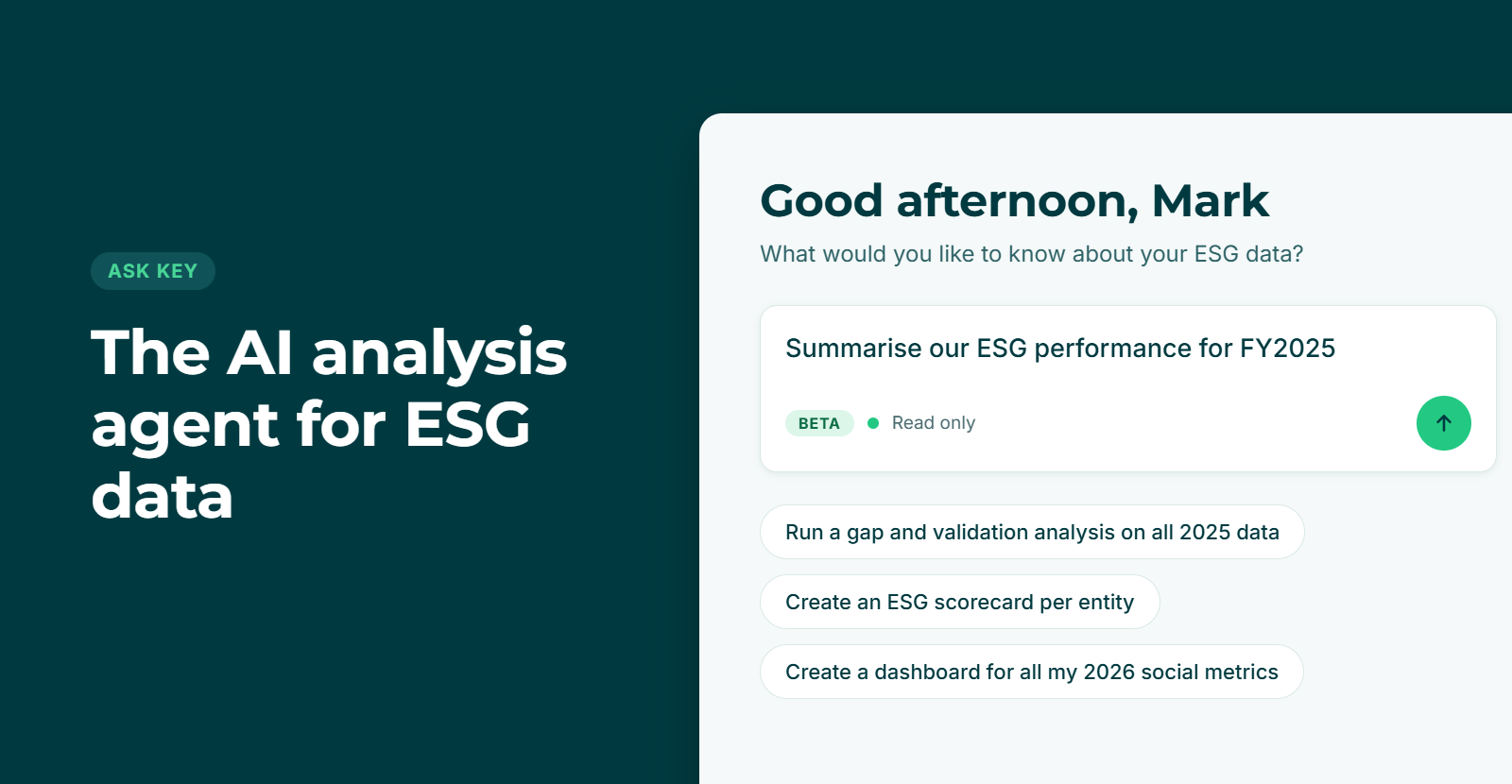
KEY ESG customers use Ask KEY and the MCP connector as two routes into one validated data layer. Ask KEY, KEY ESG's AI analysis agent, brings together qualitative and quantitative data across environmental, social and governance metrics, connects trends to targets and action plans, reads uploaded evidence and analyses data down to the level it was entered, such as an individual entity or country. Teams use it for data validation, trend analysis, identifying data gaps, and insights and suggestions, without taking data out of the platform. The MCP connector brings the same data into Claude, ChatGPT or Copilot, where it can be combined with finance, operational and deal data.
Sophie Rathmell, Customer Success Manager at KEY ESG, presented two illustrative workflows:
A corporate tracking a group emissions target. Ask KEY identified which sites had moved the group off track since its baseline year. Through the MCP connector, Claude then drafted an action plan for each lagging site, using the best-performing site as an internal benchmark.
A private equity firm answering investor ESG questionnaires. A reusable skill pre-fills each questionnaire from portfolio data, with a source for every answer and a list of gaps for investor relations.
The depth of data determines the depth of insight. When data is recorded per site or per fuel type, AI can show why one location outperforms another, not only that it does. Because metrics are calculated in KEY ESG using recognised methodologies, AI works with validated, traceable figures rather than generating its own.
What did attendees build in the AI Hackathon?
During the AI Hackathon, every table built a working AI skill in Claude, connected to demonstration data through the KEY ESG MCP connector, to automate a repetitive sustainability task. A skill is a reusable set of instructions that tells Claude how to carry out a task, so the same work is done the same way each time.
Tables mixed attendees with different levels of AI experience, alongside KEY ESG facilitators from sales and product. In one hour, each table agreed a task, described it as they would brief a new analyst, built and tested the skill, and presented one result to the room. A prize was awarded for the most useful skill.
Why does KEY ESG host Sustainability Unlocked?
KEY ESG hosts Sustainability Unlocked twice a year to bring sustainability leaders together, to let practitioners learn from one another and to hear first-hand the challenges our software should solve. This reflects how we build our product: combining our expertise in sustainability reporting with leading AI technology, such as Claude from Anthropic and the open Model Context Protocol, and with the experience of industry practitioners. AI remains optional in KEY ESG; it can be switched off for any account and every workflow continues to work.
Get started with AI in your sustainability reporting
The most effective first step is to apply AI to one repetitive task, using data you already trust. Book a demo to see Ask KEY and the KEY ESG MCP connector on your own reporting workflow. To join our next summit, contact your Customer Success Manager or get in touch via contact@keyesg.com.
Frequently asked questions
What is Sustainability Unlocked?
Sustainability Unlocked is KEY ESG's bi-annual summit for sustainability leaders from private equity firms, portfolio companies and corporates. The October 2026 edition took place on 8 October at The Marylebone Hotel in London and focused on how AI can support sustainability reporting, governance and analysis.
What is Ask KEY?
Ask KEY is KEY ESG's AI analysis agent, built into the KEY ESG platform. It brings together qualitative and quantitative data across environmental, social and governance metrics, connects data and trends to targets and action plans, and reads uploaded evidence. Teams use it for data validation, trend analysis, identifying data gaps, and insights and suggestions, drawing on ESG context from KEY ESG's sustainability database.
What is the KEY ESG MCP connector?
The KEY ESG MCP connector links validated ESG data held in KEY ESG to enterprise AI tools that support the Model Context Protocol, such as Claude, ChatGPT and Microsoft Copilot. Teams can combine ESG data with finance, operational and deal data in their own AI environment and turn repeated analyses into reusable skills.
How can companies measure the carbon emissions of their AI use?
Companies can multiply the tokens they use per model by a published emission factor for that model, such as those from the Sustainable AI Group's CLEER methodology, and report the result under Scope 3, Category 1 (purchased goods and services) of the GHG Protocol. Where token data is not available, other usage data can be converted, with spend used only as a last resort.
What happened at Sustainability Unlocked October 2026?
On 8 October 2026, KEY ESG brought together sustainability leaders from private equity firms, portfolio companies and corporates at The Marylebone Hotel in London for Sustainability Unlocked, its bi-annual sustainability summit.
The theme was "Your expertise, amplified": how artificial intelligence (AI) can take on manual, repetitive reporting work so that sustainability professionals can concentrate on judgement, analysis and decisions.
KEY ESG is an AI-native sustainability reporting platform that helps private equity fund managers, portfolio companies and corporate sustainability teams collect, validate, analyse and report ESG (environmental, social and governance) data. Customers work with AI in two ways on the same validated data: through Ask KEY, KEY ESG's AI analysis agent inside the platform, and through the KEY ESG MCP connector, which brings that data into enterprise AI tools such as Claude, ChatGPT and Microsoft Copilot. MCP, the Model Context Protocol, is an open standard that allows AI assistants to connect securely to external data sources.
The programme included a keynote from KEY ESG co-founders Heleen van Poecke and Anne-Marie Schoonbeek, a fireside chat with Valerie Monk of Montagu, customer use cases, a product session on AI in sustainability workflows and a hands-on AI Hackathon.
Key takeaways:
-AI delivers the most value when combined with human expertise. As AI adoption becomes universal and companies use the same models and tools, how they use them becomes the differentiator. Human expertise, together with diversity of thought and experience, is what sets organisations apart.
-AI governance is becoming part of the ESG mandate. The EU AI Act indicates the direction of travel. While AI regulation remains a topic of debate globally, AI clearly needs to be governed well, and sustainability and compliance practitioners need to add AI governance to their toolkit and workstreams.
-AI workflows are only as reliable as the underlying data. The strongest results come from applying AI to validated ESG data. AI can support data ingestion and validation, but a person must remain in the loop. ESG data is tracked because it needs to be accurate, so there is no room for hallucinated figures.
-AI can now take on much of the manual, repetitive work in sustainability reporting. This includes data ingestion, data cleaning, validation and report building, which creates clear efficiency gains for sustainability teams.
Why is AI in sustainability reporting "combined intelligence"?
AI works best in sustainability reporting when it is combined with human expertise rather than used as a replacement for it. Opening the summit, Heleen van Poecke, CEO and Co-Founder of KEY ESG, shared a phrase coined by another firm that speaks of "combined intelligence" rather than artificial intelligence. AI can produce an 80 to 90% draft at great speed. The final 10%, which depends on context, experience and judgement, is where sustainability professionals add the most value.
The keynote drew out three implications:
-The advantage will not come from the tools. According to McKinsey's The state of AI in 2025, 88% of organisations now use AI in at least one business function. When every firm has the same models, expertise and unique insight become the differentiator.
-Experienced professionals have an important role to play. Practitioners who know what good looks like can brief and review AI as they would a junior colleague. Firms will need to think carefully about how they continue to develop junior talent.
-Rethink the process, do not just automate it. McKinsey finds that AI high performers are nearly three times as likely to have fundamentally redesigned their workflows
Where does AI save sustainability teams the most time?
AI saves the most time in three areas of sustainability reporting: data ingestion, data validation and turning data into insight.
Michael Greig of KEY ESG's product team set out where customers see the greatest value:
1. Data ingestion and cleaning. AI extracts data from PDFs, spreadsheets and other unstructured sources and transposes it into the required format.
2. Data validation. AI takes on much of the detective work of understanding why a figure looks wrong, connecting large datasets far faster than a person can.
3. Insight and narrative. AI turns data into commentary for boards and reports, and reframes ESG data in the language that finance, deal teams and other stakeholders use, which leads to better discussions and better decisions.
None of this works without trust. Michael proposed a simple test for any output AI has touched: where did this number come from, can the calculation be reproduced, and has a person checked it? These principles of traceability and human oversight guide how KEY ESG builds its AI features. In 2026 these have included AI-assisted policy narratives, root cause analysis when a validation rule is triggered, AI mapping of imported data and, now in beta, AI ingestion that accepts a spreadsheet as it is and shows every assumption before data is applied.
How should sustainability teams govern AI and its footprint?
AI is becoming a governance topic in the same way that cyber security did. Heleen described AI as the new governance element within the G of ESG. In some firms the sustainability team tracks AI risk; in others it sits with technology, data or compliance. Regulation points the same way: the EU has taken a comprehensive, risk-based approach through the EU AI Act (Regulation (EU) 2024/1689), while the United States has been more hesitant. A proportionate response starts with mapping where AI is used, classifying each use case by risk and keeping a person in the loop.
Anne-Marie Schoonbeek, COO and Co-Founder of KEY ESG, addressed the environmental footprint of AI. Data centres already use around 1.5% of global electricity (IEA, Energy and AI), and newer models are not always more efficient. Research from the Sustainable AI Group's CLEER project found that energy use can differ by more than 30 times between models doing the same task, so accurate measurement needs token use by model from AI providers, not just spend. Materiality still applies: for a manufacturer with significant fuel and energy use, AI emissions are unlikely to be a priority.
How should companies govern compliance, ESG and AI together?
In a fireside chat, Heleen van Poecke and Valerie Monk, Partner in Montagu's Full Potential Partners team, discussed how companies can treat compliance, ESG and AI as one governance conversation. The discussion covered how to make governance topics relevant to deal teams and portfolio companies, how to assess new requirements such as the EU AI Act, and how AI can help portfolio companies with limited resources put practical tools in place. The session closed with questions from the audience.
How are KEY ESG customers use the platform's AI capabilities?
KEY ESG customers use Ask KEY and the MCP connector as two routes into one validated data layer. Ask KEY, KEY ESG's AI analysis agent, brings together qualitative and quantitative data across environmental, social and governance metrics, connects trends to targets and action plans, reads uploaded evidence and analyses data down to the level it was entered, such as an individual entity or country. Teams use it for data validation, trend analysis, identifying data gaps, and insights and suggestions, without taking data out of the platform. The MCP connector brings the same data into Claude, ChatGPT or Copilot, where it can be combined with finance, operational and deal data.
Sophie Rathmell, Customer Success Manager at KEY ESG, presented two illustrative workflows:
A corporate tracking a group emissions target. Ask KEY identified which sites had moved the group off track since its baseline year. Through the MCP connector, Claude then drafted an action plan for each lagging site, using the best-performing site as an internal benchmark.
A private equity firm answering investor ESG questionnaires. A reusable skill pre-fills each questionnaire from portfolio data, with a source for every answer and a list of gaps for investor relations.
The depth of data determines the depth of insight. When data is recorded per site or per fuel type, AI can show why one location outperforms another, not only that it does. Because metrics are calculated in KEY ESG using recognised methodologies, AI works with validated, traceable figures rather than generating its own.
What did attendees build in the AI Hackathon?
During the AI Hackathon, every table built a working AI skill in Claude, connected to demonstration data through the KEY ESG MCP connector, to automate a repetitive sustainability task. A skill is a reusable set of instructions that tells Claude how to carry out a task, so the same work is done the same way each time.
Tables mixed attendees with different levels of AI experience, alongside KEY ESG facilitators from sales and product. In one hour, each table agreed a task, described it as they would brief a new analyst, built and tested the skill, and presented one result to the room. A prize was awarded for the most useful skill.
Why does KEY ESG host Sustainability Unlocked?
KEY ESG hosts Sustainability Unlocked twice a year to bring sustainability leaders together, to let practitioners learn from one another and to hear first-hand the challenges our software should solve. This reflects how we build our product: combining our expertise in sustainability reporting with leading AI technology, such as Claude from Anthropic and the open Model Context Protocol, and with the experience of industry practitioners. AI remains optional in KEY ESG; it can be switched off for any account and every workflow continues to work.
Get started with AI in your sustainability reporting
The most effective first step is to apply AI to one repetitive task, using data you already trust. Book a demo to see Ask KEY and the KEY ESG MCP connector on your own reporting workflow. To join our next summit, contact your Customer Success Manager or get in touch via contact@keyesg.com.
Frequently asked questions
What is Sustainability Unlocked?
Sustainability Unlocked is KEY ESG's bi-annual summit for sustainability leaders from private equity firms, portfolio companies and corporates. The October 2026 edition took place on 8 October at The Marylebone Hotel in London and focused on how AI can support sustainability reporting, governance and analysis.
What is Ask KEY?
Ask KEY is KEY ESG's AI analysis agent, built into the KEY ESG platform. It brings together qualitative and quantitative data across environmental, social and governance metrics, connects data and trends to targets and action plans, and reads uploaded evidence. Teams use it for data validation, trend analysis, identifying data gaps, and insights and suggestions, drawing on ESG context from KEY ESG's sustainability database.
What is the KEY ESG MCP connector?
The KEY ESG MCP connector links validated ESG data held in KEY ESG to enterprise AI tools that support the Model Context Protocol, such as Claude, ChatGPT and Microsoft Copilot. Teams can combine ESG data with finance, operational and deal data in their own AI environment and turn repeated analyses into reusable skills.
How can companies measure the carbon emissions of their AI use?
Companies can multiply the tokens they use per model by a published emission factor for that model, such as those from the Sustainable AI Group's CLEER methodology, and report the result under Scope 3, Category 1 (purchased goods and services) of the GHG Protocol. Where token data is not available, other usage data can be converted, with spend used only as a last resort.