Why are sustainability teams being asked about AI emissions?
There is a rising awareness about the environmental impact of AI use. This article explains how to decide whether AI emissions are material for your business, where they sit in your greenhouse gas (GHG) inventory and how to calculate them. It draws on recent discussions at Sustainability Unlocked, and on recent research from the Sustainable AI Group. KEY ESG is an AI-native sustainability reporting platform used by corporate sustainability teams, private equity firms and their portfolio companies to collect, validate, analyse and report ESG data.
Do companies need to measure AI emissions?
Not all companies need to measure AI emissions in detail; the decision should follow materiality. For many companies AI emissions will not be material. A manufacturer with significant fuel, energy and raw material use will gain more from focusing on those sources. AI emissions are more likely to be material for software, technology and financial services companies, where AI use is high and the rest of the footprint is relatively small. They also become more significant as teams move from chat tools to AI agents. The Sustainable AI Group found that, for the same model, a typical agentic session used 27 times more energy than a typical chat session (Computing, 2026).
Which scope do AI emissions fall under?
AI services bought from third parties fall under Scope 3, Category 1 (purchased goods and services) of the GHG Protocol. This includes API access, enterprise licences and software with built-in AI features. Electricity used to run models on hardware a company controls falls under Scope 2.
How do you calculate AI emissions?
AI emissions are calculated in the same way as emissions from any other purchased service, by multiplying an activity figure by an emission factor:
AI emissions (kgCO₂e) = tokens used per model × emission factor per token for that model
A token is the unit in which AI models process and bill text; 1,000 tokens is roughly 750 words. At the summit, Anne-Marie Schoonbeek, COO of KEY ESG, recommended asking the colleagues who manage enterprise AI accounts for token data by model, rather than relying on spend alone, because the choice of model has a large effect on energy use. For the emission factor, independent estimates are now available. CLEER, developed by the Sustainable AI Group, converts a company's token use into energy and greenhouse gas emissions estimates and is available as a free, open resource. If a model provider later publishes reliable model-specific measurements, these can replace the CLEER estimates without the user having to rebuild their accounting approach (Trellis, 2026).
How can companies reduce AI emissions?
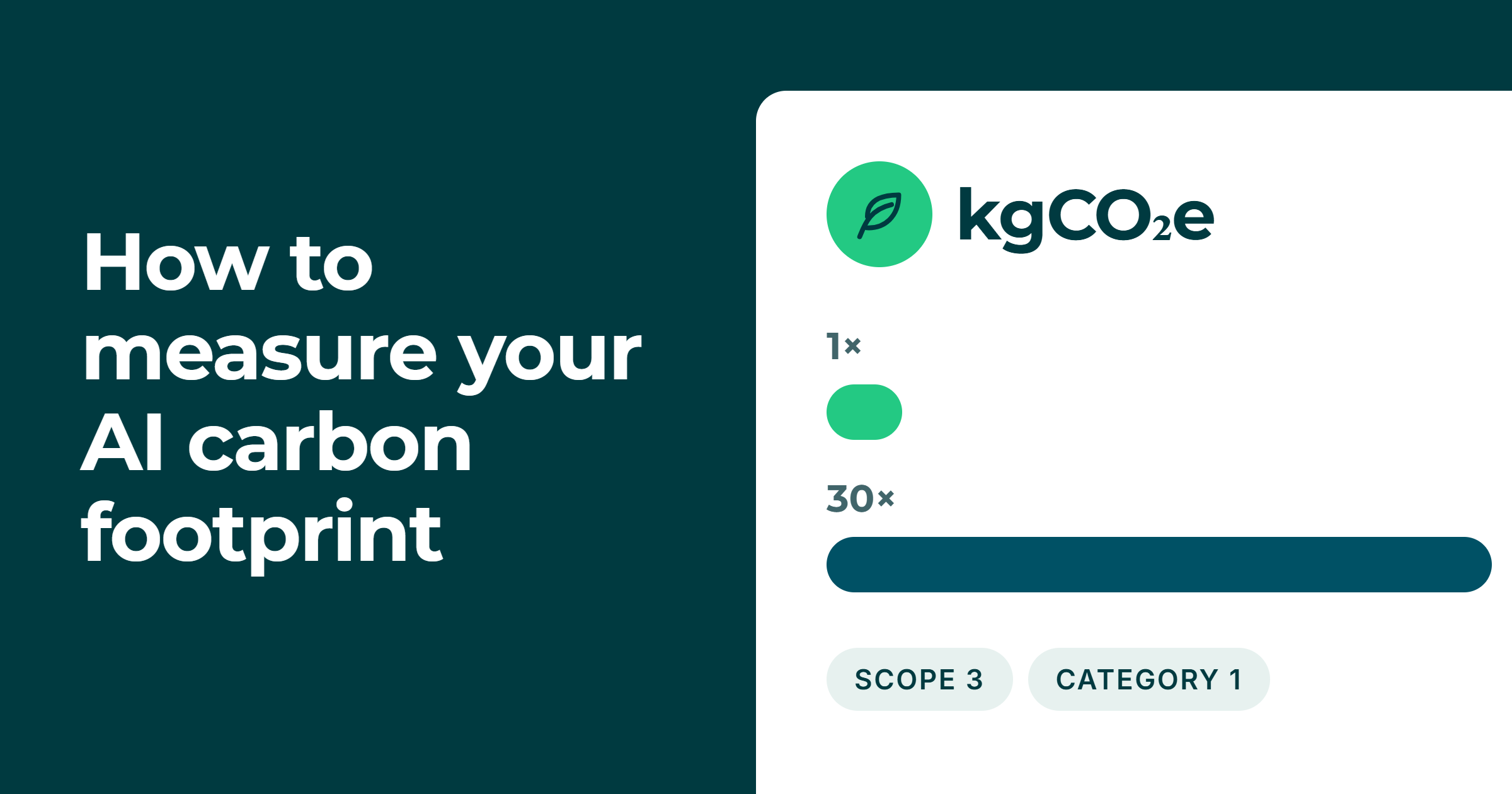
The most effective lever is model choice. The Sustainable AI Group found that, for the same task, the least efficient models can use more than 30 times the energy of the most efficient ones (Heatmap News, 2026). Within the same model family, the more capable variants used nearly four times as much energy on average as their lighter counterparts (Computing, 2026). Companies can reduce AI emissions by using the smallest model that does the job well, keeping premium models and agents for tasks that need them, and sharing only the context each task requires.
Tools that already hold your context also use fewer tokens. Ask KEY, KEY ESG's AI analysis agent, retrieves the specific data it needs from the platform rather than processing whole files in every session.
Frequently asked questions
Do all companies need to report AI emissions?
No. AI emissions should be treated like any other emissions source and measured in detail only where they are material.
Which scope do AI emissions fall under?
Third-party AI services fall under Scope 3, Category 1. Electricity for models run on a company's own hardware falls under Scope 2.
What data is needed to calculate AI emissions?
Token use by model, from enterprise AI accounts. Spend data should be used only as a fallback.
Where can I find emission factors for AI models?
The Sustainable AI Group's CLEER method publishes free estimates of energy use per token for widely used models.
Can KEY ESG measure AI emissions?
Yes. KEY ESG can help you measure your AI emissions footprint from token data and report it in your carbon inventory under Scope 3, Category 1.
How can KEY ESG help?
KEY ESG can help you measure your AI emissions footprint and include it in your carbon accounting. Token data by model can be recorded and converted into emissions with a per-model emission factor. The result is reported under Scope 3, Category 1 alongside the rest of your Scope 1, 2 and 3 inventory, with a clear record of the source, method and calculation behind each figure. KEY ESG can also support your wider AI governance, from mapping AI use to collecting AI governance data across sites, subsidiaries or portfolio companies. To discuss how this would work for your organisation, book a demo.
Why are sustainability teams being asked about AI emissions?
There is a rising awareness about the environmental impact of AI use. This article explains how to decide whether AI emissions are material for your business, where they sit in your greenhouse gas (GHG) inventory and how to calculate them. It draws on recent discussions at Sustainability Unlocked, and on recent research from the Sustainable AI Group. KEY ESG is an AI-native sustainability reporting platform used by corporate sustainability teams, private equity firms and their portfolio companies to collect, validate, analyse and report ESG data.
Do companies need to measure AI emissions?
Not all companies need to measure AI emissions in detail; the decision should follow materiality. For many companies AI emissions will not be material. A manufacturer with significant fuel, energy and raw material use will gain more from focusing on those sources. AI emissions are more likely to be material for software, technology and financial services companies, where AI use is high and the rest of the footprint is relatively small. They also become more significant as teams move from chat tools to AI agents. The Sustainable AI Group found that, for the same model, a typical agentic session used 27 times more energy than a typical chat session (Computing, 2026).
Which scope do AI emissions fall under?
AI services bought from third parties fall under Scope 3, Category 1 (purchased goods and services) of the GHG Protocol. This includes API access, enterprise licences and software with built-in AI features. Electricity used to run models on hardware a company controls falls under Scope 2.
How do you calculate AI emissions?
AI emissions are calculated in the same way as emissions from any other purchased service, by multiplying an activity figure by an emission factor:
AI emissions (kgCO₂e) = tokens used per model × emission factor per token for that model
A token is the unit in which AI models process and bill text; 1,000 tokens is roughly 750 words. At the summit, Anne-Marie Schoonbeek, COO of KEY ESG, recommended asking the colleagues who manage enterprise AI accounts for token data by model, rather than relying on spend alone, because the choice of model has a large effect on energy use. For the emission factor, independent estimates are now available. CLEER, developed by the Sustainable AI Group, converts a company's token use into energy and greenhouse gas emissions estimates and is available as a free, open resource. If a model provider later publishes reliable model-specific measurements, these can replace the CLEER estimates without the user having to rebuild their accounting approach (Trellis, 2026).
How can companies reduce AI emissions?
The most effective lever is model choice. The Sustainable AI Group found that, for the same task, the least efficient models can use more than 30 times the energy of the most efficient ones (Heatmap News, 2026). Within the same model family, the more capable variants used nearly four times as much energy on average as their lighter counterparts (Computing, 2026). Companies can reduce AI emissions by using the smallest model that does the job well, keeping premium models and agents for tasks that need them, and sharing only the context each task requires.
Tools that already hold your context also use fewer tokens. Ask KEY, KEY ESG's AI analysis agent, retrieves the specific data it needs from the platform rather than processing whole files in every session.
Frequently asked questions
Do all companies need to report AI emissions?
No. AI emissions should be treated like any other emissions source and measured in detail only where they are material.
Which scope do AI emissions fall under?
Third-party AI services fall under Scope 3, Category 1. Electricity for models run on a company's own hardware falls under Scope 2.
What data is needed to calculate AI emissions?
Token use by model, from enterprise AI accounts. Spend data should be used only as a fallback.
Where can I find emission factors for AI models?
The Sustainable AI Group's CLEER method publishes free estimates of energy use per token for widely used models.
Can KEY ESG measure AI emissions?
Yes. KEY ESG can help you measure your AI emissions footprint from token data and report it in your carbon inventory under Scope 3, Category 1.
How can KEY ESG help?
KEY ESG can help you measure your AI emissions footprint and include it in your carbon accounting. Token data by model can be recorded and converted into emissions with a per-model emission factor. The result is reported under Scope 3, Category 1 alongside the rest of your Scope 1, 2 and 3 inventory, with a clear record of the source, method and calculation behind each figure. KEY ESG can also support your wider AI governance, from mapping AI use to collecting AI governance data across sites, subsidiaries or portfolio companies. To discuss how this would work for your organisation, book a demo.