8.4.2026
10.4.2026
CSRD Engineering & Construction Sector Report 2026 - what 43 CSRD reports reveal about engineering & construction sustainability
Event Date:


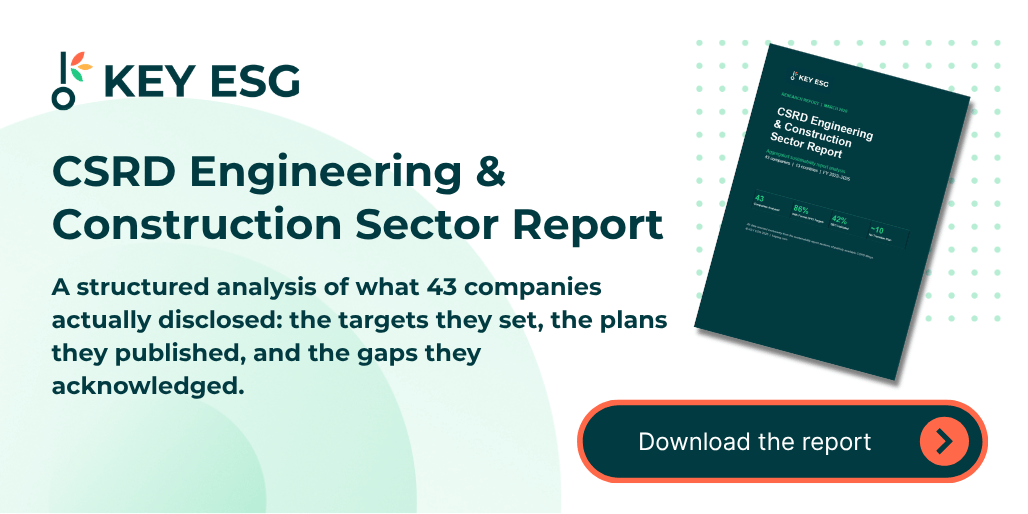
This report is a structured analysis of what 43 companies actually disclosed in their CSRD reports, including the targets they set, the plans they published, and the gaps they acknowledged.
The sector is splitting, and the gap is widening
Twelve companies have credible, SBTi-validated transition plans with quantified decarbonisation levers and demonstrated progress. Ten have no transition plan at all. The differentiator is not size or geography but instead is specificity.
Scope 3 is where disclosure breaks down
For virtually every company in the sample, Scope 3 represents 85–99% of total emissions. Yet approximately 35 of 43 companies rely entirely on spend-based estimation rather than primary supplier data. The report explains why this matters and what best practice looks like.
SBTi validation is becoming the baseline, not the benchmark
42% of companies hold validated SBTi targets. The absence of engagement no longer reads as a neutral position, but instead invites investor scrutiny. We show who is engaged, who is pending, and who has not started.
Some disclosures are more credible than others
From BAM's no-offset policy to STRABAG's quantity-based materials tracking to Arcadis's 2035 net-zero commitment, the report identifies the practices that set leading reporters apart and the red flags that undermine credibility elsewhere.
The first CSRD cycle gives you richer data than you have ever had on portfolio and prospective companies, but it requires careful interpretation. This report tells you what to look for, what to discount, and which companies carry the highest disclosure risk.
If your company is in scope for CSRD, or preparing to be, this report shows where the bar is being set and where peers are falling short. The best practice section is designed to be used directly in internal discussions.
Scope 3 methodology choices, baseline year changes, and target downgrades all affect how you should read reported emissions. We explain the most common ways disclosures mislead and how to identify them.
All data in this report was extracted from the sustainability report sections of publicly available CSRD filings. No survey data or self-reported questionnaires. What companies wrote in their mandatory disclosures and analysed systematically across 43 companies, 13 countries, and three reporting years.
The full library of CSRD disclosures referenced in this report, covering 944 reports across 38 countries and 13 SASB industry sectors, is available at the KEY ESG CSRD Reports Vault.
KEY ESG is a sustainability reporting and data management platform built for private equity investors and their portfolio companies, as well as standalone companies.
Our platform handles the data collection, double materiality workflow, and ESRS-aligned reporting that makes the difference between a credible disclosure and a problematic one.
Click on the image to download the full report - no registration required.

This report is a structured analysis of what 43 companies actually disclosed in their CSRD reports, including the targets they set, the plans they published, and the gaps they acknowledged.
The sector is splitting, and the gap is widening
Twelve companies have credible, SBTi-validated transition plans with quantified decarbonisation levers and demonstrated progress. Ten have no transition plan at all. The differentiator is not size or geography but instead is specificity.
Scope 3 is where disclosure breaks down
For virtually every company in the sample, Scope 3 represents 85–99% of total emissions. Yet approximately 35 of 43 companies rely entirely on spend-based estimation rather than primary supplier data. The report explains why this matters and what best practice looks like.
SBTi validation is becoming the baseline, not the benchmark
42% of companies hold validated SBTi targets. The absence of engagement no longer reads as a neutral position, but instead invites investor scrutiny. We show who is engaged, who is pending, and who has not started.
Some disclosures are more credible than others
From BAM's no-offset policy to STRABAG's quantity-based materials tracking to Arcadis's 2035 net-zero commitment, the report identifies the practices that set leading reporters apart and the red flags that undermine credibility elsewhere.
The first CSRD cycle gives you richer data than you have ever had on portfolio and prospective companies, but it requires careful interpretation. This report tells you what to look for, what to discount, and which companies carry the highest disclosure risk.
If your company is in scope for CSRD, or preparing to be, this report shows where the bar is being set and where peers are falling short. The best practice section is designed to be used directly in internal discussions.
Scope 3 methodology choices, baseline year changes, and target downgrades all affect how you should read reported emissions. We explain the most common ways disclosures mislead and how to identify them.
All data in this report was extracted from the sustainability report sections of publicly available CSRD filings. No survey data or self-reported questionnaires. What companies wrote in their mandatory disclosures and analysed systematically across 43 companies, 13 countries, and three reporting years.
The full library of CSRD disclosures referenced in this report, covering 944 reports across 38 countries and 13 SASB industry sectors, is available at the KEY ESG CSRD Reports Vault.
KEY ESG is a sustainability reporting and data management platform built for private equity investors and their portfolio companies, as well as standalone companies.
Our platform handles the data collection, double materiality workflow, and ESRS-aligned reporting that makes the difference between a credible disclosure and a problematic one.
Click on the image to download the full report - no registration required.
%402x.png)
%402x.png)
