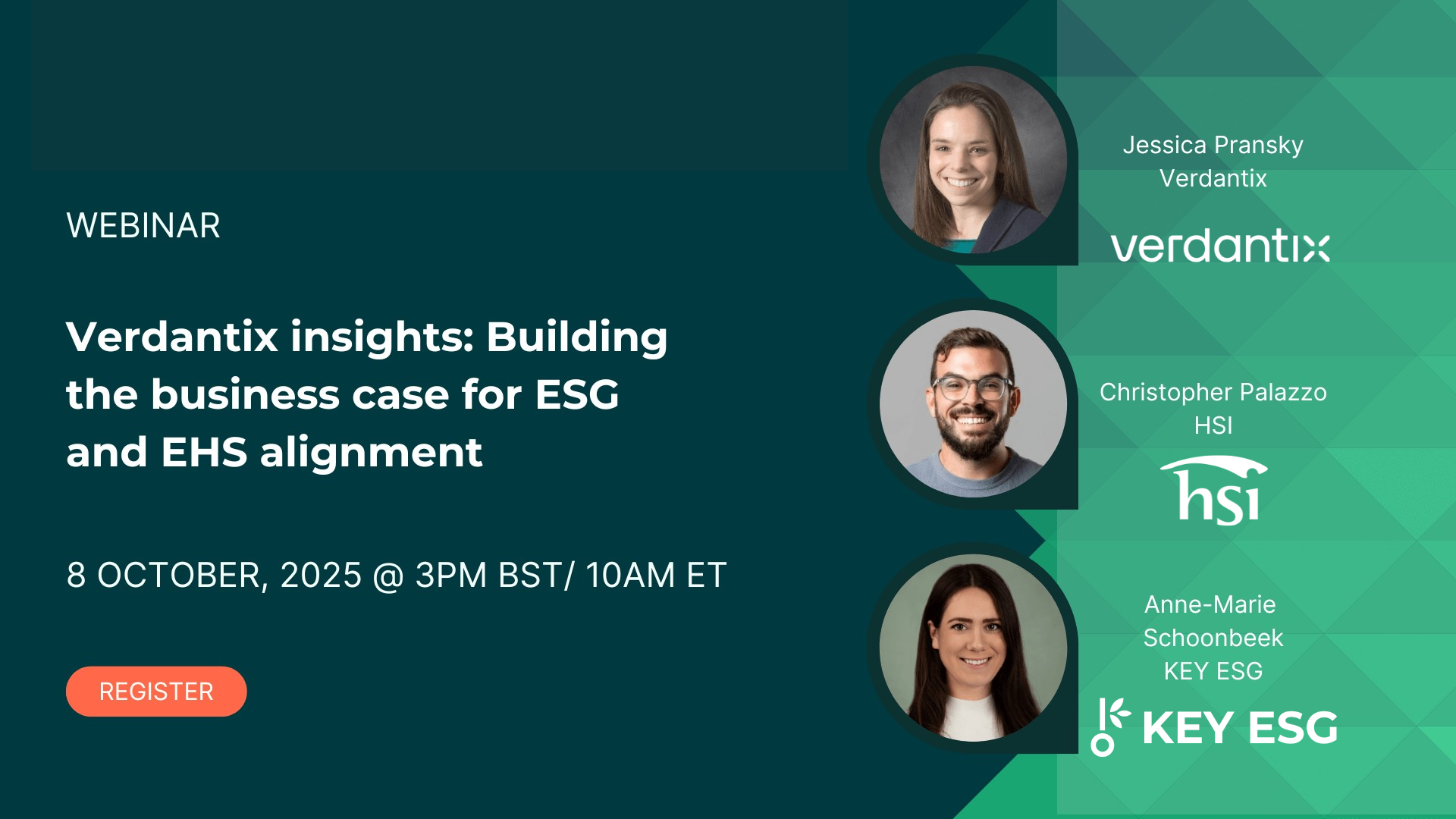
As ESG expectations rise and regulations shift many organisations are re-evaluating how Environmental, Health & Safety (EHS) and ESG functions interact and what the future of ESG reporting looks like. From siloed data, duplicated efforts, and misaligned reporting systems, organizations are looking for ways to reduce operational risk and inefficiencies.
This webinar, featuring insights from Verdantix, HSI, and KEY ESG, explores how aligning EHS and ESG programs can deliver measurable business value – from operational efficiency to risk reduction and strategic reporting gains, while discussing the state of the ever-evolving ESG reporting landscape and how organizations can stay ahead of the regulatory curve.
What You’ll Learn:
Market Trends & Data-Driven Insights
- Verdantix shares recent research from its 2025 Global Corporate Survey: 2025: ESG & Sustainability Budgets, Priorities and Tech Preferences to set the regulatory picture and draw conclusion on how ESG and EHS alignment can be implemented to futureproof organizations against stakeholder and regulatory demands
The Business Case for Integration
- Understand why alignment reduces reporting duplication, improves data quality, and creates a single source of truth for operational and sustainability metrics.
Real-World Challenges and Solutions
- Explore live case studies of how companies are using technology partnerships to centralise ESG and EHS data capture, streamline workflows, and drive cross-functional collaboration.
Technology & Tools
- Learn how ESG and EHS technology stacks are converging – what’s working, what to watch out for, and how to future-proof your systems
Who should watch on-demand:
- Operations Leaders
- EHS and ESG Professionals
- Chief Sustainability Officers
- Compliance and Risk Managers
- Technology & Data Integration Teams
Why watch?
By aligning ESG and EHS, you can:
- Reduce manual reporting burdens
- Improve cross-team collaboration
- Support risk management with better, centralised data
- Demonstrate measurable sustainability and safety improvements to investors and regulators
Watch now to gain actionable insights and build a stronger case for operational ESG and EHS integration.
Webinar transcript
Chris Palazzo | 00:00
Thank you for joining us this morning with myself, Chris, from HSI and from KEY ESG featuring Verdantix. Our session today is called Building the Business Case for ESG and EHS Alignment.
So we thank you for joining us this morning or this afternoon, wherever you are in the world. And we'll be getting started in just a few moments. A quick reminder before we begin. Today's session is being recorded and you'll receive a follow-up email with a link to the recording afterwards. You'll be able to find it on our website at hsi.com under the webinar section on our resources page. During our conversation today, we will be utilizing the Q&A feature.
So take a look for that questions box in your panel for any questions that you may have during the presentation. Feel free to submit your questions at any time. We will allocate some time after our discussion today to answering those questions. But don't worry, if we do not have time to answer those questions during the live sessions, we will follow up with you afterwards via email.
So we thank you for being here. We're going to get started very shortly. But first, I wanted to take a moment to introduce the folks that are going to be speaking with you, starting with myself. My name is Christopher Palazzo. I am the Director of EHS and ESG Product Marketing here at HSI. For those of you that do not know, HSI is a full-service EHS operational risk management platform that helps organizations achieve their compliance needs through configurable workflows as well as advanced AI. And this morning I am joined by my co-host for our discussion, question today. Anne-Marie from KEY ESG.
Anne-Marie Schoonbeek | 01:53
Good morning, thank you Chris for that introduction and great to be joining everyone. I see a lot of already a lot of folks dialing in. I'm dialing in myself from Boston where it's very rainy right now.
So I'm very glad. It's a good time to have an indoor webinar and I'm excited for today's discussion.
So maybe first of all, who am I? My name is indeed Anne-Marie co-hosting today with Chris on behalf of KEY ESG. We are very excited to be here and speak about. How together we are helping with our software solutions. Companies really move beyond compliance on the topic of ESG and EHS to build inside their organizations a genuine sustainability infrastructure. Who are we as KEY ESG? In that part of the equation, we've designed our software platform. To be simple yet comprehensive.
So we really believe that sustainability shouldn't live in a silo. We believe in embedding it across the organization and we'll bring that to life today with a few real life examples. And we're really keen to make sure that the discussion is interactive. And as Chris already mentioned, we're very open to receiving questions during the session, but available afterwards if that's of interest. In terms of what we stand for, I would summarize KEY ESG with three core principles that guide everything we do, from our software to our support offering. Compliance changes as they come about. That's what we make sure that today we'll go through a number of regulatory frameworks. We'll touch on that and how our support comes through there. And finally, we believe in being pragmatic and really embedding ourselves with your organization's existing infrastructure. And we'll speak a bit more about what that means.
So thank you for joining us today. And I'll hand it over to Chris again to introduce our guest who's joining our session today.
Chris Palazzo | 03:38
Awesome. And so together, Anne-Marie and myself are excited to welcome Jessica Pransky from Verdantix for our conversation today. For those of you who have yet to meet Jessica is the principal analyst at Verdantix, specializing in providing insights to sustainability leaders and analyzing ESG and sustainability reporting software. She advises technology and services firms on the priorities and challenges facing sustainability leaders offering insights into decision-making, regulatory pressures, particularly the evolving regulations in the United States, as well as resource allocation. And just a reminder that today's research presented by Verdantix plus much more reports and insights are available for free for corporate attendees via Verdantix Vantage.
So be sure to check that out after our conversation. And so with that, let's begin our conversation today. I'm going to hand things over to Jessica to walk through the agenda and begin our discussion.
Jessica Pransky | 04:39
- Great, thanks, Chris. Thanks, Anne- Marie, for the introduction. And hi, everyone, I am Jessica Pransky, as Chris mentioned, principal analyst with Verdantix. And today we have a packed full agenda, starting with a brief overview of some of the market trends that we're seeing, including data-driven insights from some of the Verdantix global corporate surveys. We'll then talk about the business case for integration between EHS and ESG functionality, go through some real-world challenges and solutions, and then dive a little bit deeper into different technology and tools.
So starting more high level, I know there's a variety of people on this call coming from, you know, different geographies, different backgrounds. So just wanted to do some high level setting, so that when we talk about these regulations or some of the challenges we're seeing, were all on the same page. And I don't think it's a surprise to anyone that when we look back at the past year, sustainability, EHS has really been in flux, a lot of confusion, uncertainty surrounding, you know, both areas. And when we started out the year, we saw Trump get inaugurated in January. And immediately starting issuing executive orders, you know, aimed to increase American energy independence, aimed to decrease regulations within the country.
You know, uncertainty about funds promised under the Inflation Reduction Act. A lot of, you know, items creating uncertainty, creating unease for both environmental and sustainability leaders. We saw different agencies within the Trump administration begin to follow his lead. And, you know, the SEC withdrew their legal defense on their long awaited climate disclosure rules. The EPA is pulling back, you know, cutting back staffing, pulling back. Certain regulations, so certainly a time of uncertainty. But then we jumped forward a month into February of this year, and the European Commission issued its omnibus proposals. Which added even more uncertainty for sustainability and environmental professionals, really creating a lot of delays in terms of some of the key European regulations governing sustainability, as well as really limiting who might be subject to some of those regulations.
So I think if we had to describe 2025, In a nutshell, I think most sustainability environmental practitioners would agree, a year of uncertainty, a year of unease, a year of change. So just to dive into the omnibus, you know, I'm not going to go into the specifics of the regulations, but really just wanted to describe, you know, for those of you who might not be as familiar. With what the omnibus proposals are or what their consequences could be. A lot of times when I talk to people about the omnibus proposals, they think it's really just impacting the number of companies subject to the CSRD or the Corporate Sustainability Reporting Directive, which is that directive coming out of the European Commission that was originally expected to target about 50,000 firms under the omnibus proposal that's being cut down to less than 10,000. But there's other regulations as well.
So the CBAM or the Carbon Border Adjustment Mechanism, for example, and being affected. And the bottom line is that expect delays in reporting requirements and streamlining reporting requirements across, you know, a variety of industries, a variety of firm sizes throughout the world. We hear a lot of companies expressing uncertainty around the omnibus proposals. What does it mean?
You know, it's still in the proposal phase right now, so we still don't have... Clarity. But at Verdantix, we ran a webinar in March of this year, so just after these omnibus proposals were announced, while people were still really digesting what they mean. And one of the questions we asked, and we asked this of 250 respondents that were located globally, we asked, how do you expect the omnibus proposal will impact your firm's approach to ESG and sustainability? And we saw that over half of firms are saying they're just going to continue with their original plans. They're not going to cut back funding. They're not going to reduce their initiatives. And I think to me, this really signals that ESG and sustainability have moved beyond just a compliance exercise for quite a few firms.
You know, and that companies are really thinking about sustainability as more from a risk management perspective and how to really operationalize sustainability and include it in their day-to-day tasks. Move over to the U.S. One of the things that I keep hearing about is, you know, if we go back a year or two, Top of mind for many companies in the US was the SEC. What are their climate related disclosures going to look like? What's going to be required? What are those timeframes? But with Trump in office, the SEC has withdrawn its legal defense of those climate disclosure laws. And we don't expect there to be any sort of federal climate disclosure rulings while President Trump is still in office.
So what we are seeing is we're seeing states really taking the lead on requiring climate related disclosures. And not surprisingly, California is really leading the way. And I'm assuming many companies on this call, especially if you're based in the US and really, especially if you're doing business in California, have heard of these requirements and that they're nothing new. If you have not heard of them, I suggest that you speak with your legal teams and get a little bit more insight as to whether or not they could be applicable, because the deadlines for these requirements are fast approaching.
So there's two different overarching types of requirements that California is requiring. And again, this is for companies of a certain threshold that are doing business in California. But one is related to climate-related financial risk, so having to disclose, both those risks and any measures to mitigate those risks. And the timelines for those, the first reports are due on January 1st.
So that's, you know, less than three months away. And the other main aspect of those bills are disclosures of Scope 1, 2, and 3 emissions. And that's required, or at least scope one and scope two requirements are due next year as well.
So really pressing, really timely. So just something that we're hearing a lot of concern over is how do we make sure we're prepared?
Anne-Marie Schoonbeek | 11:19
And maybe if I can ask a question there, that stuck with me, if I look at the, if I hear your description, I think that penalty, right, if you go to the page prior in terms of what has California on top of stipulating regulation, it seems like they're really coming with an enforcement and a penalty up to 500,000 per year.
Jessica Pransky | 11:43
Yeah. Yeah. How.
Anne-Marie Schoonbeek | 11:44
Can we use that? Enforcement, how could folks on the phone, as they're trying to create internal buy-in on the importance and urgency on this topic, how could they use that as a sort of a stick, so to say?
Jessica Pransky | 12:00
Yeah, no, it's, That's a great question. And I think one thing to keep in mind is that these penalties, I don't think they're going to take effect in the first year.
So I don't think we're going to see CARB issuing significant penalties within the first year that company within 2026, really, Because first of all, a lot of the guidance that, which is the California Air Resources Board, the government body that's overseeing these regulations. They provided a lot of guidance just this summer.
So fairly new for companies, fairly quick for them to get into compliance. And CARB has basically said that for the first round of disclosures, they're going to base everything on good faith efforts.
So if you're making your best efforts to disclose your scope one and scope two emissions, even if you have to make some assumptions that might not otherwise fly, they're okay with that for the first round of reporting. That being said, if we jump ahead to 2027, I think we're going to see CARB take a much more stringent approach and come down a little bit harder on firms. What I think that means for a lot of companies is that the first year that, penalty of you know, might not be a huge threat, but I think going forwards, I think companies really have to take this seriously, you know, half a million dollars a year, you know, for not properly disclosing your carbon emissions, I think could really come to fruition. We've seen I mean, from other regulations. Under CARB's purview, we've seen huge penalties issued to companies. Amazon Logistics, for example, is one that comes to mind. I think that was a multimillion dollar penalty last year. There are several others.
So I think companies can really make the business case for why They need to have, you know, accurate, traceable emissions data in order to prevent some of these big fines from CARB.
Anne-Marie Schoonbeek | 13:57
Okay, very clear. Bit of a dry run grace period coming year, but definitely already the opportunity to bring quite concrete examples forward. And before we head over to the, and I'm sorry to stop you in your tracks. No, it's as I mentioned, I'm dialing in today from Massachusetts.
Jessica Pransky | 14:11
Fine. But.
Anne-Marie Schoonbeek | 14:16
So this example is California. Are there other states emerging from your research that are taking similar routes as CARB in California?
Yeah.
Jessica Pransky | 14:25
Yeah. Great question. Last step.
So in 2024, we saw or 2025. We saw several other states come up with their own very similar climate-related disclosure requirements. This would be New York, New Jersey, Colorado, and Illinois. And In all four states, there was some issue where the bills failed to pass through all of the legislative processes that they need to.
So they never actually became law. They're not enforced right now. But that doesn't mean that those states are going to stop trying. California, for example, had a different climate related disclosure bill that failed. Previous to the current ones that we're seeing, so SB 253 and 261.
So I certainly think that those four states potentially I've heard Washington state with rumors of disclosure bills. So I think we'll start to see other states follow suit. But one thing to note is that Because of the language in the California legislation, I think a lot of companies that are subject will be to California's legislation will be subject to the other states as well.
So it's something to watch out for, but I don't think any other states will have regulations that are drastically different based on the draft guidance that we saw earlier this year.
Anne-Marie Schoonbeek | 15:47
Great. Thank you for clarifying.
Jessica Pransky | 15:51
No problem. Okay.
And then just, I know I've focused most of this conversation on Europe and the US. But really what we're seeing around the world is that more and more companies and at a pretty quick rate are really adopting regulations based on the ISSB standards. The ISSB standards are really focused on risks that are material to your individual company, as well as climate related disclosures.
So we're seeing a lot of increase in adoption, especially in APAC. So these are the countries that are listed on the IFRS website, which is the body overseeing the ISSB regulations and standards. But you'll see here Japan, Singapore, Australia.
So a lot of significant you know, pretty large economies who are adopting these disclosure requirements and making these mandatory for firms of a certain size. So now I wanted to turn your attention to one of the global corporate surveys that we run every year through our sustainability practice.
So as part of this survey, we interview 400 sustainability leaders from around the world. So I think we have over 30 countries represented this year, over 15 industries ranging from finance to mining to manufacturing, healthcare, you name it. And one of the questions that we asked is, you know, what is the significance of different rules and frameworks regarding how you're thinking about spending in terms of sustainability? Right. And not surprisingly, the CSRD came out on top. And I should just caveat that this survey was run in between April and June of this year.
So after you know, that omnibus right or proposal was released. But what's really interesting to see is that even with all these regulations, you know, ISSB, California Climate Bill, CSRD, voluntary reporting is still a really high priority for a lot of firms.
So we're seeing nearly 50% of firms saying that they think of voluntary reporting as either a very significant or their most significant framework that they're looking at right now. And we've been running a similar question for the past few years. And this is a trend that we thought would start to slow down, you know, in terms of how many companies are putting pressure on voluntary reporting. But we're really seeing companies continue to emphasize it. And I think part of that is again, walking away from the compliance-based approach. To sustainability reporting and moving more towards, you know, a risk-based approach or, you know, more of that even more proactive approach to sustainability.
Anne-Marie Schoonbeek | 18:46
No, I think that's a great, as I was going through these insights, I think that's a very relevant call out here. Basically what you're saying is the research pointing out is that companies are maintaining both their voluntary commitments alongside the mandatory ones and if I think about some of the you know what actually is underneath and that's not what the goal of today so don't worry those folks that are joining we're not going to go in depth through all of these in terms of what actually is included in there because that could by itself be a three day workshop. But I think the takeaway that we see on the software platform side is a lot of the data is similar so hopefully part of the reason why folks are indeed still walking along different avenues is because the work for one has actually helped them enable the work for another.
So hopefully that's a positive note from this slide.
Jessica Pransky | 19:34
Yeah, exactly.
Chris Palazzo | 19:38
Right.
Jessica Pransky | 19:42
And We'll start moving into the business case for integration, really talking about the overlap between the EHS and ESG functions. And a lot of the disclosures and the regulations that I've been talking about so far, one common theme is carbon data, carbon emissions. And where does that carbon data come from?
So a lot of times in most organizations that we work with, we see that the data owners are within the EHS teams. The ESG and sustainability teams might be in charge of collating that data, or they are reporting out that data, but they're really reliant on the EHS teams to really provide that data. And one of the questions that we always ask about in our corporate surveys to really figure out where companies are struggling or what their challenges are. Is, or rather, we asked about what their challenges are in terms of meeting their sustainability goals. And so this year, a key theme that we saw was around collaboration and a lack of collaboration or challenges around collaboration. Causing issues or problems with data collection. And data collection is such a key element of all of these disclosures, because if you don't have proper data, you really can't trust the accuracy of your reports. And because these reports are going out to regulators, to investors, to your customers, your shareholders, whoever it may be, having, you know, high quality, trustworthy data is just extremely important.
So we're seeing this as a key challenge, both on the external side, so, you know, communicating with suppliers, but internally. So really those communications across business functions, and that includes, you know, the sustainability team ensuring that they're, you know, speaking the right language and communicating properly with the EHS function. We actually asked another question in the survey. About how sustainability leaders see engagement with different functions. And overwhelmingly, what we found, and this is not entirely surprising, is that sustainability teams find themselves engaging very heavily with the EHS team.
So a quarter of the respondents in our survey said that the EHS team was their or was the function that they were interacting with the most. And if we looked at, if we did a data cut and looked just at extractives, oil and gas, some of these more emissions intensive, resource intensive sectors, this percentage, not surprisingly, goes up. Significantly. And I think this just goes to show the intersection and how much, overlap there is between the data provided by the EHS function and the data that the ESG and the sustainability functions need, to really report out and to, you know, enhance their disclosures related to sustainability, whether or not those are really mandatory or voluntary, as we discussed earlier.
Yeah, but certainly other functions key to those disclosures, but EHS really taking the lead in terms of, you know, how sustainability leaders collaborate.
Chris Palazzo | 23:08
So before we jump over to the next section, I just have a quick, some follow-up questions and a brief discussion around some of the top challenges that professionals are having when it comes to achieving their sustainability outcomes. It's really interesting that data collection remains at the highest part. On the EHS side, it is.. One of all the main issues that EHS professionals are facing in achieving their outcomes.
So it's quite interesting that after all of these years, we've been talking and promoting the relevancy of data hygiene, proper data practices, the necessity to have collecting accurate data, why do you feel that still to this day, EHS as well as ESG professionals are still facing issues when it comes to data collection and data accuracy? And is there any recommendations you might have to improve their outcomes?
Jessica Pransky | 24:04
Yeah, Chris, that's a great question. And actually, so I didn't mention that Verdantix runs a survey of EHS practitioners. And we asked a similar question about challenges. And we found that 60% of practitioners just about, and this is EHS practitioners, we're really centralizing, prioritizing, you know, So certainly an issue we're seeing with both sets of teams. And I think one of the issues that we're seeing is that a lot of sustainability data comes from so many different places.
So it's really hard when you're gathering data from, you know, different systems from different sensors, whatever it may be, is that it's really hard to ensure consistency. And it's really hard to ensure traceability.
So making sure you have that audit trail available, making sure you really feel comfortable with the quality of your data. So in terms of, I think one of the, I think you asked about recommendations for how to improve this and I would say one of the issues that we see with data, you know, Tech certainly helps out.
So having some sort of software to really ensure that you have data available in similar formats across, you know, functions across media. Having some sort of central repository so that you can have multiple people accessing the data with that visibility, with that audit trail to look into.
And then I think there's a human element. So making sure employees understand the importance of data quality, making sure they understand how data is collected and how it's used so that they really see the end goal as opposed to just collecting data because it's just part of their job. But really seeing the. Different types of analyses, the different types of decisions that can be made based on looking at this data.
Chris Palazzo | 26:02
It's definitely the proverbial problem that I think most teams and most organizations are facing. We hope to see a resolution hopefully soon. And it's interesting that a very close second to that and certainly very timely given the political climate that we're in is the concerns around that. Political climate. And says, I wonder if you can delve a little bit more into the findings and what you're seeing as a potential solution for ESG professionals to navigate this shifting regulatory environment to ensure that the strategies that perhaps they have in place either remain funding, remain funded for their organizations or still remain top of mind for their organizations.
Jessica Pransky | 26:42
Yeah, it's a struggle. And a lot of companies, especially in terms of sustainability, they're a lot of the drivers for funding are, that the internal drivers for funding are related to regulations.
So that there's that regulatory driver, which really pushes the board, the C-suite, the finance team, whoever may be holding the budget, to really allocate more funds to sustainability related initiatives. Now, without that compliance driver in place, sustainability teams really, they have an uphill battle with getting funding.
So what we see working well is to really, you know, make the business case and talk the language of the teams that you're working with. Simple steps such as, you know, removing... Acronyms is something that which you know i'm here looking at a slide with acronyms in it but so not to not just sound too contradictory but removing acronyms so that when you're speaking to the finance team for example you're not speaking in EHS or ESG jargon, you're speaking in terms that they understand. Thinking about the business value that you can add, you know, in our global corporate survey last year, we asked about some of the business benefits that companies were seeing. And it wasn't just, you know, a compliance exercise or, you know, making our legal team happy. Face-to-face sustainability is lower in costs as increasing revenue.
So really making those business cases and trying to figure out how you can obtain funding without, you know, those other, drivers that you can use for funding besides just that regulatory stick.
Chris Palazzo | 28:19
Awesome. And finally, just before we break and go to the next section, I'm curious to know that is there any consistency or differentiation or variation of these results across the very different geographic regions? Is there, you know, are they geographic specific? Are there patterns or are there striking patterns? - Sorry.
Jessica Pransky | 28:41
One thing that we do whenever we get this data is look across geographies. And with this question in particular, and I don't think that this was, overly surprising. Is that In the US, the current political or regulatory environment ranked as the most urgent across the board.
So certainly a very high priority concern for companies in the US. But the regulatory uncertainty, interestingly enough, was a really high concern for companies in APAC.
So I mentioned, and this could be due to a few reasons. One, a lot of countries in APAC are suppliers or customers to companies both in the US and Europe, but those increasing ISSB regulations that we're seeing.
So I was a little bit surprised to see how many companies in APAC were emphasizing the or we're prioritizing this current political or regulatory environment in this question. You But when we looked to Europe, we saw that their main concern overwhelmingly was this piece around external collaboration with suppliers and customers.
So at first I was thinking, you know, why isn't, the political or regulatory environment is big. It's a concern there, given, you know, everything I mentioned about the omnibus proposal. And I think that overall, the firms in Europe, especially the firms that we end up speaking to as part of these surveys, tend to be a little bit more mature. And so in terms of their sustainability initiatives. And because of that, they might not be as, I've mentioned this a few times, but they might not be as compliance-based.
So they might already have programs and initiatives in place to sort of get more of the basics down and they're, The nuances of the regulations obviously will affect how they go about reporting, but it might not affect what they're actually doing. Helping internally. And But a lot of the challenges that they're seeing come from, you know, what you'd expect with a maturing sustainability team. And that, Once you have your own initiatives or your own sustainability programs well understood, you're looking to improve sustainability throughout your supply chain. And that's where we're seeing that issue with external collaboration with suppliers and customers coming into play.
Chris Palazzo | 31:05
Thank you for that. I'll let you jump back into it.
Jessica Pransky | 31:08
- Sure. Just-- Right. At this point, I'd like to hand it over to Anne-Marie to walk through some real world examples.
Anne-Marie Schoonbeek | 31:20
Thank you, Jessica and Chris, for that discussion. And I think the great segue to this next section.
So basically, - What you already laid out so nicely, Jessica, is what is really that opportunity that the EHS and ESG colleagues alignment brings, right? I think at the core, what you're describing is, what makes success? What I heard you saying, it's collaboration. It's working together. It's ensuring that in networking together, we gather proper data with trust and accuracy around that. But that we have consistency because the regulations that you showed us in earlier slides these are regular regulations that were voluntary or involuntary frameworks these require annual reporting so it's a recurring cycle so the repeatability of that is so important so if I take all that what you've so nicely described and I want to now turn it over to some real-life case examples And what I've done today is I've thought about two QGC customer instances that are quite different industries.
So I'll start with a heavy manufacturer or whether you are operating in my second case example, I'm focusing on a childcare provisionary services. So I wanted to take two quite different examples, both which have a strong EHS element and walk you through how did some of the things we discussed today come to life in such instances.
So starting with Witter, for those who may not be familiar, this is a manufacturer of supplier components. So if you next time you get into a lift and have a look, you can see their name. It's part of one of those things that we use on a daily basis, but don't always are not always aware who has built the components. But you can imagine this is an organization that has a big supply chain. They manufacture in-house, but across 50 plus countries. Have different production sites, are based and headquartered in Germany, but have operations extending across North America, Latin America, Europe and APAC.
So what was the challenge they were facing as they were coming in, potentially in scope of the CSRD regulations? As you said, Jessica, this was an organization that already had a lot of processes in place. With existing EHS measurements, sustainability measurement, but now had to take into account, does it hit that regulatory bar? And realizing that a prior process that was really based on manual workflows, sending emails to each other. And I'm sure some folks on the phone that work in EHS may remember receiving emails to ask for input around, hey, in your specific production site, how much has XYZ happened or how much oil or top ups have you used?
So really a very manual workflow that was repeated every month or every quarter and had a lot of potential for making mistakes in a data collection part. But then second, and I think you pointed out very nicely, If you think about the post data collection, right, it didn't have the opportunity to then feedback. To those different locations, to those different colleagues, hey, now what is the lesson that we're learning from how carbon accounting emissions are looking at your site? What are potential opportunities to improve that?
So the loop was initially much more one-way stream. So data going from those different sites into a global team. And not always feeding back the results as easily through digital solutions. Now here is where one of the solutions that we provided is how can we actually turn that process into a repeatable automated approach? Where the role of the local, in the words of Witter, they call them the local sustainability champions.
So these were very often EHS colleagues sitting in the different production sites. They really took ownership of both the data gathering as it comes to CSRD carbon accounting. You can imagine because of the different jurisdictions, there were many other frameworks that they had to take account of. But basically, the software allows you to understand what is the overlap between those different frameworks and hence what are the inputs we need. Those local champions took ownership, worked together with their respective colleagues to really translate some of that acronym heavy language into business user understandable verbose.
So one of the platform functionalities we most often see used is that in platform chat function that really enables to explain and try to demystify some of the carbon or the jargon heavy themes. To then build a process that at the top level hub and spoke models from ESG team sitting at the global office. In this case, they actually reported into the CFO to make sure that sustainability data runs into similar cycles as financial data is. But in terms of getting those data and feeding back the insights from the data that was very is was and is very much owned by those local champions, primarily EHS folks.
So to both make sure that the global team feels ready, that when they become into the post omnibus scope again, that they have the data, they have had a dry run, they feel confident about it, but that they're already in the process towards that, are able to focus on value creation and feeding back insights to the different local teams. So that's an example of how a very decentralized manufacturing organization has gone about the opportunity that CSOD positioned them. I like to use positive words.
So going to a second example, so moving over from manufacturing to in this case a Babidou family, this is a nursery provisioning provider. So they have over 3000 physical sites so you can imagine perhaps you have children you drop them off in the morning so these are obviously very heavily regulated service providers because we're dealing with young children here and but very side heavy so reporting underground data in such a scale of 3000 plus sites you can imagine the yeah what that means if you would do that manually so you In light of the here, just the increasing requirements and what we wrote down here is a few examples and that could be different for folks on the phone. But it really was indeed a mix of what you showed us early on the call. It's voluntary reporting, it is local jurisdiction.
So in this case, in France, there's even a specific legal compliance that was already there prior to CSRD. There's investor requests.
So a lot of KPIs from both a compliance perspective and an operational KPI point that had a lot of overlap and could be living in the same process, the same software, the same system. But today, or initially, I should say, data was owned regionally and there wasn't a central system of repository, as you called out earlier. What that means, it means that there was a lot of time lost on doing that reporting cycle, but being at risk of then the data that came out of that sequence may not be traceable, auditable. You couldn't see who was the person actually contributing it. Folks for excellent overriding Excel cells. We've all been there.
So one thing is the time lost in getting the data. The second is indeed on that traceability side.
So what do we do together with the organization and here are initially spearheaded by the ESG team. Again, a hub and spoke model where they sit at the global level, but very much are dependent and see partnerships rolled out across the different countries. In this case 10 countries having country level heads, they on their regard then roll it out to their different sites that may need to contribute to parts of the data gathering. But really having the benefits to in that process both cater to regulations like csd but embed operational kpis in a language that is familiar to colleagues so that again there we are able to feedback the insights at the end of the quarterly in this case but we see actually more and more of our users reporting quarterly that doesn't as you say what they report externally doesn't always translate to what happens internally so monthly or quarterly reports that the are then aggregated into yearly output reports. But really having that to support that ongoing engagement and identifying, as you say, opportunities for improvement, find cost savings, but find enthusiasm and local grassroots initiatives. 'Cause in that exercise, you'll always find that there's colleagues that actually really, yeah, are personally passionate and see how this hits their day-to-day job and want to drive that forward.
So what did we achieve in the end with this large multi-site organization? Together we were able to cut their reporting time from eight to four months.
So that's a very concrete, like half of the time saved. What that means is, one thing, it's great we save time, but it just means that people in the process are able to spend more time on thinking about, so what's next? What can I do with this data? What does it tell me about improvements that we can run? Two examples of quite different industries, but a strong angle of that EHS and ESG alignment. Sending it over to section four technology and tools which i think again is bringing us back to some market insights from your side jessica.
Jessica Pransky | 40:41
Yeah, and you know, Anne-Marie, before we get into the market insights, I was just listening to the case studies and a few things that really stuck out to me that you were talking about. And one, you mentioned the time lost. I'm just looking at my notes here, the time lost to getting the data. And I think that really speaks to some of the insights that we've seen at Verdantix and, you know, why there's such a need for collaboration and why collaboration is such a challenge, as well as a priority is that, you know, that lost time from getting the data because there are those departmental silos in place.
So that point stuck out. And then the other one was when you talked about, you know, the voluntary initiatives and. And it's nice to see, you know, we talk about that, we see that in our data, but really nice to see a story and get some color on that.
So don't want to delay things too much and Now I would like to dive into some technology and tools that we're seeing. So every year for the past few years in our global corporate survey, We've asked how companies are managing their ESG and sustainability data. And what we've seen up until 2023 or so was a heavy reliance on spreadsheets.
So instead of using software, we saw a heavier reliance on Excel-based tools to really manage pretty much all ESG data. So as of 2023, we saw about 30% of firms using this, and this was consistent with data we collected in 2022 as well. But then 2024, we noticed a steep decrease in the number of firms relying on software. I'm sorry, relying on spreadsheets and instead relying more heavily on either tools built in-house, which was a big shift we saw in 2024. Or increasingly in 2025, we saw even more of a push towards commercially available solutions.
So software to really help them manage a variety of issues. Sustainability and ESG data. What we saw in conjunction with this push to software, is that companies began to get more confidence around their data quality.
So as part of this global corporate survey, we asked how companies felt about whether or not they had the right capabilities in place to really provide ingress investor grade data for ESG reporting and disclosures. And investor grade data, you know, is data that you're supplying to your investors and the regulators. It's high quality. It's auditable. It's traceable. And it's timely.
So it's not just once a year. It's, you know, I think Anne-Marie said she saw, a company moving to quarterly reporting. And that's at least the level that we're seeing a lot of companies talk about is quarterly, if not more frequent reporting, whether that's for internal purposes or, you know, more externally facing. But really interesting to see if you look here between the companies that have, that agree or strongly agree that they have those data management capabilities in place. We saw over a 10 percentage point jump from 2023 to 2024. And I think that really aligns with the number of companies who, we're using spreadsheets to the number who are using software. Because when you're using software, you have those, you know, those functionality to, You know, you have that central repository. You have more capabilities to trace, to audit your data. And I think that gives companies a lot more confidence in being able to provide that data for investors and to feel confident when reporting out on it. I think there's a variety of ways that we see companies using software, both for EHS purposes and ESG purposes. And looking at how you align that data and how you really align, care. Your software, your spreadsheets, whatever you're using, but we see a ton of benefits when it comes to alignment in terms of data centralization.
So being able, alluding again to what Anne-Marie mentioned with reducing time, so reducing manual data entry. And it's not just that it's, you know, time savings, but it reduces human error and just makes the whole reporting process much more efficient. But speaking against that timely process, but less training that needs to be done if you have some sort of alignment between your EHS and your ESG software.
So if there's some sort of communication between your tools, reducing the training onboarding costs. Between, you know, to report out on that data. But we're seeing increased strategic benefits with having alignment between EHS and ESG data.
So I think increasingly, I've talked a lot about how, we're seeing. Carbon as it's being one of the central data points from an EHS team. But certainly there's other elements of an EHS team that are vital. Data points that are vital to an ESG and sustainability team.
So other environmental data, water, waste, chemical data, but you know, increasingly, if we look at the S in ESG, that social piece, there's quite a strong component that comes over from EHS. So we're seeing worker safety, worker well-being, mental health even. And So by having those aligned platforms, we're seeing, you know, increased risk management, more operational safety data in place, and just overall really a proactive approach to both sustainability and EHS.
So focus on more leading indicators and really being able to be more proactive, stay ahead of regulation. And again, looking at some of those actions that are... Beneficial to your company regardless of what comes into with all the uncertainty out there right now.
Chris Palazzo | 46:47
Awesome. We're almost at the tail end of our conversation today. This is just a reminder to our folks in the audience that if you have any questions, please drop them in the chat. We'll give them over to Jessica to answer very shortly. But before we open up the questions from the folks listening to us today, just a quick follow-ups around the data management capabilities research. You showed because it was really quite interesting.
So while technology adoption certainly has increased year over year, there still remains a sizable amount of companies who do not feel that they have the data management capabilities to provide that investor grade ESG reporting and disclosure. So on behalf of myself at HSI and Maria Key ESG, why do you feel that this problem is still so pertinent when there's still so much technology that is readily available for organizations today to take advantage and solve this issue.
Jessica Pransky | 47:46
Yeah, so that's a great question. And I think part of it is that there's still... A fairly decent size reliance on spreadsheets.
So just under 20% of companies that we spoke with are still relying on spreadsheets. And it can be hard to sort of, Again, we talked about regulatory drivers earlier being the incentive for funding.
So we do hear some firms that are struggling to get funding for software because there's no regulatory driver in place. But I think once you adopt software, you know, assuming that you are in that 80-ish percent of firms that have moved beyond spreadsheets, I think some of that confidence issues comes to a lot of the internal processes that we talked about earlier. And some of that both internal and external collaboration.
So certainly a lot. And we have actually asked additional questions about confidence around scope three emissions data.
So emissions data that's really gathered from your suppliers and we see confidence around that drop off even more. And I think part of the reason for that is just... Limited engagement or not enough engagement with suppliers, not enough confidence in the data that they're providing. But making sure if you're looking internally again, making sure that you understand where within your organization, the data comes from and feeling that you can trust where that data comes from. And I know we talked a lot about that ESG EHS alignment. But because so much of ESG data comes from an EHS department, really understanding where that data comes from and being able to talk to your EHS team and making sure that you're comfortable tracing that data and trusting that data. I think that really leads to some of this confidence that we're seeing. Or lack thereof, depending on which side of the coin you fall on.
Chris Palazzo | 49:40
Absolutely. And while not a focus on the technology section, but certainly something that is going to be on the backburners or the back minds of many of our folks listening to us today, it is the role of AI. It's prevalent and growing relevance in technology platforms across the different fields and genres.
So curious to see that. Is there any insights you can share on that? On the role of AI and the impact they might be having on ESG teams moving forward.
Jessica Pransky | 50:12
Yeah, and you know, I think it's not just ESG teams, it's EHS teams as well. And we ask about this as well in both our sustainability and our EHS global corporate surveys. And in both surveys, we're hearing that, Over the past couple of years, there's more acceptance of AI relative to maybe, say, two years ago. But how...
You know, EHS and sustainability leaders are planning to use AI really differs. Certainly a case-by-case basis, but one common theme is that we're seeing more acceptance of using AI for data collection.
So being able to use you know, to better aggregate data, to aggregate data more quickly. To be able to use natural language processing, or machine learning to really gain more insights. That data gathering, sentiment monitoring are things that we're seeing companies getting more acceptance of and starting to use much more openly. I think some of the areas where AI is a little more controversial and I think we're seeing more companies adopting more of like a wait and see approach is using AI and really generative AI to generate content for, you know, EHS or sustainability reports. And I think part of that is, you know, the level of trust that companies have over the use of AI and the quality of the data that they're expecting out.
So you don't want to put anything outward facing that you don't completely trust as you know, the slide shows. And so, I think there's still some issues around trust and, you know, we do certainly see an interest both on the EHS and the ESG sides. Of corporates wanting to adopt AI more readily. But what that looks like really varies from firm to firm.
Chris Palazzo | 52:09
And just to pick up on that point, I mean, you mentioned trust. I'm just curious to hear is that, is there any risk areas or additional risk areas that EHS and ESG professionals should be thinking about as they're increasing their level of adoption of AI as part of their day-to-day workflows beyond just simply the data management portion?
Jessica Pransky | 52:29
Yeah, so I mean, there's the data management portion. You know, if you're a sustainability team, even an EHS team, I think, you have to look at the environmental footprint of AI, what are the emissions increases associated with using AI, water usage increases. But I think more importantly, it's a governance issue.
You know, what are the guardrails that your company has in place regarding AI? You know, how do you use AI responsibly and ethically? And this is not done within a silo.
So this is not something that I think sustainability or EHS teams should be looking at alone. I think this is a conversation that needs to take place among, you know, a variety of departments.
So getting IT's involvement. Legal, compliance even.
So really the risks around AI, the benefits are huge, but there are significant risks and figuring out how to balance those benefits and risks you know, and it's not, it's, as I said, a lot of firms that we speak to, it's a decision beyond, the sustainability team or the EHS team. It's really a corporate-wide decision and how to use AI.
Chris Palazzo | 53:41
I think definitely it's going to be a conversation that a lot of firms are going to be having internally about what those guardrails are going to be. Maybe we'll actually be seeing regulations or some form of standards coming forward in the foreseeable future just to help organizations determine what is that red line on the use cases of AI for either reporting or beyond just simply the data management.
So let's jump into some of our audience questions that we have. We have a few more minutes left. And again, just a reminder that if you do have any last minute questions that you would like to ask Jessica today, please drop them into the chat.
So just this question is around the integration of EHS and ESG. Do you feel that integrating or enhanced integration between the two functions of EHS and ESG, could that become a differentiator between the two? For investors or customer decision-making for an organization.
Jessica Pransky | 54:34
So integrate, so will that, so... I think yes and no to answer that question. I think in the short term, yeah, maybe it could be a differentiator to have that really integrated alignment. But I think if we're looking out a couple of years even, I think this will be more an expectation than a differentiator. I think investors will sort of expect more of that alignment between EHS and ESG teams because there's so much – you know, interplay between the two.
So a differentiator, not necessarily, but I think if you don't have that integration and you don't have that alignment, that might stand out more as a negative. So as a, why don't you have, you know, these you know, I think it speaks a bit to a risk management piece as well.
Like, why aren't, why isn't one team talking to another? How do you know that you can trust data coming from this source?
So I think differentiator, no, but requirement, yes. So not sure if that quite answered the question, but hopefully it provided some clarity.
Chris Palazzo | 55:48
The next one is around employee engagement. And this is actually an interesting one.
So the role of employee engagement in the success of a winning sustainability strategy. So obviously we talked a lot about the data management processes, the role of technology in order to achieving those goals, the harmonization between the different departments within an organization. But curious to see, is there any insights that you could share on the roles of employees in achieving that company specific sustainability strategy?
Jessica Pransky | 56:21
Yeah. I mean, I think employee engagement is really essential.
You know, and it's, There's not one set reason for it. There's just so many.
I mean, if you're looking purely on the EHS side, which feeds into the social component, really, I think you need to get employee engagement to enhance, like, the work safety culture to make sure that, you know, employees are speaking up when there's a problem, that they feel safe, that they trust, you know, that they trust their employer to really ensure their mental well-being. But I think there are ways that employees can find ways to make processes more efficient.
So, they're the people most often, you know, employees are the ones responsible for, you know, the processes, the day-to-day, you know, they can find efficiencies that if they're, if they know what to look for. So, if they know that they could save energy by, you know, altering this process, that's something and that could be part of their strategy.
You know, their performance reviews is, I think those incentives and figuring out, how to educate your employees about what to look for, ways to drive innovation, I think that can really create a culture, both around accountability, around safety and really drive employees to be enthusiastic about sustainability initiatives and really thinking about ways to move the needle forward. So I think it's just a different point of view. And I think that engagement across employees is extremely beneficial.
Chris Palazzo | 57:56
Okay, awesome. We are pretty much at time right now, so we don't want to go over our allocated time, but On behalf of myself at HSI, as well as Anne-Marie at KEY ESG, I want to take a moment to thank Jessica Pransky from Verdantix for sharing her insights on the integration and the business case for integrating EHS and ESG today. We hope you had an opportunity to learn something new and take something valuable away from our conversation today. Again, we'll be sharing this recording to all of those who have registered. You'll be getting an email. As well as a copy of our deck.
So thank you so much for taking the time to speak with us and joining our conversation today. We hope to see you again very shortly. Take care, everyone.
Jessica Pransky | 58:43
Thank you so much. Thank.
Anne-Marie Schoonbeek | 58:44
Thank you everyone. Bye.
As ESG expectations rise and regulations shift many organisations are re-evaluating how Environmental, Health & Safety (EHS) and ESG functions interact and what the future of ESG reporting looks like. From siloed data, duplicated efforts, and misaligned reporting systems, organizations are looking for ways to reduce operational risk and inefficiencies.
This webinar, featuring insights from Verdantix, HSI, and KEY ESG, explores how aligning EHS and ESG programs can deliver measurable business value – from operational efficiency to risk reduction and strategic reporting gains, while discussing the state of the ever-evolving ESG reporting landscape and how organizations can stay ahead of the regulatory curve.
What You’ll Learn:
Market Trends & Data-Driven Insights
- Verdantix shares recent research from its 2025 Global Corporate Survey: 2025: ESG & Sustainability Budgets, Priorities and Tech Preferences to set the regulatory picture and draw conclusion on how ESG and EHS alignment can be implemented to futureproof organizations against stakeholder and regulatory demands
The Business Case for Integration
- Understand why alignment reduces reporting duplication, improves data quality, and creates a single source of truth for operational and sustainability metrics.
Real-World Challenges and Solutions
- Explore live case studies of how companies are using technology partnerships to centralise ESG and EHS data capture, streamline workflows, and drive cross-functional collaboration.
Technology & Tools
- Learn how ESG and EHS technology stacks are converging – what’s working, what to watch out for, and how to future-proof your systems
Who should watch on-demand:
- Operations Leaders
- EHS and ESG Professionals
- Chief Sustainability Officers
- Compliance and Risk Managers
- Technology & Data Integration Teams
Why watch?
By aligning ESG and EHS, you can:
- Reduce manual reporting burdens
- Improve cross-team collaboration
- Support risk management with better, centralised data
- Demonstrate measurable sustainability and safety improvements to investors and regulators
Watch now to gain actionable insights and build a stronger case for operational ESG and EHS integration.
Webinar transcript
Chris Palazzo | 00:00
Thank you for joining us this morning with myself, Chris, from HSI and from KEY ESG featuring Verdantix. Our session today is called Building the Business Case for ESG and EHS Alignment.
So we thank you for joining us this morning or this afternoon, wherever you are in the world. And we'll be getting started in just a few moments. A quick reminder before we begin. Today's session is being recorded and you'll receive a follow-up email with a link to the recording afterwards. You'll be able to find it on our website at hsi.com under the webinar section on our resources page. During our conversation today, we will be utilizing the Q&A feature.
So take a look for that questions box in your panel for any questions that you may have during the presentation. Feel free to submit your questions at any time. We will allocate some time after our discussion today to answering those questions. But don't worry, if we do not have time to answer those questions during the live sessions, we will follow up with you afterwards via email.
So we thank you for being here. We're going to get started very shortly. But first, I wanted to take a moment to introduce the folks that are going to be speaking with you, starting with myself. My name is Christopher Palazzo. I am the Director of EHS and ESG Product Marketing here at HSI. For those of you that do not know, HSI is a full-service EHS operational risk management platform that helps organizations achieve their compliance needs through configurable workflows as well as advanced AI. And this morning I am joined by my co-host for our discussion, question today. Anne-Marie from KEY ESG.
Anne-Marie Schoonbeek | 01:53
Good morning, thank you Chris for that introduction and great to be joining everyone. I see a lot of already a lot of folks dialing in. I'm dialing in myself from Boston where it's very rainy right now.
So I'm very glad. It's a good time to have an indoor webinar and I'm excited for today's discussion.
So maybe first of all, who am I? My name is indeed Anne-Marie co-hosting today with Chris on behalf of KEY ESG. We are very excited to be here and speak about. How together we are helping with our software solutions. Companies really move beyond compliance on the topic of ESG and EHS to build inside their organizations a genuine sustainability infrastructure. Who are we as KEY ESG? In that part of the equation, we've designed our software platform. To be simple yet comprehensive.
So we really believe that sustainability shouldn't live in a silo. We believe in embedding it across the organization and we'll bring that to life today with a few real life examples. And we're really keen to make sure that the discussion is interactive. And as Chris already mentioned, we're very open to receiving questions during the session, but available afterwards if that's of interest. In terms of what we stand for, I would summarize KEY ESG with three core principles that guide everything we do, from our software to our support offering. Compliance changes as they come about. That's what we make sure that today we'll go through a number of regulatory frameworks. We'll touch on that and how our support comes through there. And finally, we believe in being pragmatic and really embedding ourselves with your organization's existing infrastructure. And we'll speak a bit more about what that means.
So thank you for joining us today. And I'll hand it over to Chris again to introduce our guest who's joining our session today.
Chris Palazzo | 03:38
Awesome. And so together, Anne-Marie and myself are excited to welcome Jessica Pransky from Verdantix for our conversation today. For those of you who have yet to meet Jessica is the principal analyst at Verdantix, specializing in providing insights to sustainability leaders and analyzing ESG and sustainability reporting software. She advises technology and services firms on the priorities and challenges facing sustainability leaders offering insights into decision-making, regulatory pressures, particularly the evolving regulations in the United States, as well as resource allocation. And just a reminder that today's research presented by Verdantix plus much more reports and insights are available for free for corporate attendees via Verdantix Vantage.
So be sure to check that out after our conversation. And so with that, let's begin our conversation today. I'm going to hand things over to Jessica to walk through the agenda and begin our discussion.
Jessica Pransky | 04:39
- Great, thanks, Chris. Thanks, Anne- Marie, for the introduction. And hi, everyone, I am Jessica Pransky, as Chris mentioned, principal analyst with Verdantix. And today we have a packed full agenda, starting with a brief overview of some of the market trends that we're seeing, including data-driven insights from some of the Verdantix global corporate surveys. We'll then talk about the business case for integration between EHS and ESG functionality, go through some real-world challenges and solutions, and then dive a little bit deeper into different technology and tools.
So starting more high level, I know there's a variety of people on this call coming from, you know, different geographies, different backgrounds. So just wanted to do some high level setting, so that when we talk about these regulations or some of the challenges we're seeing, were all on the same page. And I don't think it's a surprise to anyone that when we look back at the past year, sustainability, EHS has really been in flux, a lot of confusion, uncertainty surrounding, you know, both areas. And when we started out the year, we saw Trump get inaugurated in January. And immediately starting issuing executive orders, you know, aimed to increase American energy independence, aimed to decrease regulations within the country.
You know, uncertainty about funds promised under the Inflation Reduction Act. A lot of, you know, items creating uncertainty, creating unease for both environmental and sustainability leaders. We saw different agencies within the Trump administration begin to follow his lead. And, you know, the SEC withdrew their legal defense on their long awaited climate disclosure rules. The EPA is pulling back, you know, cutting back staffing, pulling back. Certain regulations, so certainly a time of uncertainty. But then we jumped forward a month into February of this year, and the European Commission issued its omnibus proposals. Which added even more uncertainty for sustainability and environmental professionals, really creating a lot of delays in terms of some of the key European regulations governing sustainability, as well as really limiting who might be subject to some of those regulations.
So I think if we had to describe 2025, In a nutshell, I think most sustainability environmental practitioners would agree, a year of uncertainty, a year of unease, a year of change. So just to dive into the omnibus, you know, I'm not going to go into the specifics of the regulations, but really just wanted to describe, you know, for those of you who might not be as familiar. With what the omnibus proposals are or what their consequences could be. A lot of times when I talk to people about the omnibus proposals, they think it's really just impacting the number of companies subject to the CSRD or the Corporate Sustainability Reporting Directive, which is that directive coming out of the European Commission that was originally expected to target about 50,000 firms under the omnibus proposal that's being cut down to less than 10,000. But there's other regulations as well.
So the CBAM or the Carbon Border Adjustment Mechanism, for example, and being affected. And the bottom line is that expect delays in reporting requirements and streamlining reporting requirements across, you know, a variety of industries, a variety of firm sizes throughout the world. We hear a lot of companies expressing uncertainty around the omnibus proposals. What does it mean?
You know, it's still in the proposal phase right now, so we still don't have... Clarity. But at Verdantix, we ran a webinar in March of this year, so just after these omnibus proposals were announced, while people were still really digesting what they mean. And one of the questions we asked, and we asked this of 250 respondents that were located globally, we asked, how do you expect the omnibus proposal will impact your firm's approach to ESG and sustainability? And we saw that over half of firms are saying they're just going to continue with their original plans. They're not going to cut back funding. They're not going to reduce their initiatives. And I think to me, this really signals that ESG and sustainability have moved beyond just a compliance exercise for quite a few firms.
You know, and that companies are really thinking about sustainability as more from a risk management perspective and how to really operationalize sustainability and include it in their day-to-day tasks. Move over to the U.S. One of the things that I keep hearing about is, you know, if we go back a year or two, Top of mind for many companies in the US was the SEC. What are their climate related disclosures going to look like? What's going to be required? What are those timeframes? But with Trump in office, the SEC has withdrawn its legal defense of those climate disclosure laws. And we don't expect there to be any sort of federal climate disclosure rulings while President Trump is still in office.
So what we are seeing is we're seeing states really taking the lead on requiring climate related disclosures. And not surprisingly, California is really leading the way. And I'm assuming many companies on this call, especially if you're based in the US and really, especially if you're doing business in California, have heard of these requirements and that they're nothing new. If you have not heard of them, I suggest that you speak with your legal teams and get a little bit more insight as to whether or not they could be applicable, because the deadlines for these requirements are fast approaching.
So there's two different overarching types of requirements that California is requiring. And again, this is for companies of a certain threshold that are doing business in California. But one is related to climate-related financial risk, so having to disclose, both those risks and any measures to mitigate those risks. And the timelines for those, the first reports are due on January 1st.
So that's, you know, less than three months away. And the other main aspect of those bills are disclosures of Scope 1, 2, and 3 emissions. And that's required, or at least scope one and scope two requirements are due next year as well.
So really pressing, really timely. So just something that we're hearing a lot of concern over is how do we make sure we're prepared?
Anne-Marie Schoonbeek | 11:19
And maybe if I can ask a question there, that stuck with me, if I look at the, if I hear your description, I think that penalty, right, if you go to the page prior in terms of what has California on top of stipulating regulation, it seems like they're really coming with an enforcement and a penalty up to 500,000 per year.
Jessica Pransky | 11:43
Yeah. Yeah. How.
Anne-Marie Schoonbeek | 11:44
Can we use that? Enforcement, how could folks on the phone, as they're trying to create internal buy-in on the importance and urgency on this topic, how could they use that as a sort of a stick, so to say?
Jessica Pransky | 12:00
Yeah, no, it's, That's a great question. And I think one thing to keep in mind is that these penalties, I don't think they're going to take effect in the first year.
So I don't think we're going to see CARB issuing significant penalties within the first year that company within 2026, really, Because first of all, a lot of the guidance that, which is the California Air Resources Board, the government body that's overseeing these regulations. They provided a lot of guidance just this summer.
So fairly new for companies, fairly quick for them to get into compliance. And CARB has basically said that for the first round of disclosures, they're going to base everything on good faith efforts.
So if you're making your best efforts to disclose your scope one and scope two emissions, even if you have to make some assumptions that might not otherwise fly, they're okay with that for the first round of reporting. That being said, if we jump ahead to 2027, I think we're going to see CARB take a much more stringent approach and come down a little bit harder on firms. What I think that means for a lot of companies is that the first year that, penalty of you know, might not be a huge threat, but I think going forwards, I think companies really have to take this seriously, you know, half a million dollars a year, you know, for not properly disclosing your carbon emissions, I think could really come to fruition. We've seen I mean, from other regulations. Under CARB's purview, we've seen huge penalties issued to companies. Amazon Logistics, for example, is one that comes to mind. I think that was a multimillion dollar penalty last year. There are several others.
So I think companies can really make the business case for why They need to have, you know, accurate, traceable emissions data in order to prevent some of these big fines from CARB.
Anne-Marie Schoonbeek | 13:57
Okay, very clear. Bit of a dry run grace period coming year, but definitely already the opportunity to bring quite concrete examples forward. And before we head over to the, and I'm sorry to stop you in your tracks. No, it's as I mentioned, I'm dialing in today from Massachusetts.
Jessica Pransky | 14:11
Fine. But.
Anne-Marie Schoonbeek | 14:16
So this example is California. Are there other states emerging from your research that are taking similar routes as CARB in California?
Yeah.
Jessica Pransky | 14:25
Yeah. Great question. Last step.
So in 2024, we saw or 2025. We saw several other states come up with their own very similar climate-related disclosure requirements. This would be New York, New Jersey, Colorado, and Illinois. And In all four states, there was some issue where the bills failed to pass through all of the legislative processes that they need to.
So they never actually became law. They're not enforced right now. But that doesn't mean that those states are going to stop trying. California, for example, had a different climate related disclosure bill that failed. Previous to the current ones that we're seeing, so SB 253 and 261.
So I certainly think that those four states potentially I've heard Washington state with rumors of disclosure bills. So I think we'll start to see other states follow suit. But one thing to note is that Because of the language in the California legislation, I think a lot of companies that are subject will be to California's legislation will be subject to the other states as well.
So it's something to watch out for, but I don't think any other states will have regulations that are drastically different based on the draft guidance that we saw earlier this year.
Anne-Marie Schoonbeek | 15:47
Great. Thank you for clarifying.
Jessica Pransky | 15:51
No problem. Okay.
And then just, I know I've focused most of this conversation on Europe and the US. But really what we're seeing around the world is that more and more companies and at a pretty quick rate are really adopting regulations based on the ISSB standards. The ISSB standards are really focused on risks that are material to your individual company, as well as climate related disclosures.
So we're seeing a lot of increase in adoption, especially in APAC. So these are the countries that are listed on the IFRS website, which is the body overseeing the ISSB regulations and standards. But you'll see here Japan, Singapore, Australia.
So a lot of significant you know, pretty large economies who are adopting these disclosure requirements and making these mandatory for firms of a certain size. So now I wanted to turn your attention to one of the global corporate surveys that we run every year through our sustainability practice.
So as part of this survey, we interview 400 sustainability leaders from around the world. So I think we have over 30 countries represented this year, over 15 industries ranging from finance to mining to manufacturing, healthcare, you name it. And one of the questions that we asked is, you know, what is the significance of different rules and frameworks regarding how you're thinking about spending in terms of sustainability? Right. And not surprisingly, the CSRD came out on top. And I should just caveat that this survey was run in between April and June of this year.
So after you know, that omnibus right or proposal was released. But what's really interesting to see is that even with all these regulations, you know, ISSB, California Climate Bill, CSRD, voluntary reporting is still a really high priority for a lot of firms.
So we're seeing nearly 50% of firms saying that they think of voluntary reporting as either a very significant or their most significant framework that they're looking at right now. And we've been running a similar question for the past few years. And this is a trend that we thought would start to slow down, you know, in terms of how many companies are putting pressure on voluntary reporting. But we're really seeing companies continue to emphasize it. And I think part of that is again, walking away from the compliance-based approach. To sustainability reporting and moving more towards, you know, a risk-based approach or, you know, more of that even more proactive approach to sustainability.
Anne-Marie Schoonbeek | 18:46
No, I think that's a great, as I was going through these insights, I think that's a very relevant call out here. Basically what you're saying is the research pointing out is that companies are maintaining both their voluntary commitments alongside the mandatory ones and if I think about some of the you know what actually is underneath and that's not what the goal of today so don't worry those folks that are joining we're not going to go in depth through all of these in terms of what actually is included in there because that could by itself be a three day workshop. But I think the takeaway that we see on the software platform side is a lot of the data is similar so hopefully part of the reason why folks are indeed still walking along different avenues is because the work for one has actually helped them enable the work for another.
So hopefully that's a positive note from this slide.
Jessica Pransky | 19:34
Yeah, exactly.
Chris Palazzo | 19:38
Right.
Jessica Pransky | 19:42
And We'll start moving into the business case for integration, really talking about the overlap between the EHS and ESG functions. And a lot of the disclosures and the regulations that I've been talking about so far, one common theme is carbon data, carbon emissions. And where does that carbon data come from?
So a lot of times in most organizations that we work with, we see that the data owners are within the EHS teams. The ESG and sustainability teams might be in charge of collating that data, or they are reporting out that data, but they're really reliant on the EHS teams to really provide that data. And one of the questions that we always ask about in our corporate surveys to really figure out where companies are struggling or what their challenges are. Is, or rather, we asked about what their challenges are in terms of meeting their sustainability goals. And so this year, a key theme that we saw was around collaboration and a lack of collaboration or challenges around collaboration. Causing issues or problems with data collection. And data collection is such a key element of all of these disclosures, because if you don't have proper data, you really can't trust the accuracy of your reports. And because these reports are going out to regulators, to investors, to your customers, your shareholders, whoever it may be, having, you know, high quality, trustworthy data is just extremely important.
So we're seeing this as a key challenge, both on the external side, so, you know, communicating with suppliers, but internally. So really those communications across business functions, and that includes, you know, the sustainability team ensuring that they're, you know, speaking the right language and communicating properly with the EHS function. We actually asked another question in the survey. About how sustainability leaders see engagement with different functions. And overwhelmingly, what we found, and this is not entirely surprising, is that sustainability teams find themselves engaging very heavily with the EHS team.
So a quarter of the respondents in our survey said that the EHS team was their or was the function that they were interacting with the most. And if we looked at, if we did a data cut and looked just at extractives, oil and gas, some of these more emissions intensive, resource intensive sectors, this percentage, not surprisingly, goes up. Significantly. And I think this just goes to show the intersection and how much, overlap there is between the data provided by the EHS function and the data that the ESG and the sustainability functions need, to really report out and to, you know, enhance their disclosures related to sustainability, whether or not those are really mandatory or voluntary, as we discussed earlier.
Yeah, but certainly other functions key to those disclosures, but EHS really taking the lead in terms of, you know, how sustainability leaders collaborate.
Chris Palazzo | 23:08
So before we jump over to the next section, I just have a quick, some follow-up questions and a brief discussion around some of the top challenges that professionals are having when it comes to achieving their sustainability outcomes. It's really interesting that data collection remains at the highest part. On the EHS side, it is.. One of all the main issues that EHS professionals are facing in achieving their outcomes.
So it's quite interesting that after all of these years, we've been talking and promoting the relevancy of data hygiene, proper data practices, the necessity to have collecting accurate data, why do you feel that still to this day, EHS as well as ESG professionals are still facing issues when it comes to data collection and data accuracy? And is there any recommendations you might have to improve their outcomes?
Jessica Pransky | 24:04
Yeah, Chris, that's a great question. And actually, so I didn't mention that Verdantix runs a survey of EHS practitioners. And we asked a similar question about challenges. And we found that 60% of practitioners just about, and this is EHS practitioners, we're really centralizing, prioritizing, you know, So certainly an issue we're seeing with both sets of teams. And I think one of the issues that we're seeing is that a lot of sustainability data comes from so many different places.
So it's really hard when you're gathering data from, you know, different systems from different sensors, whatever it may be, is that it's really hard to ensure consistency. And it's really hard to ensure traceability.
So making sure you have that audit trail available, making sure you really feel comfortable with the quality of your data. So in terms of, I think one of the, I think you asked about recommendations for how to improve this and I would say one of the issues that we see with data, you know, Tech certainly helps out.
So having some sort of software to really ensure that you have data available in similar formats across, you know, functions across media. Having some sort of central repository so that you can have multiple people accessing the data with that visibility, with that audit trail to look into.
And then I think there's a human element. So making sure employees understand the importance of data quality, making sure they understand how data is collected and how it's used so that they really see the end goal as opposed to just collecting data because it's just part of their job. But really seeing the. Different types of analyses, the different types of decisions that can be made based on looking at this data.
Chris Palazzo | 26:02
It's definitely the proverbial problem that I think most teams and most organizations are facing. We hope to see a resolution hopefully soon. And it's interesting that a very close second to that and certainly very timely given the political climate that we're in is the concerns around that. Political climate. And says, I wonder if you can delve a little bit more into the findings and what you're seeing as a potential solution for ESG professionals to navigate this shifting regulatory environment to ensure that the strategies that perhaps they have in place either remain funding, remain funded for their organizations or still remain top of mind for their organizations.
Jessica Pransky | 26:42
Yeah, it's a struggle. And a lot of companies, especially in terms of sustainability, they're a lot of the drivers for funding are, that the internal drivers for funding are related to regulations.
So that there's that regulatory driver, which really pushes the board, the C-suite, the finance team, whoever may be holding the budget, to really allocate more funds to sustainability related initiatives. Now, without that compliance driver in place, sustainability teams really, they have an uphill battle with getting funding.
So what we see working well is to really, you know, make the business case and talk the language of the teams that you're working with. Simple steps such as, you know, removing... Acronyms is something that which you know i'm here looking at a slide with acronyms in it but so not to not just sound too contradictory but removing acronyms so that when you're speaking to the finance team for example you're not speaking in EHS or ESG jargon, you're speaking in terms that they understand. Thinking about the business value that you can add, you know, in our global corporate survey last year, we asked about some of the business benefits that companies were seeing. And it wasn't just, you know, a compliance exercise or, you know, making our legal team happy. Face-to-face sustainability is lower in costs as increasing revenue.
So really making those business cases and trying to figure out how you can obtain funding without, you know, those other, drivers that you can use for funding besides just that regulatory stick.
Chris Palazzo | 28:19
Awesome. And finally, just before we break and go to the next section, I'm curious to know that is there any consistency or differentiation or variation of these results across the very different geographic regions? Is there, you know, are they geographic specific? Are there patterns or are there striking patterns? - Sorry.
Jessica Pransky | 28:41
One thing that we do whenever we get this data is look across geographies. And with this question in particular, and I don't think that this was, overly surprising. Is that In the US, the current political or regulatory environment ranked as the most urgent across the board.
So certainly a very high priority concern for companies in the US. But the regulatory uncertainty, interestingly enough, was a really high concern for companies in APAC.
So I mentioned, and this could be due to a few reasons. One, a lot of countries in APAC are suppliers or customers to companies both in the US and Europe, but those increasing ISSB regulations that we're seeing.
So I was a little bit surprised to see how many companies in APAC were emphasizing the or we're prioritizing this current political or regulatory environment in this question. You But when we looked to Europe, we saw that their main concern overwhelmingly was this piece around external collaboration with suppliers and customers.
So at first I was thinking, you know, why isn't, the political or regulatory environment is big. It's a concern there, given, you know, everything I mentioned about the omnibus proposal. And I think that overall, the firms in Europe, especially the firms that we end up speaking to as part of these surveys, tend to be a little bit more mature. And so in terms of their sustainability initiatives. And because of that, they might not be as, I've mentioned this a few times, but they might not be as compliance-based.
So they might already have programs and initiatives in place to sort of get more of the basics down and they're, The nuances of the regulations obviously will affect how they go about reporting, but it might not affect what they're actually doing. Helping internally. And But a lot of the challenges that they're seeing come from, you know, what you'd expect with a maturing sustainability team. And that, Once you have your own initiatives or your own sustainability programs well understood, you're looking to improve sustainability throughout your supply chain. And that's where we're seeing that issue with external collaboration with suppliers and customers coming into play.
Chris Palazzo | 31:05
Thank you for that. I'll let you jump back into it.
Jessica Pransky | 31:08
- Sure. Just-- Right. At this point, I'd like to hand it over to Anne-Marie to walk through some real world examples.
Anne-Marie Schoonbeek | 31:20
Thank you, Jessica and Chris, for that discussion. And I think the great segue to this next section.
So basically, - What you already laid out so nicely, Jessica, is what is really that opportunity that the EHS and ESG colleagues alignment brings, right? I think at the core, what you're describing is, what makes success? What I heard you saying, it's collaboration. It's working together. It's ensuring that in networking together, we gather proper data with trust and accuracy around that. But that we have consistency because the regulations that you showed us in earlier slides these are regular regulations that were voluntary or involuntary frameworks these require annual reporting so it's a recurring cycle so the repeatability of that is so important so if I take all that what you've so nicely described and I want to now turn it over to some real-life case examples And what I've done today is I've thought about two QGC customer instances that are quite different industries.
So I'll start with a heavy manufacturer or whether you are operating in my second case example, I'm focusing on a childcare provisionary services. So I wanted to take two quite different examples, both which have a strong EHS element and walk you through how did some of the things we discussed today come to life in such instances.
So starting with Witter, for those who may not be familiar, this is a manufacturer of supplier components. So if you next time you get into a lift and have a look, you can see their name. It's part of one of those things that we use on a daily basis, but don't always are not always aware who has built the components. But you can imagine this is an organization that has a big supply chain. They manufacture in-house, but across 50 plus countries. Have different production sites, are based and headquartered in Germany, but have operations extending across North America, Latin America, Europe and APAC.
So what was the challenge they were facing as they were coming in, potentially in scope of the CSRD regulations? As you said, Jessica, this was an organization that already had a lot of processes in place. With existing EHS measurements, sustainability measurement, but now had to take into account, does it hit that regulatory bar? And realizing that a prior process that was really based on manual workflows, sending emails to each other. And I'm sure some folks on the phone that work in EHS may remember receiving emails to ask for input around, hey, in your specific production site, how much has XYZ happened or how much oil or top ups have you used?
So really a very manual workflow that was repeated every month or every quarter and had a lot of potential for making mistakes in a data collection part. But then second, and I think you pointed out very nicely, If you think about the post data collection, right, it didn't have the opportunity to then feedback. To those different locations, to those different colleagues, hey, now what is the lesson that we're learning from how carbon accounting emissions are looking at your site? What are potential opportunities to improve that?
So the loop was initially much more one-way stream. So data going from those different sites into a global team. And not always feeding back the results as easily through digital solutions. Now here is where one of the solutions that we provided is how can we actually turn that process into a repeatable automated approach? Where the role of the local, in the words of Witter, they call them the local sustainability champions.
So these were very often EHS colleagues sitting in the different production sites. They really took ownership of both the data gathering as it comes to CSRD carbon accounting. You can imagine because of the different jurisdictions, there were many other frameworks that they had to take account of. But basically, the software allows you to understand what is the overlap between those different frameworks and hence what are the inputs we need. Those local champions took ownership, worked together with their respective colleagues to really translate some of that acronym heavy language into business user understandable verbose.
So one of the platform functionalities we most often see used is that in platform chat function that really enables to explain and try to demystify some of the carbon or the jargon heavy themes. To then build a process that at the top level hub and spoke models from ESG team sitting at the global office. In this case, they actually reported into the CFO to make sure that sustainability data runs into similar cycles as financial data is. But in terms of getting those data and feeding back the insights from the data that was very is was and is very much owned by those local champions, primarily EHS folks.
So to both make sure that the global team feels ready, that when they become into the post omnibus scope again, that they have the data, they have had a dry run, they feel confident about it, but that they're already in the process towards that, are able to focus on value creation and feeding back insights to the different local teams. So that's an example of how a very decentralized manufacturing organization has gone about the opportunity that CSOD positioned them. I like to use positive words.
So going to a second example, so moving over from manufacturing to in this case a Babidou family, this is a nursery provisioning provider. So they have over 3000 physical sites so you can imagine perhaps you have children you drop them off in the morning so these are obviously very heavily regulated service providers because we're dealing with young children here and but very side heavy so reporting underground data in such a scale of 3000 plus sites you can imagine the yeah what that means if you would do that manually so you In light of the here, just the increasing requirements and what we wrote down here is a few examples and that could be different for folks on the phone. But it really was indeed a mix of what you showed us early on the call. It's voluntary reporting, it is local jurisdiction.
So in this case, in France, there's even a specific legal compliance that was already there prior to CSRD. There's investor requests.
So a lot of KPIs from both a compliance perspective and an operational KPI point that had a lot of overlap and could be living in the same process, the same software, the same system. But today, or initially, I should say, data was owned regionally and there wasn't a central system of repository, as you called out earlier. What that means, it means that there was a lot of time lost on doing that reporting cycle, but being at risk of then the data that came out of that sequence may not be traceable, auditable. You couldn't see who was the person actually contributing it. Folks for excellent overriding Excel cells. We've all been there.
So one thing is the time lost in getting the data. The second is indeed on that traceability side.
So what do we do together with the organization and here are initially spearheaded by the ESG team. Again, a hub and spoke model where they sit at the global level, but very much are dependent and see partnerships rolled out across the different countries. In this case 10 countries having country level heads, they on their regard then roll it out to their different sites that may need to contribute to parts of the data gathering. But really having the benefits to in that process both cater to regulations like csd but embed operational kpis in a language that is familiar to colleagues so that again there we are able to feedback the insights at the end of the quarterly in this case but we see actually more and more of our users reporting quarterly that doesn't as you say what they report externally doesn't always translate to what happens internally so monthly or quarterly reports that the are then aggregated into yearly output reports. But really having that to support that ongoing engagement and identifying, as you say, opportunities for improvement, find cost savings, but find enthusiasm and local grassroots initiatives. 'Cause in that exercise, you'll always find that there's colleagues that actually really, yeah, are personally passionate and see how this hits their day-to-day job and want to drive that forward.
So what did we achieve in the end with this large multi-site organization? Together we were able to cut their reporting time from eight to four months.
So that's a very concrete, like half of the time saved. What that means is, one thing, it's great we save time, but it just means that people in the process are able to spend more time on thinking about, so what's next? What can I do with this data? What does it tell me about improvements that we can run? Two examples of quite different industries, but a strong angle of that EHS and ESG alignment. Sending it over to section four technology and tools which i think again is bringing us back to some market insights from your side jessica.
Jessica Pransky | 40:41
Yeah, and you know, Anne-Marie, before we get into the market insights, I was just listening to the case studies and a few things that really stuck out to me that you were talking about. And one, you mentioned the time lost. I'm just looking at my notes here, the time lost to getting the data. And I think that really speaks to some of the insights that we've seen at Verdantix and, you know, why there's such a need for collaboration and why collaboration is such a challenge, as well as a priority is that, you know, that lost time from getting the data because there are those departmental silos in place.
So that point stuck out. And then the other one was when you talked about, you know, the voluntary initiatives and. And it's nice to see, you know, we talk about that, we see that in our data, but really nice to see a story and get some color on that.
So don't want to delay things too much and Now I would like to dive into some technology and tools that we're seeing. So every year for the past few years in our global corporate survey, We've asked how companies are managing their ESG and sustainability data. And what we've seen up until 2023 or so was a heavy reliance on spreadsheets.
So instead of using software, we saw a heavier reliance on Excel-based tools to really manage pretty much all ESG data. So as of 2023, we saw about 30% of firms using this, and this was consistent with data we collected in 2022 as well. But then 2024, we noticed a steep decrease in the number of firms relying on software. I'm sorry, relying on spreadsheets and instead relying more heavily on either tools built in-house, which was a big shift we saw in 2024. Or increasingly in 2025, we saw even more of a push towards commercially available solutions.
So software to really help them manage a variety of issues. Sustainability and ESG data. What we saw in conjunction with this push to software, is that companies began to get more confidence around their data quality.
So as part of this global corporate survey, we asked how companies felt about whether or not they had the right capabilities in place to really provide ingress investor grade data for ESG reporting and disclosures. And investor grade data, you know, is data that you're supplying to your investors and the regulators. It's high quality. It's auditable. It's traceable. And it's timely.
So it's not just once a year. It's, you know, I think Anne-Marie said she saw, a company moving to quarterly reporting. And that's at least the level that we're seeing a lot of companies talk about is quarterly, if not more frequent reporting, whether that's for internal purposes or, you know, more externally facing. But really interesting to see if you look here between the companies that have, that agree or strongly agree that they have those data management capabilities in place. We saw over a 10 percentage point jump from 2023 to 2024. And I think that really aligns with the number of companies who, we're using spreadsheets to the number who are using software. Because when you're using software, you have those, you know, those functionality to, You know, you have that central repository. You have more capabilities to trace, to audit your data. And I think that gives companies a lot more confidence in being able to provide that data for investors and to feel confident when reporting out on it. I think there's a variety of ways that we see companies using software, both for EHS purposes and ESG purposes. And looking at how you align that data and how you really align, care. Your software, your spreadsheets, whatever you're using, but we see a ton of benefits when it comes to alignment in terms of data centralization.
So being able, alluding again to what Anne-Marie mentioned with reducing time, so reducing manual data entry. And it's not just that it's, you know, time savings, but it reduces human error and just makes the whole reporting process much more efficient. But speaking against that timely process, but less training that needs to be done if you have some sort of alignment between your EHS and your ESG software.
So if there's some sort of communication between your tools, reducing the training onboarding costs. Between, you know, to report out on that data. But we're seeing increased strategic benefits with having alignment between EHS and ESG data.
So I think increasingly, I've talked a lot about how, we're seeing. Carbon as it's being one of the central data points from an EHS team. But certainly there's other elements of an EHS team that are vital. Data points that are vital to an ESG and sustainability team.
So other environmental data, water, waste, chemical data, but you know, increasingly, if we look at the S in ESG, that social piece, there's quite a strong component that comes over from EHS. So we're seeing worker safety, worker well-being, mental health even. And So by having those aligned platforms, we're seeing, you know, increased risk management, more operational safety data in place, and just overall really a proactive approach to both sustainability and EHS.
So focus on more leading indicators and really being able to be more proactive, stay ahead of regulation. And again, looking at some of those actions that are... Beneficial to your company regardless of what comes into with all the uncertainty out there right now.
Chris Palazzo | 46:47
Awesome. We're almost at the tail end of our conversation today. This is just a reminder to our folks in the audience that if you have any questions, please drop them in the chat. We'll give them over to Jessica to answer very shortly. But before we open up the questions from the folks listening to us today, just a quick follow-ups around the data management capabilities research. You showed because it was really quite interesting.
So while technology adoption certainly has increased year over year, there still remains a sizable amount of companies who do not feel that they have the data management capabilities to provide that investor grade ESG reporting and disclosure. So on behalf of myself at HSI and Maria Key ESG, why do you feel that this problem is still so pertinent when there's still so much technology that is readily available for organizations today to take advantage and solve this issue.
Jessica Pransky | 47:46
Yeah, so that's a great question. And I think part of it is that there's still... A fairly decent size reliance on spreadsheets.
So just under 20% of companies that we spoke with are still relying on spreadsheets. And it can be hard to sort of, Again, we talked about regulatory drivers earlier being the incentive for funding.
So we do hear some firms that are struggling to get funding for software because there's no regulatory driver in place. But I think once you adopt software, you know, assuming that you are in that 80-ish percent of firms that have moved beyond spreadsheets, I think some of that confidence issues comes to a lot of the internal processes that we talked about earlier. And some of that both internal and external collaboration.
So certainly a lot. And we have actually asked additional questions about confidence around scope three emissions data.
So emissions data that's really gathered from your suppliers and we see confidence around that drop off even more. And I think part of the reason for that is just... Limited engagement or not enough engagement with suppliers, not enough confidence in the data that they're providing. But making sure if you're looking internally again, making sure that you understand where within your organization, the data comes from and feeling that you can trust where that data comes from. And I know we talked a lot about that ESG EHS alignment. But because so much of ESG data comes from an EHS department, really understanding where that data comes from and being able to talk to your EHS team and making sure that you're comfortable tracing that data and trusting that data. I think that really leads to some of this confidence that we're seeing. Or lack thereof, depending on which side of the coin you fall on.
Chris Palazzo | 49:40
Absolutely. And while not a focus on the technology section, but certainly something that is going to be on the backburners or the back minds of many of our folks listening to us today, it is the role of AI. It's prevalent and growing relevance in technology platforms across the different fields and genres.
So curious to see that. Is there any insights you can share on that? On the role of AI and the impact they might be having on ESG teams moving forward.
Jessica Pransky | 50:12
Yeah, and you know, I think it's not just ESG teams, it's EHS teams as well. And we ask about this as well in both our sustainability and our EHS global corporate surveys. And in both surveys, we're hearing that, Over the past couple of years, there's more acceptance of AI relative to maybe, say, two years ago. But how...
You know, EHS and sustainability leaders are planning to use AI really differs. Certainly a case-by-case basis, but one common theme is that we're seeing more acceptance of using AI for data collection.
So being able to use you know, to better aggregate data, to aggregate data more quickly. To be able to use natural language processing, or machine learning to really gain more insights. That data gathering, sentiment monitoring are things that we're seeing companies getting more acceptance of and starting to use much more openly. I think some of the areas where AI is a little more controversial and I think we're seeing more companies adopting more of like a wait and see approach is using AI and really generative AI to generate content for, you know, EHS or sustainability reports. And I think part of that is, you know, the level of trust that companies have over the use of AI and the quality of the data that they're expecting out.
So you don't want to put anything outward facing that you don't completely trust as you know, the slide shows. And so, I think there's still some issues around trust and, you know, we do certainly see an interest both on the EHS and the ESG sides. Of corporates wanting to adopt AI more readily. But what that looks like really varies from firm to firm.
Chris Palazzo | 52:09
And just to pick up on that point, I mean, you mentioned trust. I'm just curious to hear is that, is there any risk areas or additional risk areas that EHS and ESG professionals should be thinking about as they're increasing their level of adoption of AI as part of their day-to-day workflows beyond just simply the data management portion?
Jessica Pransky | 52:29
Yeah, so I mean, there's the data management portion. You know, if you're a sustainability team, even an EHS team, I think, you have to look at the environmental footprint of AI, what are the emissions increases associated with using AI, water usage increases. But I think more importantly, it's a governance issue.
You know, what are the guardrails that your company has in place regarding AI? You know, how do you use AI responsibly and ethically? And this is not done within a silo.
So this is not something that I think sustainability or EHS teams should be looking at alone. I think this is a conversation that needs to take place among, you know, a variety of departments.
So getting IT's involvement. Legal, compliance even.
So really the risks around AI, the benefits are huge, but there are significant risks and figuring out how to balance those benefits and risks you know, and it's not, it's, as I said, a lot of firms that we speak to, it's a decision beyond, the sustainability team or the EHS team. It's really a corporate-wide decision and how to use AI.
Chris Palazzo | 53:41
I think definitely it's going to be a conversation that a lot of firms are going to be having internally about what those guardrails are going to be. Maybe we'll actually be seeing regulations or some form of standards coming forward in the foreseeable future just to help organizations determine what is that red line on the use cases of AI for either reporting or beyond just simply the data management.
So let's jump into some of our audience questions that we have. We have a few more minutes left. And again, just a reminder that if you do have any last minute questions that you would like to ask Jessica today, please drop them into the chat.
So just this question is around the integration of EHS and ESG. Do you feel that integrating or enhanced integration between the two functions of EHS and ESG, could that become a differentiator between the two? For investors or customer decision-making for an organization.
Jessica Pransky | 54:34
So integrate, so will that, so... I think yes and no to answer that question. I think in the short term, yeah, maybe it could be a differentiator to have that really integrated alignment. But I think if we're looking out a couple of years even, I think this will be more an expectation than a differentiator. I think investors will sort of expect more of that alignment between EHS and ESG teams because there's so much – you know, interplay between the two.
So a differentiator, not necessarily, but I think if you don't have that integration and you don't have that alignment, that might stand out more as a negative. So as a, why don't you have, you know, these you know, I think it speaks a bit to a risk management piece as well.
Like, why aren't, why isn't one team talking to another? How do you know that you can trust data coming from this source?
So I think differentiator, no, but requirement, yes. So not sure if that quite answered the question, but hopefully it provided some clarity.
Chris Palazzo | 55:48
The next one is around employee engagement. And this is actually an interesting one.
So the role of employee engagement in the success of a winning sustainability strategy. So obviously we talked a lot about the data management processes, the role of technology in order to achieving those goals, the harmonization between the different departments within an organization. But curious to see, is there any insights that you could share on the roles of employees in achieving that company specific sustainability strategy?
Jessica Pransky | 56:21
Yeah. I mean, I think employee engagement is really essential.
You know, and it's, There's not one set reason for it. There's just so many.
I mean, if you're looking purely on the EHS side, which feeds into the social component, really, I think you need to get employee engagement to enhance, like, the work safety culture to make sure that, you know, employees are speaking up when there's a problem, that they feel safe, that they trust, you know, that they trust their employer to really ensure their mental well-being. But I think there are ways that employees can find ways to make processes more efficient.
So, they're the people most often, you know, employees are the ones responsible for, you know, the processes, the day-to-day, you know, they can find efficiencies that if they're, if they know what to look for. So, if they know that they could save energy by, you know, altering this process, that's something and that could be part of their strategy.
You know, their performance reviews is, I think those incentives and figuring out, how to educate your employees about what to look for, ways to drive innovation, I think that can really create a culture, both around accountability, around safety and really drive employees to be enthusiastic about sustainability initiatives and really thinking about ways to move the needle forward. So I think it's just a different point of view. And I think that engagement across employees is extremely beneficial.
Chris Palazzo | 57:56
Okay, awesome. We are pretty much at time right now, so we don't want to go over our allocated time, but On behalf of myself at HSI, as well as Anne-Marie at KEY ESG, I want to take a moment to thank Jessica Pransky from Verdantix for sharing her insights on the integration and the business case for integrating EHS and ESG today. We hope you had an opportunity to learn something new and take something valuable away from our conversation today. Again, we'll be sharing this recording to all of those who have registered. You'll be getting an email. As well as a copy of our deck.
So thank you so much for taking the time to speak with us and joining our conversation today. We hope to see you again very shortly. Take care, everyone.
Jessica Pransky | 58:43
Thank you so much. Thank.
Anne-Marie Schoonbeek | 58:44
Thank you everyone. Bye.