How can you prepare for your ESG reporting?
The most effective way to prepare for ESG reporting season is to treat data collection as a repeatable process that is refined each year, rather than a one-off exercise. This matters more each year, as teams are asked to cover more frameworks, entities and questionnaires without additional resources.
KEY ESG is an AI-first environmental, social and governance (ESG) data platform used by more than 500 companies and private equity fund managers. This guide summarises our Getting ready for reporting season webinar [internal link: webinar recording] and covers the trends shaping the 2026 cycle, a five-step data collection process and how to use AI safely.
What is changing in the 2026 ESG reporting cycle?
Three shifts stand out heading into the 2026 reporting cycle: more work for the same resources, AI governance joining the ESG remit, and AI moving into the reporting workflow itself.
1. More is expected from the same resources
The scope of ESG reporting keeps growing. Companies and investors report against a wider set of frameworks, including the Corporate Sustainability Reporting Directive (CSRD), the Voluntary Sustainability Reporting Standard for SMEs (VSME), the Sustainable Finance Disclosure Regulation (SFDR) and the ESG Data Convergence Initiative (EDCI). They collect from more entities, sites and portfolio companies, and answer more investor, limited partner (LP) and customer questionnaires. Team size and budget rarely increase at the same rate, and stakeholders have less tolerance for errors and restatements.
Teams that manage this well treat data collection as a repeatable process, with agreed metrics, named data owners and clear review steps. This allows each reporting cycle to be completed more efficiently than the previous one.
2. AI governance is joining the ESG remit
AI governance is increasingly considered part of the ESG remit rather than solely an IT matter. ESG leads are now often asked to own AI policies, inventories and controls alongside their existing sustainability work. Investors are taking a similar approach. According to the EDCI 2026 member survey and benchmark, half of investors already assess AI risk across their portfolios and a further 30% plan to start, while 46% give portfolio companies guidance on AI use. BCG’s 2026 research on sustainability in private markets associates active investor monitoring of AI risk with six percentage points higher revenue growth at portfolio companies.
A practical AI governance framework follows the same principles as other sustainability topics and consists of five components:
- Strategy and policy: principles, risk appetite and approved use cases
- Governance: ownership, decision rights, accountability and KPIs
- Processes and controls: approval, testing, monitoring and human oversight
- Technology and tools: secure architecture, data controls and vendor standards
- Culture and capabilities: training, responsibilities and adoption guardrails
3. AI is moving into the reporting workflow
Companies are adopting AI across their operations and are now applying it to sustainability data. The biggest gains are in data ingestion (uploading spreadsheets as they are and letting AI map them), data validation (flagging gaps, outliers and year-on-year jumps before a reviewer sees the data), and reporting and analysis (drafting reports, answering questionnaires and writing board updates). In each case, a person should review and approve the output, and every AI action should be logged.
How do you build a repeatable ESG data collection process?
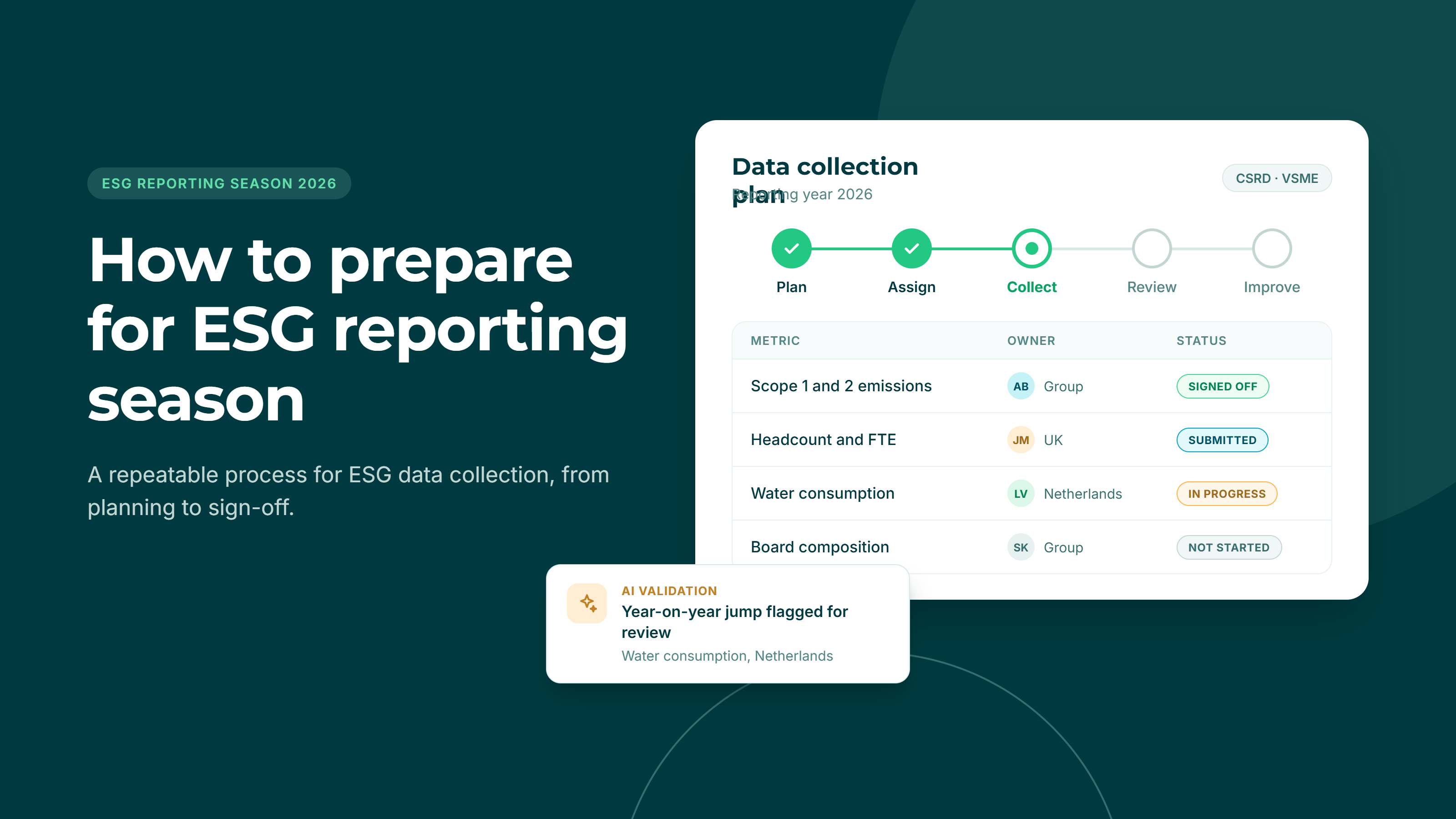
A repeatable ESG data collection process has five steps: plan, assign and train, collect, review, and improve. Rebuilding the collection process each year tends to make it slow and prone to errors. Following the same steps each cycle, and addressing the issues that caused delays in the previous year, makes the process faster and more reliable over time.
- Plan: agree frameworks and metrics, starting from last year’s set.
- Assign and train: name a data owner and a deadline for each metric and entity, and train them.
- Collect: send requests, automate reminders and accept files in the format contributors already use.
- Review: validate, query and sign off with a clear audit trail.
- Improve: record what slowed you down and fix it before the next cycle.
Check what has changed since last year
The previous year’s metric set provides a useful starting point, but it should be reviewed before any data requests are sent. We recommend checking both the frameworks you report against and the methodologies you use to calculate your figures.
Frameworks:
- Have the regulatory requirements or reporting timelines that apply to your organisation changed?
- Have investor, lender or customer templates changed since the last cycle?
- Are new topics now in scope, and are there metrics you no longer need to collect?
Methodologies:
- Are emission factors updated to this year’s sources?
- Do your Scope 2 renewable electricity certificates still meet the latest Greenhouse Gas (GHG) Protocol guidance?
- Have definitions changed, for example for full-time equivalent (FTE) employees or leaver types?
- Has your boundary changed through acquisitions, disposals or new sites?
- Does a method change mean you need to restate your base year?
- Is every change documented for your assurance provider?
Decide the level and frequency of collection
Two decisions shape how much data you collect, who provides it and how useful it is: granularity and cadence. Group-level collection provides one consolidated view and requires less effort, but the data is more difficult to use for operational decisions. Entity-level collection is required by some regulations and makes it easier to identify where improvements can be made.
On cadence, annual collection supports the external report, quarterly collection supports board updates, and monthly collection supports operational management. The right choice depends on who will use the data and how often they need it to make decisions.
How do you prepare contributors and collect ESG data?
Short training sessions held before data requests are sent prevent most of the errors that would otherwise be identified during review. Every contributor should leave training knowing four things:
- Why the data matters: what it is for, who relies on it and why it matters this year.
- Their responsibilities: which metrics and entities they own, and what evidence to attach.
- Where to go with questions: one named contact and channel, so answers stay consistent.
- Deadlines, and why they are set: when data is due, and how review time feeds into sign-off.
Training is also an opportunity for the ESG lead to address the mistakes that recur in each cycle. Each recurring mistake can be turned into guidance, a training example or a validation check. In social data, common examples include mixing up headcount and FTE, reporting year-end figures where the framework asks for averages, and reusing one figure for every framework even though the definitions differ.
Collecting the data
During collection, send requests with clear deadlines, automate reminders rather than following up manually, and accept files as contributors already hold them instead of asking them to reformat. Track what is outstanding by entity and data owner, so that delays can be identified and addressed early in the cycle.
How should you validate ESG data before you report?
Validation works best when it is designed into the process rather than left to a final review. A good ESG data validation process:
- Flags large outliers and year-on-year jumps for review
- Blocks impossible values at entry, for example more female board members than total board members
- Asks for evidence alongside each figure
- Plans enough time for review before sign-off
- Uses AI to support validation, with a person approving every change
Most reporting errors arise from definitions, units and boundaries rather than from missing data. We recommend running the following checks before submission.
Environmental data checks
- One consolidation approach is applied to every entity
- Every data point has a unit, with conversions in one place
- Every emission factor has a recorded source, year and geography
- Scope 2 is reported on both a location-based and a market-based basis
- All 15 Scope 3 categories are screened, with exclusions explained
- Estimates are flagged, with the method recorded
Social data checks
- Headcount or FTE is stated, on the same basis as last year
- Rates use the denominator the framework asks for
- Turnover uses each framework’s leaver categories
- Injury rates show their formula and multiplier
- The gender pay gap uses hourly pay and the listed pay elements
- Policy answers are backed by evidence of practice
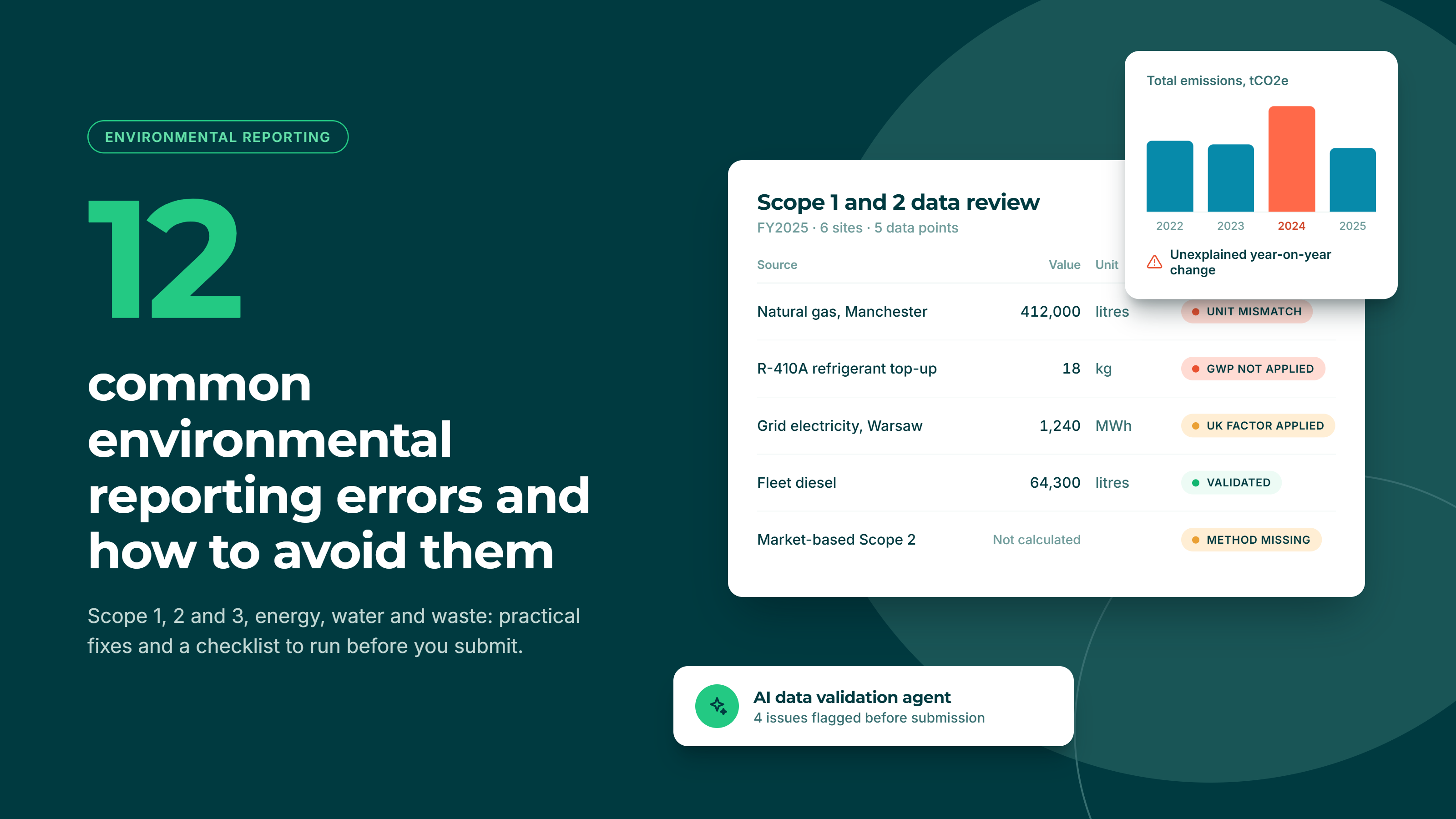
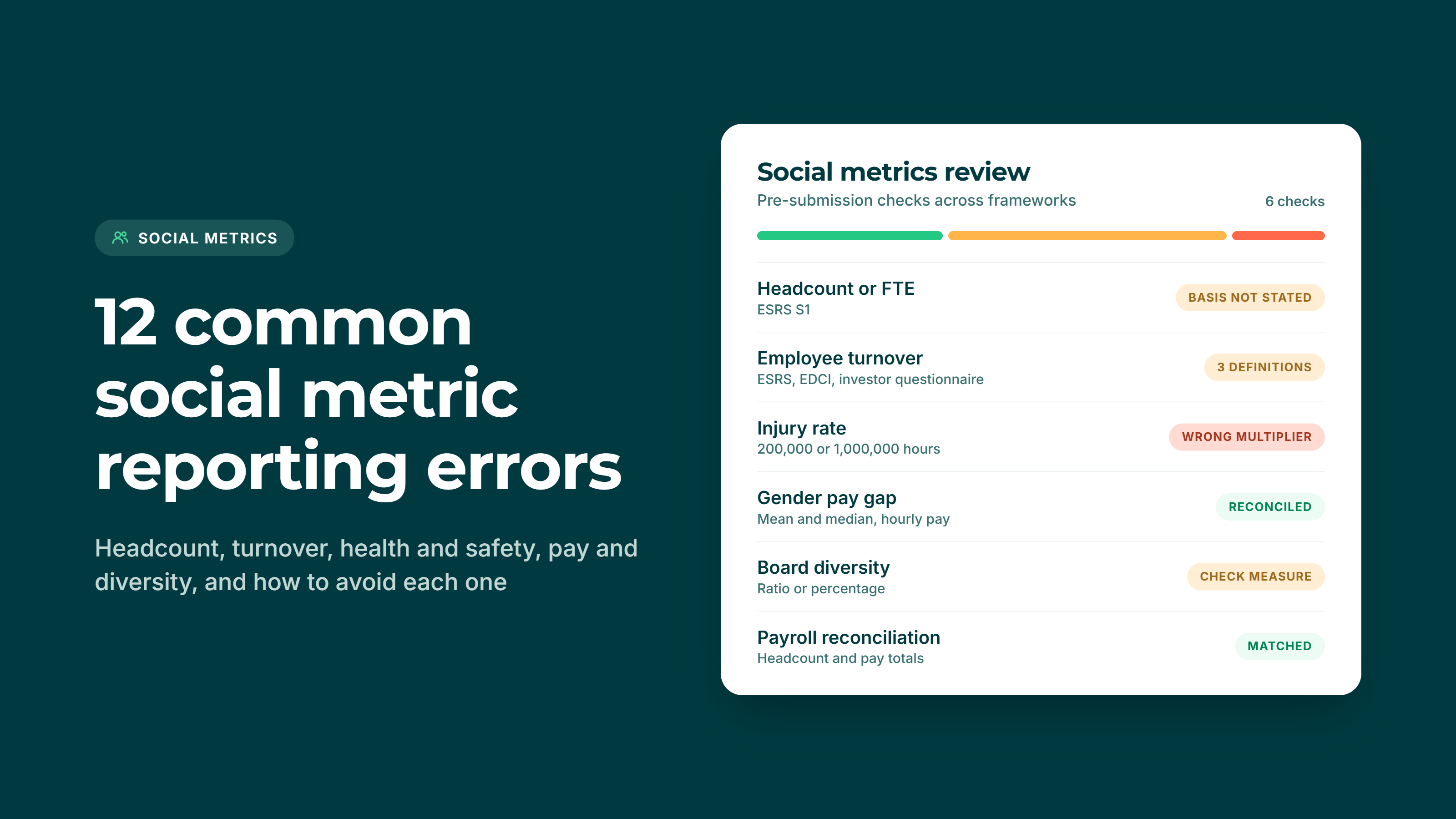
For a full explanation of each error and how to fix it, see our guides to 12 common environmental reporting errors and how to avoid them and 12 common social metric reporting errors and how to avoid them.
How can you use AI in ESG reporting safely?
AI is most useful in ESG reporting where it reduces manual work, and it can be used safely when a named person remains responsible for every reported figure. The main areas where AI adds value are:
- Ingesting unedited spreadsheets in bulk
- Spotting gaps and outliers early
- Producing first drafts of narrative and questionnaire answers
- Answering questions about your data in plain language
We recommend putting the following safeguards in place before you begin:
- Review every AI-proposed change before it is imported
- Keep a log of every AI action
- Use approved enterprise AI tools, not personal accounts
- Add your ESG tools to your AI inventory, so they fall under the same governance as your other AI systems
Using AI skills on live ESG data
The Model Context Protocol (MCP) is an open standard that lets AI assistants connect to external platforms and query live data. The KEY ESG MCP server connects assistants such as Claude, ChatGPT, Microsoft 365 Copilot, Cursor and Mistral Le Chat to your ESG data in KEY ESG, so your team can ask questions, check progress and draft reports without exporting spreadsheets.
KEY ESG also publishes pre-built AI skills in the open Agent Skills format. These are pre-written workflows that run on live data through the MCP server and cover four stages of the reporting cycle:
- Collect and track: find late contributors or portfolio companies, draft chase emails, and flag off-track targets and coverage gaps
- Check: flag carbon data gaps by site, scope and period, and break any metric down by period, entity or company
- Analyse: answer questions across funds and years, and apply your own ESG scoring methodology
- Report: answer LP and regulatory questionnaires, and draft board packs and investor updates
Building your own AI skills
You do not need to use the KEY ESG platform to benefit from AI skills. A skill is a set of written instructions that tells an AI assistant how to carry out a specific task in the same way each time, and both ChatGPT and Claude allow users to create their own. This makes skills a practical way to turn recurring ESG tasks, such as drafting chase emails, checking a data submission against your methodology or answering a standard investor questionnaire, into a repeatable workflow.
To get started, ask your AI assistant how to create a skill and describe the task you want to repeat. The assistant can guide you through writing the instructions, testing them on an example and refining them until the output meets your standards.
Frequently asked questions
When should we start preparing for ESG reporting season?
Preparation should begin before your data collection window opens. This allows time to confirm frameworks and methodologies, assign data owners and train contributors, so that issues are resolved at the start of the cycle rather than during review.
Should we collect ESG data at group level or entity level?
Collect at the level your users and regulations need. Entity-level data is required by some regulations and is more useful for operational improvement, even if you only report group-level figures externally, because it shows where changes need to happen.
What is the most common mistake in ESG data collection?
The most common mistakes come from inconsistent definitions, units and boundaries rather than missing data, for example fuel recorded in the wrong unit or headcount reported where the framework asks for FTE. Agreeing definitions up front and building validation checks into collection prevents most of them.
Is it safe to connect ESG data to an AI assistant?
Yes, provided that you use approved enterprise AI tools, control who has access and keep a person responsible for reviewing outputs. The KEY ESG MCP server gives AI assistants read access to your ESG data, and its documentation sets out its security, authentication and usage policies.
Can we use KEY ESG’s AI skills without the KEY ESG platform?
KEY ESG’s pre-built skills run on live data through the KEY ESG MCP server, so they require a KEY ESG account to work with your data. However, you can build your own skills in ChatGPT or Claude regardless of whether you use the KEY ESG platform. Ask your AI assistant how to create a skill, and it will guide you through setting up a repeatable workflow for your ESG tasks.
How KEY ESG helps you prepare for reporting season
KEY ESG is an AI-first ESG data platform that helps companies collect,validata, manage and report sustainability data in one place. It is highly configurable, has carbon accounting built in, and supports both standard frameworks and the tailored metrics your stakeholders ask for.
Our team keeps frameworks such as CSRD, VSME, SFDR and EDCI current in the platform, updates emission factors and calculation rules, and maps what each year’s changes mean for your metrics.
The platform is designed for business users as well as sustainability specialists. Contributors receive clear guidance on every question, requests, reminders and progress tracking run in the platform, and contributors can upload spreadsheets as they are.
The KEY ESG support team trains all platform users on the relevant ESG topics and the most common reporting errors, and answers their questions throughout the reporting cycle. This support helps prevent errors before data is submitted and reduces the workload for ESG leads, who no longer need to train and support every contributor themselves. As a result, data quality improves from one cycle to the next and reporting deadlines are met.
Built-in validation checks flag issues as data is entered, and our AI data validation agent, trained to spot the common errors described in this guide, identifies any errors that are not caught at entry. Every calculation stays traceable, with a full audit trail.
With the KEY ESG MCP server and KEY ESG's internal AI agents, your team can query data, chase contributors and draft questionnaire answers directly from the AI assistant they already use.
Book a 30-minute reporting readiness review
Answer yes or no to these five questions:
- Do you know which frameworks and metrics you report against this year?
- Does every metric have a named owner and a deadline?
- Is your methodology written down and shared, for example headcount versus FTE?
- Are you using AI in your ESG reporting, with guardrails in place?
- Can you trace every reported figure to its evidence?
If you answered no to two or more questions, we will review those areas with you. In 30 minutes, we will review how you collect data today, show how KEY ESG would address your weak points, and tailor it to your frameworks and group structure.
To arrange a session, please book your reporting readiness review.