Osapiens positions itself as an AI-enabled, cloud-based platform designed to improve operational efficiency and support regulatory compliance. Through its modular “Osapiens HUB,” the company combines supply chain visibility, sustainability compliance, and maintenance management within a single ecosystem.
As European sustainability regulations such as CSRD, EUDR and CSDDD reshape reporting obligations, many organisations are evaluating platforms that connect compliance requirements with operational data.
This review examines Osapiens’ core capabilities, pricing structure and suitability for enterprises and investment-backed organisations. It also outlines where structural differences emerge when compared with KEY ESG.
Osapiens overview
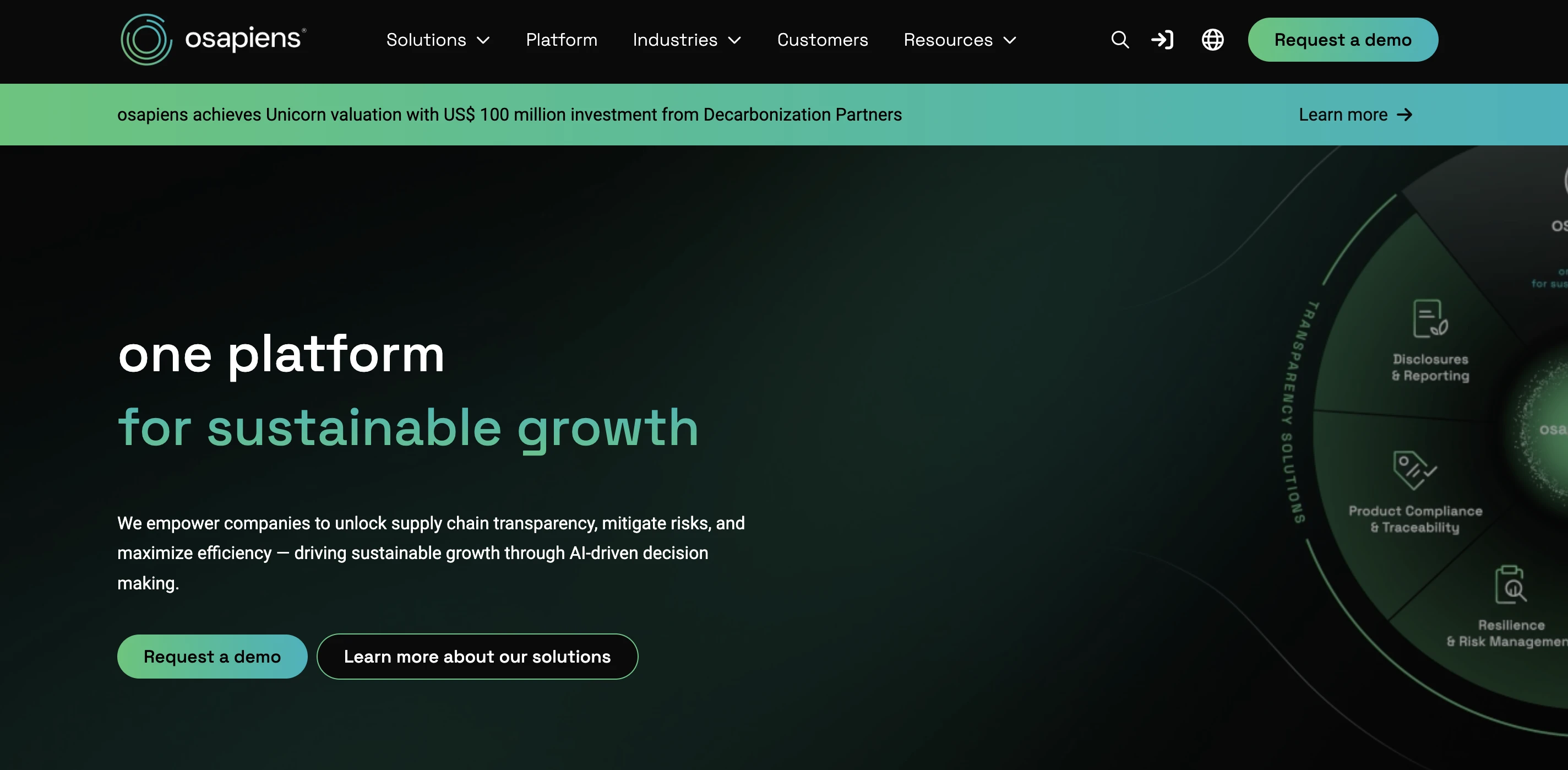
Osapiens is a Germany-based software provider offering a modular platform focused on operational compliance, supply chain management and sustainability reporting. Its core product, the Osapiens HUB, integrates sustainability compliance tools with supply chain visibility and maintenance management capabilities.
The platform is particularly oriented toward European regulatory requirements. It supports compliance with CSRD, EUDR, CBAM, NIS2 and related directives. Native SAP integration plays a central role in its positioning, connecting sustainability and compliance processes with enterprise resource planning systems.
Unlike sustainability-first platforms, Osapiens operates at the intersection of sustainability compliance, logistics oversight and operational efficiency.
Osapiens core features
Osapiens structures its offering around modular solutions spanning sustainability management, supply chain transparency and asset maintenance.
ESG and sustainability management
The Osapiens HUB includes automated reporting capabilities aligned with European regulatory frameworks.
Features include:
- Automated workflows for CSRD, EUDR and CSDDD reporting
- Product carbon footprint (PCF) calculations
- Supplier risk and due diligence management
- Data aggregation for regulatory disclosures
Practical impact:
Organisations subject to EU sustainability regulations can centralise compliance workflows and supplier oversight within a single environment. Automated reporting structures reduce administrative burden and improve audit traceability for European directives.
Supply chain and logistics visibility
Osapiens provides tools for real-time tracking and supplier monitoring across global supply chains.
Capabilities include:
- Real-time supply chain visibility
- Supplier audits and compliance tracking
- Logistics and shipment monitoring
- Risk identification within supplier networks
Practical impact:
For companies with complex international supply chains, these tools support transparency and regulatory due diligence obligations. Visibility across suppliers can reduce compliance risk and strengthen oversight of upstream partners.
CMMS and maintenance management
Through its dedicated CMMS module, Osapiens offers maintenance and asset management functionality.
Features include:
- Digital work order management
- Preventive maintenance scheduling
- Mobile application with offline access
- Asset lifecycle tracking
The company reports operational efficiency metrics, including reduced equipment downtime and faster maintenance processing times.
Practical impact:
For asset-intensive industries, integrating maintenance management with compliance processes can reduce operational disruption and eliminate paper-based workflows. Mobile functionality supports field technicians and on-site teams.
ERP integration and operational efficiency
A defining characteristic of Osapiens is its native SAP integration, including connections to SAP PM, MM and FI/CO modules. The platform also supports integration with other ERP systems.
Capabilities include:
- Automated data synchronisation
- Elimination of double data entry
- Integrated financial and operational data flows
- Analytics dashboards across business processes
Practical impact:
For SAP-centric enterprises, this integration reduces friction between sustainability compliance and operational systems. Data consistency across ERP and compliance environments supports process alignment.
Who Osapiens is best suited to
Osapiens may be well suited to:
- European enterprises subject to EUDR, CSRD and related directives
- Asset-intensive organisations requiring integrated maintenance management
- Companies operating SAP as their primary ERP system
- Businesses seeking to combine supply chain visibility with compliance workflows
Its positioning aligns closely with organisations that view sustainability compliance as part of broader operational risk management.
Osapiens pricing
Osapiens offers modular pricing depending on selected products and scope.
For its CMMS solution, public pricing information is available via the Osapiens CMMS website. Pricing tiers range from $0 to $49 per month, plus an enterprise package, and vary based on:
- Number of users
- Number of assets
- Feature access
- Deployment scale
Sustainability and supply chain modules appear to follow a customised enterprise pricing model, with costs determined through consultation.
Prospective customers should contact Osapiens directly for full pricing aligned with regulatory scope and operational complexity.
Why customers choose KEY ESG
Osapiens connects sustainability compliance with supply chain visibility, ERP integration and maintenance management. Its platform is structured around operational processes and European regulatory workflows.
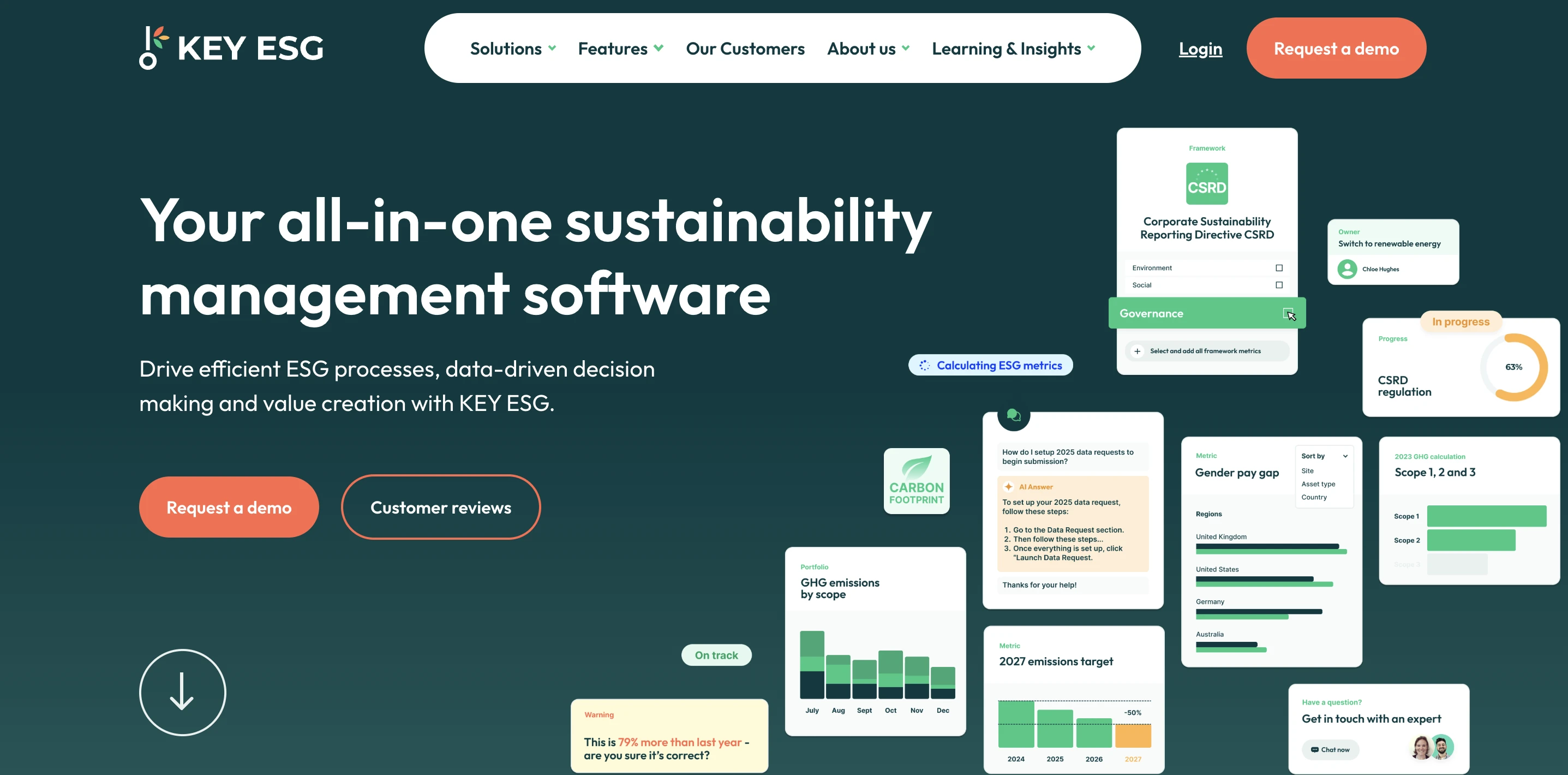
KEY ESG, by contrast, is designed specifically as a sustainability workflow and reporting system for enterprises and investment firms. Its architecture centres on structured data collection, carbon accounting and multi-framework disclosure management rather than operational logistics or asset maintenance.
Multi-framework sustainability architecture
KEY ESG is built around a single data model that supports CSRD, IFRS S1/S2, SFDR, TCFD, CDP, GRI, Invest Europe, EDCI, and California Climate Laws within a single system.
While Osapiens emphasises compliance with EU directives such as EUDR and CSDDD, KEY ESG is structured to enable organisations to report across multiple global frameworks and investor requirements simultaneously. Data is captured once and reused across disclosures, reducing structural duplication as reporting obligations expand.
Comprehensive Scope 1–3 carbon accounting
KEY ESG supports full Scope 1, 2 and 3 carbon accounting across all 15 Scope 3 categories. The platform incorporates more than 70,000 emission factors sourced from DEFRA, US EPA and Climatiq.
This depth supports enterprise-wide and portfolio-wide emissions reporting beyond product carbon footprint calculations. For organisations facing detailed Scope 3 scrutiny, comprehensive category coverage becomes critical.
Portfolio and multi-entity sustainability oversight
KEY ESG combines portfolio-level dashboards with company-level operational sustainability workflows in one environment.
Osapiens integrates sustainability compliance within broader operational systems. KEY ESG concentrates on sustainability governance across subsidiaries, business units and portfolio companies. This distinction becomes relevant for investment managers and complex enterprise groups that require consistent reporting across multiple entities.
Workflow-first audit structure
KEY ESG is designed around structured approvals, audit trails and evidence management across sustainability processes.
For finance, compliance and investor relations teams, this architecture supports assurance readiness and traceable documentation across reporting cycles. The system is built for sustainability governance rather than operational maintenance management.
If you're interested in Osapiens alternatives, we wrote a comparison piece here.
Final verdict
Osapiens delivers a modular platform that integrates sustainability compliance with supply chain visibility, ERP connectivity and maintenance management. For European enterprises seeking to embed regulatory workflows directly into operational systems, this approach offers strong alignment.
For organisations whose priority is structured, multi-framework sustainability reporting and comprehensive Scope 1–3 carbon accounting across complex entities or portfolios, a sustainability-native platform provides a different foundation. KEY ESG is designed specifically for this purpose, with a single data model spanning global frameworks, portfolio-level oversight and audit-ready workflows within a unified solution.
The distinction is less about features and more about architectural intent. Osapiens connects compliance with operations. KEY ESG centres sustainability governance and reporting as a dedicated enterprise capability.
If your organisation requires portfolio-wide visibility, multi-framework alignment and full Scope 3 depth within a sustainability-focused system, KEY ESG should be evaluated as a primary option.
Request a demo to assess fit for your sustainability reporting requirements.
Osapiens positions itself as an AI-enabled, cloud-based platform designed to improve operational efficiency and support regulatory compliance. Through its modular “Osapiens HUB,” the company combines supply chain visibility, sustainability compliance, and maintenance management within a single ecosystem.
As European sustainability regulations such as CSRD, EUDR and CSDDD reshape reporting obligations, many organisations are evaluating platforms that connect compliance requirements with operational data.
This review examines Osapiens’ core capabilities, pricing structure and suitability for enterprises and investment-backed organisations. It also outlines where structural differences emerge when compared with KEY ESG.
Osapiens overview
Osapiens is a Germany-based software provider offering a modular platform focused on operational compliance, supply chain management and sustainability reporting. Its core product, the Osapiens HUB, integrates sustainability compliance tools with supply chain visibility and maintenance management capabilities.
The platform is particularly oriented toward European regulatory requirements. It supports compliance with CSRD, EUDR, CBAM, NIS2 and related directives. Native SAP integration plays a central role in its positioning, connecting sustainability and compliance processes with enterprise resource planning systems.
Unlike sustainability-first platforms, Osapiens operates at the intersection of sustainability compliance, logistics oversight and operational efficiency.
Osapiens core features
Osapiens structures its offering around modular solutions spanning sustainability management, supply chain transparency and asset maintenance.
ESG and sustainability management
The Osapiens HUB includes automated reporting capabilities aligned with European regulatory frameworks.
Features include:
- Automated workflows for CSRD, EUDR and CSDDD reporting
- Product carbon footprint (PCF) calculations
- Supplier risk and due diligence management
- Data aggregation for regulatory disclosures
Practical impact:
Organisations subject to EU sustainability regulations can centralise compliance workflows and supplier oversight within a single environment. Automated reporting structures reduce administrative burden and improve audit traceability for European directives.
Supply chain and logistics visibility
Osapiens provides tools for real-time tracking and supplier monitoring across global supply chains.
Capabilities include:
- Real-time supply chain visibility
- Supplier audits and compliance tracking
- Logistics and shipment monitoring
- Risk identification within supplier networks
Practical impact:
For companies with complex international supply chains, these tools support transparency and regulatory due diligence obligations. Visibility across suppliers can reduce compliance risk and strengthen oversight of upstream partners.
CMMS and maintenance management
Through its dedicated CMMS module, Osapiens offers maintenance and asset management functionality.
Features include:
- Digital work order management
- Preventive maintenance scheduling
- Mobile application with offline access
- Asset lifecycle tracking
The company reports operational efficiency metrics, including reduced equipment downtime and faster maintenance processing times.
Practical impact:
For asset-intensive industries, integrating maintenance management with compliance processes can reduce operational disruption and eliminate paper-based workflows. Mobile functionality supports field technicians and on-site teams.
ERP integration and operational efficiency
A defining characteristic of Osapiens is its native SAP integration, including connections to SAP PM, MM and FI/CO modules. The platform also supports integration with other ERP systems.
Capabilities include:
- Automated data synchronisation
- Elimination of double data entry
- Integrated financial and operational data flows
- Analytics dashboards across business processes
Practical impact:
For SAP-centric enterprises, this integration reduces friction between sustainability compliance and operational systems. Data consistency across ERP and compliance environments supports process alignment.
Who Osapiens is best suited to
Osapiens may be well suited to:
- European enterprises subject to EUDR, CSRD and related directives
- Asset-intensive organisations requiring integrated maintenance management
- Companies operating SAP as their primary ERP system
- Businesses seeking to combine supply chain visibility with compliance workflows
Its positioning aligns closely with organisations that view sustainability compliance as part of broader operational risk management.
Osapiens pricing
Osapiens offers modular pricing depending on selected products and scope.
For its CMMS solution, public pricing information is available via the Osapiens CMMS website. Pricing tiers range from $0 to $49 per month, plus an enterprise package, and vary based on:
- Number of users
- Number of assets
- Feature access
- Deployment scale
Sustainability and supply chain modules appear to follow a customised enterprise pricing model, with costs determined through consultation.
Prospective customers should contact Osapiens directly for full pricing aligned with regulatory scope and operational complexity.
Why customers choose KEY ESG
Osapiens connects sustainability compliance with supply chain visibility, ERP integration and maintenance management. Its platform is structured around operational processes and European regulatory workflows.
KEY ESG, by contrast, is designed specifically as a sustainability workflow and reporting system for enterprises and investment firms. Its architecture centres on structured data collection, carbon accounting and multi-framework disclosure management rather than operational logistics or asset maintenance.
Multi-framework sustainability architecture
KEY ESG is built around a single data model that supports CSRD, IFRS S1/S2, SFDR, TCFD, CDP, GRI, Invest Europe, EDCI, and California Climate Laws within a single system.
While Osapiens emphasises compliance with EU directives such as EUDR and CSDDD, KEY ESG is structured to enable organisations to report across multiple global frameworks and investor requirements simultaneously. Data is captured once and reused across disclosures, reducing structural duplication as reporting obligations expand.
Comprehensive Scope 1–3 carbon accounting
KEY ESG supports full Scope 1, 2 and 3 carbon accounting across all 15 Scope 3 categories. The platform incorporates more than 70,000 emission factors sourced from DEFRA, US EPA and Climatiq.
This depth supports enterprise-wide and portfolio-wide emissions reporting beyond product carbon footprint calculations. For organisations facing detailed Scope 3 scrutiny, comprehensive category coverage becomes critical.
Portfolio and multi-entity sustainability oversight
KEY ESG combines portfolio-level dashboards with company-level operational sustainability workflows in one environment.
Osapiens integrates sustainability compliance within broader operational systems. KEY ESG concentrates on sustainability governance across subsidiaries, business units and portfolio companies. This distinction becomes relevant for investment managers and complex enterprise groups that require consistent reporting across multiple entities.
Workflow-first audit structure
KEY ESG is designed around structured approvals, audit trails and evidence management across sustainability processes.
For finance, compliance and investor relations teams, this architecture supports assurance readiness and traceable documentation across reporting cycles. The system is built for sustainability governance rather than operational maintenance management.
If you're interested in Osapiens alternatives, we wrote a comparison piece here.
Final verdict
Osapiens delivers a modular platform that integrates sustainability compliance with supply chain visibility, ERP connectivity and maintenance management. For European enterprises seeking to embed regulatory workflows directly into operational systems, this approach offers strong alignment.
For organisations whose priority is structured, multi-framework sustainability reporting and comprehensive Scope 1–3 carbon accounting across complex entities or portfolios, a sustainability-native platform provides a different foundation. KEY ESG is designed specifically for this purpose, with a single data model spanning global frameworks, portfolio-level oversight and audit-ready workflows within a unified solution.
The distinction is less about features and more about architectural intent. Osapiens connects compliance with operations. KEY ESG centres sustainability governance and reporting as a dedicated enterprise capability.
If your organisation requires portfolio-wide visibility, multi-framework alignment and full Scope 3 depth within a sustainability-focused system, KEY ESG should be evaluated as a primary option.
Request a demo to assess fit for your sustainability reporting requirements.