Organisations are under pressure to manage growing volumes of sustainability data while reducing manual effort in reporting processes.
To help with this, AI is being introduced into workflows to automate parts of data processing and analysis.
The challenge is ensuring accuracy and alignment across systems, teams, and frameworks, especially when it comes to reporting. Without that foundation, AI automation introduces risk rather than efficiency.
This article explains how AI can be applied across the sustainability reporting process, and how to combine it with structured data and defined methodologies to produce reliable, audit-ready reports.
What AI can and can’t do in sustainability reporting
As the technology improves, AI is becoming more prominent in sustainability reporting workflows.
Yet, its capabilities depend on how it is applied. Understanding where it adds value and where it has limitations is important for maintaining data quality and compliance.
Where AI adds value
AI can support several parts of the reporting process, particularly where large volumes of data need to be processed or analysed.
- Data aggregation and processing. Consolidating data from multiple systems and formats
- Anomaly detection and validation support. Identifying inconsistencies, gaps, or unusual patterns in reported data
- Emissions estimation and modelling. Supporting calculations where primary data is incomplete, particularly for Scope 3 emissions
- Drafting and summarising disclosures. Generating initial versions of narrative sections based on structured data
- Trend analysis and insights. Highlighting changes in performance across reporting periods or entities
Where AI has limitations
AI doesn’t, and shouldn’t, replace the core requirements of enterprise sustainability reporting.
- Defining methodologies and boundaries. Decisions on scope, assumptions, and calculation approaches require human oversight
- Ensuring compliance with frameworks. Alignment with CSRD, IFRS S1/S2, and other standards depends on interpretation and control
- Providing audit trails and supporting evidence. Reports must be backed by traceable data and documentation
- Making judgment-based disclosures. Narrative sections that require context, interpretation, or forward-looking statements cannot be fully automated
The bottom line is that AI works best when applied within a structured reporting process built on consistent data and defined methodologies.
How to create sustainability reports with AI
Creating enterprise sustainability reports involves a structured process that combines data management, KPI definition, and reporting.
AI supports specific stages within this process, particularly where large volumes of data need to be processed, validated, or summarised.
Step 1: Structure and collect sustainability data
The reporting process begins with gathering data from across the organisation, including operations, finance, HR, procurement, and suppliers. This data needs to be standardised to ensure consistency across systems and reporting periods.
AI can be used here to organise and classify incoming data. For example, invoice or procurement data can be automatically categorised into emissions categories, reducing manual tagging and improving coverage across Scope 3 inputs.
Step 2: Define KPIs and calculation methodologies
Once data is collected, it must be mapped to KPIs aligned with reporting frameworks and internal priorities. Each KPI should have a clear calculation method, including defined boundaries, assumptions, and data sources.
AI can support this stage by flagging inconsistencies in how data is applied. If two business units apply different emission factors or boundaries for the same activity, this can be identified and reviewed before calculations are finalised.
Step 3: Validate and review data
Before reporting, data needs to be checked for accuracy and completeness, including identifying anomalies, missing inputs, and unexpected changes in performance.
AI is particularly useful for detecting outliers. A sudden increase in energy consumption at a specific site or a drop in reported supplier emissions can be highlighted for investigation, rather than relying on manual review.
Step 4: Align data with reporting frameworks
KPIs and underlying data must be mapped to relevant frameworks like CSRD, VSME, IFRS S1/S2, SFDR, TCFD, California Climate Laws, EDCI, GRI, CDP and Invest Europe. This ensures disclosures are consistent and can be reused across different reporting requirements.
AI can assist by structuring data against predefined disclosure requirements. For example, emissions data and related KPIs can be grouped and mapped to the relevant sections of a CSRD report, reducing duplication across frameworks.
Step 5: Generate report content
With structured and validated data in place, organisations can begin drafting sustainability reports. This includes both quantitative disclosures and narrative sections explaining performance, risks, and progress.
AI is commonly used to generate first drafts of these sections. For example, year-on-year changes in emissions or workforce metrics can be summarised into narrative explanations, which are then reviewed and refined by internal teams.
Step 6: Review, approve, and prepare for audit
The final stage involves reviewing the report, validating outputs, and ensuring all disclosures are supported by traceable data and documentation. This step is critical for internal governance and external assurance.
AI can support consistency checks across the report. For example, it can identify when figures referenced in narrative sections do not match the underlying data tables, helping reduce errors before submission.
Common risks when using AI in sustainability reporting
AI can improve efficiency in sustainability reporting, but it also introduces risks if it is applied without sufficient control over data and processes.
These risks tend to appear when AI is used as a shortcut rather than within a structured reporting system.
Over-reliance on generated content
AI can draft narrative sections quickly, but it doesn’t understand context in the same way as internal teams.
For example, a model may generate a summary of emissions reductions without recognising that the change is due to a one-off operational shift rather than a sustained improvement. Without review, this can lead to misleading disclosures.
Inconsistent or low-quality input data
AI outputs are only as reliable as the data on which they are based.
If the underlying data is incomplete, inconsistently defined, or sourced from multiple systems without standardisation, AI-generated calculations or summaries will reflect those inconsistencies rather than correct them.
Lack of transparency in calculations
Some AI-driven processes can make it difficult to trace how outputs are produced.
For example, if emissions estimates are generated without clear documentation of emission factors or assumptions, it becomes difficult to explain or defend reported figures during an audit or investor review.
Misalignment with reporting frameworks
AI can assist with structuring disclosures, but it doesn’t guarantee alignment with frameworks such as CSRD or IFRS S1/S2, which can be nuanced.
If framework requirements aren’t defined in advance, generated outputs may omit required disclosures or apply incorrect interpretations.
Missing audit trails and supporting evidence
Enterprise sustainability reporting requires traceability.
If AI is used to generate outputs without linking them back to source data, validation steps, and supporting documentation, organisations may struggle to meet assurance requirements.
These risks reinforce a consistent pattern. AI improves specific parts of the reporting process, but it doesn’t replace the need for structured data, defined methodologies, controlled workflows and human oversight.
How KEY ESG supports AI-driven sustainability reporting
Applying AI effectively in sustainability reporting requires a structured system that ensures data consistency, transparency, and control across the entire process. This is where software plays a central role.
KEY ESG is designed to support enterprise reporting by combining a consistent data model with workflow controls and targeted use of AI.
- Centralised sustainability data across entities and portfolios. Collect and manage ESG data from multiple business units, sites, or portfolio companies within a single structure, reducing fragmentation and inconsistencies
- KPI tracking aligned with reporting frameworks. Define and monitor KPIs in line with CSRD, IFRS S1/S2, and TCFD, ensuring outputs can be reused across disclosures
- Standardised methodologies and calculation logic. Apply consistent rules for emissions calculations and ESG metrics, supporting comparability across reporting periods
- Built-in workflows, validation, and audit trails. Track data inputs, approvals, and supporting evidence to ensure all reported figures are traceable and audit-ready
- AI policy generation. Auto-generates policy descriptions from attached documentation, reducing manual drafting effort
- AI auto-fill. Auto-completes qualitative data collection questions based on uploaded documents
- AI root cause analysis. Identifies the cause of year-on-year variance in GHG Scope 1, 2, and 3 data when a validation rule flags an anomaly, so teams can investigate and resolve issues quickly
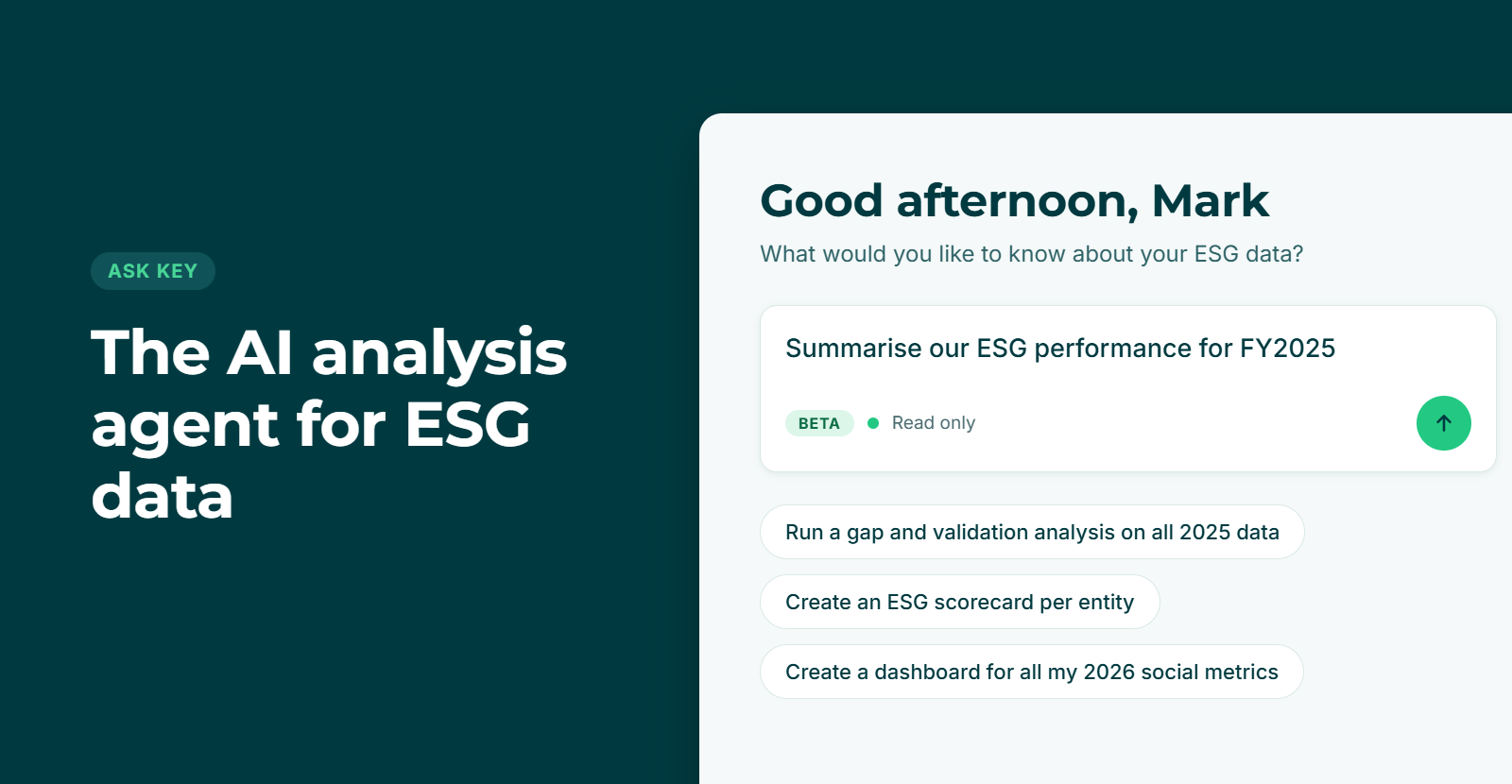
- MCP connector. Connects AI agents like Claude or ChatGPT directly to live KEY ESG data, enabling plain-language querying of ESG data and use cases such as LP questionnaire answering and carbon anomaly diagnosis; in active pilot ahead of a Q2 2026 release
By combining structured data management with targeted use of AI, organisations can improve efficiency in sustainability reporting without compromising accuracy, consistency, or auditability.
The role of AI in enterprise sustainability reporting
The effectiveness of AI depends on how it is applied. AI doesn’t replace the need for consistent data structures, defined methodologies, or alignment with reporting frameworks. These remain essential for producing reliable and audit-ready disclosures.
A practical approach is to apply AI within a structured reporting system:
- Start with standardised, well-defined data
- Use AI to support validation, analysis, and drafting
- Maintain control over calculations, assumptions, and final outputs
Combining structured sustainability data with strategic AI use allows organisations to improve reporting efficiency while maintaining data quality and auditability.
If you’re looking to structure sustainability data, align reporting across frameworks, and apply AI in a controlled and auditable way, request a demo of KEY ESG to see how a system-led approach supports enterprise reporting.
Organisations are under pressure to manage growing volumes of sustainability data while reducing manual effort in reporting processes.
To help with this, AI is being introduced into workflows to automate parts of data processing and analysis.
The challenge is ensuring accuracy and alignment across systems, teams, and frameworks, especially when it comes to reporting. Without that foundation, AI automation introduces risk rather than efficiency.
This article explains how AI can be applied across the sustainability reporting process, and how to combine it with structured data and defined methodologies to produce reliable, audit-ready reports.
What AI can and can’t do in sustainability reporting
As the technology improves, AI is becoming more prominent in sustainability reporting workflows.
Yet, its capabilities depend on how it is applied. Understanding where it adds value and where it has limitations is important for maintaining data quality and compliance.
Where AI adds value
AI can support several parts of the reporting process, particularly where large volumes of data need to be processed or analysed.
- Data aggregation and processing. Consolidating data from multiple systems and formats
- Anomaly detection and validation support. Identifying inconsistencies, gaps, or unusual patterns in reported data
- Emissions estimation and modelling. Supporting calculations where primary data is incomplete, particularly for Scope 3 emissions
- Drafting and summarising disclosures. Generating initial versions of narrative sections based on structured data
- Trend analysis and insights. Highlighting changes in performance across reporting periods or entities
Where AI has limitations
AI doesn’t, and shouldn’t, replace the core requirements of enterprise sustainability reporting.
- Defining methodologies and boundaries. Decisions on scope, assumptions, and calculation approaches require human oversight
- Ensuring compliance with frameworks. Alignment with CSRD, IFRS S1/S2, and other standards depends on interpretation and control
- Providing audit trails and supporting evidence. Reports must be backed by traceable data and documentation
- Making judgment-based disclosures. Narrative sections that require context, interpretation, or forward-looking statements cannot be fully automated
The bottom line is that AI works best when applied within a structured reporting process built on consistent data and defined methodologies.
How to create sustainability reports with AI
Creating enterprise sustainability reports involves a structured process that combines data management, KPI definition, and reporting.
AI supports specific stages within this process, particularly where large volumes of data need to be processed, validated, or summarised.
Step 1: Structure and collect sustainability data
The reporting process begins with gathering data from across the organisation, including operations, finance, HR, procurement, and suppliers. This data needs to be standardised to ensure consistency across systems and reporting periods.
AI can be used here to organise and classify incoming data. For example, invoice or procurement data can be automatically categorised into emissions categories, reducing manual tagging and improving coverage across Scope 3 inputs.
Step 2: Define KPIs and calculation methodologies
Once data is collected, it must be mapped to KPIs aligned with reporting frameworks and internal priorities. Each KPI should have a clear calculation method, including defined boundaries, assumptions, and data sources.
AI can support this stage by flagging inconsistencies in how data is applied. If two business units apply different emission factors or boundaries for the same activity, this can be identified and reviewed before calculations are finalised.
Step 3: Validate and review data
Before reporting, data needs to be checked for accuracy and completeness, including identifying anomalies, missing inputs, and unexpected changes in performance.
AI is particularly useful for detecting outliers. A sudden increase in energy consumption at a specific site or a drop in reported supplier emissions can be highlighted for investigation, rather than relying on manual review.
Step 4: Align data with reporting frameworks
KPIs and underlying data must be mapped to relevant frameworks like CSRD, VSME, IFRS S1/S2, SFDR, TCFD, California Climate Laws, EDCI, GRI, CDP and Invest Europe. This ensures disclosures are consistent and can be reused across different reporting requirements.
AI can assist by structuring data against predefined disclosure requirements. For example, emissions data and related KPIs can be grouped and mapped to the relevant sections of a CSRD report, reducing duplication across frameworks.
Step 5: Generate report content
With structured and validated data in place, organisations can begin drafting sustainability reports. This includes both quantitative disclosures and narrative sections explaining performance, risks, and progress.
AI is commonly used to generate first drafts of these sections. For example, year-on-year changes in emissions or workforce metrics can be summarised into narrative explanations, which are then reviewed and refined by internal teams.
Step 6: Review, approve, and prepare for audit
The final stage involves reviewing the report, validating outputs, and ensuring all disclosures are supported by traceable data and documentation. This step is critical for internal governance and external assurance.
AI can support consistency checks across the report. For example, it can identify when figures referenced in narrative sections do not match the underlying data tables, helping reduce errors before submission.
Common risks when using AI in sustainability reporting
AI can improve efficiency in sustainability reporting, but it also introduces risks if it is applied without sufficient control over data and processes.
These risks tend to appear when AI is used as a shortcut rather than within a structured reporting system.
Over-reliance on generated content
AI can draft narrative sections quickly, but it doesn’t understand context in the same way as internal teams.
For example, a model may generate a summary of emissions reductions without recognising that the change is due to a one-off operational shift rather than a sustained improvement. Without review, this can lead to misleading disclosures.
Inconsistent or low-quality input data
AI outputs are only as reliable as the data on which they are based.
If the underlying data is incomplete, inconsistently defined, or sourced from multiple systems without standardisation, AI-generated calculations or summaries will reflect those inconsistencies rather than correct them.
Lack of transparency in calculations
Some AI-driven processes can make it difficult to trace how outputs are produced.
For example, if emissions estimates are generated without clear documentation of emission factors or assumptions, it becomes difficult to explain or defend reported figures during an audit or investor review.
Misalignment with reporting frameworks
AI can assist with structuring disclosures, but it doesn’t guarantee alignment with frameworks such as CSRD or IFRS S1/S2, which can be nuanced.
If framework requirements aren’t defined in advance, generated outputs may omit required disclosures or apply incorrect interpretations.
Missing audit trails and supporting evidence
Enterprise sustainability reporting requires traceability.
If AI is used to generate outputs without linking them back to source data, validation steps, and supporting documentation, organisations may struggle to meet assurance requirements.
These risks reinforce a consistent pattern. AI improves specific parts of the reporting process, but it doesn’t replace the need for structured data, defined methodologies, controlled workflows and human oversight.
How KEY ESG supports AI-driven sustainability reporting
Applying AI effectively in sustainability reporting requires a structured system that ensures data consistency, transparency, and control across the entire process. This is where software plays a central role.
KEY ESG is designed to support enterprise reporting by combining a consistent data model with workflow controls and targeted use of AI.
- Centralised sustainability data across entities and portfolios. Collect and manage ESG data from multiple business units, sites, or portfolio companies within a single structure, reducing fragmentation and inconsistencies
- KPI tracking aligned with reporting frameworks. Define and monitor KPIs in line with CSRD, IFRS S1/S2, and TCFD, ensuring outputs can be reused across disclosures
- Standardised methodologies and calculation logic. Apply consistent rules for emissions calculations and ESG metrics, supporting comparability across reporting periods
- Built-in workflows, validation, and audit trails. Track data inputs, approvals, and supporting evidence to ensure all reported figures are traceable and audit-ready
- AI policy generation. Auto-generates policy descriptions from attached documentation, reducing manual drafting effort
- AI auto-fill. Auto-completes qualitative data collection questions based on uploaded documents
- AI root cause analysis. Identifies the cause of year-on-year variance in GHG Scope 1, 2, and 3 data when a validation rule flags an anomaly, so teams can investigate and resolve issues quickly
- MCP connector. Connects AI agents like Claude or ChatGPT directly to live KEY ESG data, enabling plain-language querying of ESG data and use cases such as LP questionnaire answering and carbon anomaly diagnosis; in active pilot ahead of a Q2 2026 release
By combining structured data management with targeted use of AI, organisations can improve efficiency in sustainability reporting without compromising accuracy, consistency, or auditability.
The role of AI in enterprise sustainability reporting
The effectiveness of AI depends on how it is applied. AI doesn’t replace the need for consistent data structures, defined methodologies, or alignment with reporting frameworks. These remain essential for producing reliable and audit-ready disclosures.
A practical approach is to apply AI within a structured reporting system:
- Start with standardised, well-defined data
- Use AI to support validation, analysis, and drafting
- Maintain control over calculations, assumptions, and final outputs
Combining structured sustainability data with strategic AI use allows organisations to improve reporting efficiency while maintaining data quality and auditability.
If you’re looking to structure sustainability data, align reporting across frameworks, and apply AI in a controlled and auditable way, request a demo of KEY ESG to see how a system-led approach supports enterprise reporting.