As sustainability reporting requirements expand and investor expectations increase, organisations are dealing with a growing volume and complexity of ESG data.
This is driving the adoption of AI within sustainability software, as teams look for more efficient ways to process and analyse information across their business.
At the same time, software vendors are increasingly positioning their platforms as “AI-powered.” In practice, the role of AI varies significantly. In some tools, it is used for data extraction or automation. In others, it supports emissions modelling, data validation, or performance analysis.
This guide reviews six sustainability software platforms that use AI to improve the collection, processing, and reporting of sustainability data. The focus is not on AI as a standalone feature, but on how it contributes to structured, reliable, and decision-useful sustainability management.
What to look for in AI-powered sustainability software
AI is becoming part of many sustainability platforms, but its value depends on how it is applied within the overall system. What matters is whether it improves data quality, consistency, and usability, rather than whether it is a feature.
When evaluating sustainability software, there are several areas to assess.
- Where AI is applied in the workflow. Look at whether AI is used for data collection, validation, emissions estimation, or performance analysis. The most useful applications are those that improve accuracy and reduce manual effort in core processes.
- Transparency and auditability. AI-supported outputs should remain explainable and traceable. It should be clear how calculations are performed, which data sources are used, and how results can be validated.
- Alignment with reporting frameworks. The platform should support multiple frameworks, and outputs should be structured in a way that can be reused across disclosures.
- Depth of carbon accounting capabilities. Strong platforms provide full Scope 1, 2, and 3 coverage, including detailed emissions calculations and access to recognised emission factor databases.
- Scalability across entities or portfolios. The system should support multiple business units, geographies, or portfolio companies, while maintaining consistent methodologies and data structures.
These criteria help distinguish between platforms that use AI as a surface-level feature and those that apply it to improve how sustainability performance is measured and managed.
Best AI-powered sustainability software
The list below focuses on tools that support data quality, emissions calculation, and performance analysis within a structured reporting system.
Each platform has been selected based on how it applies AI across the sustainability workflow, its ability to support recognised frameworks such as CSRD and IFRS, and its suitability for enterprise or investment firm use cases.
Persefoni
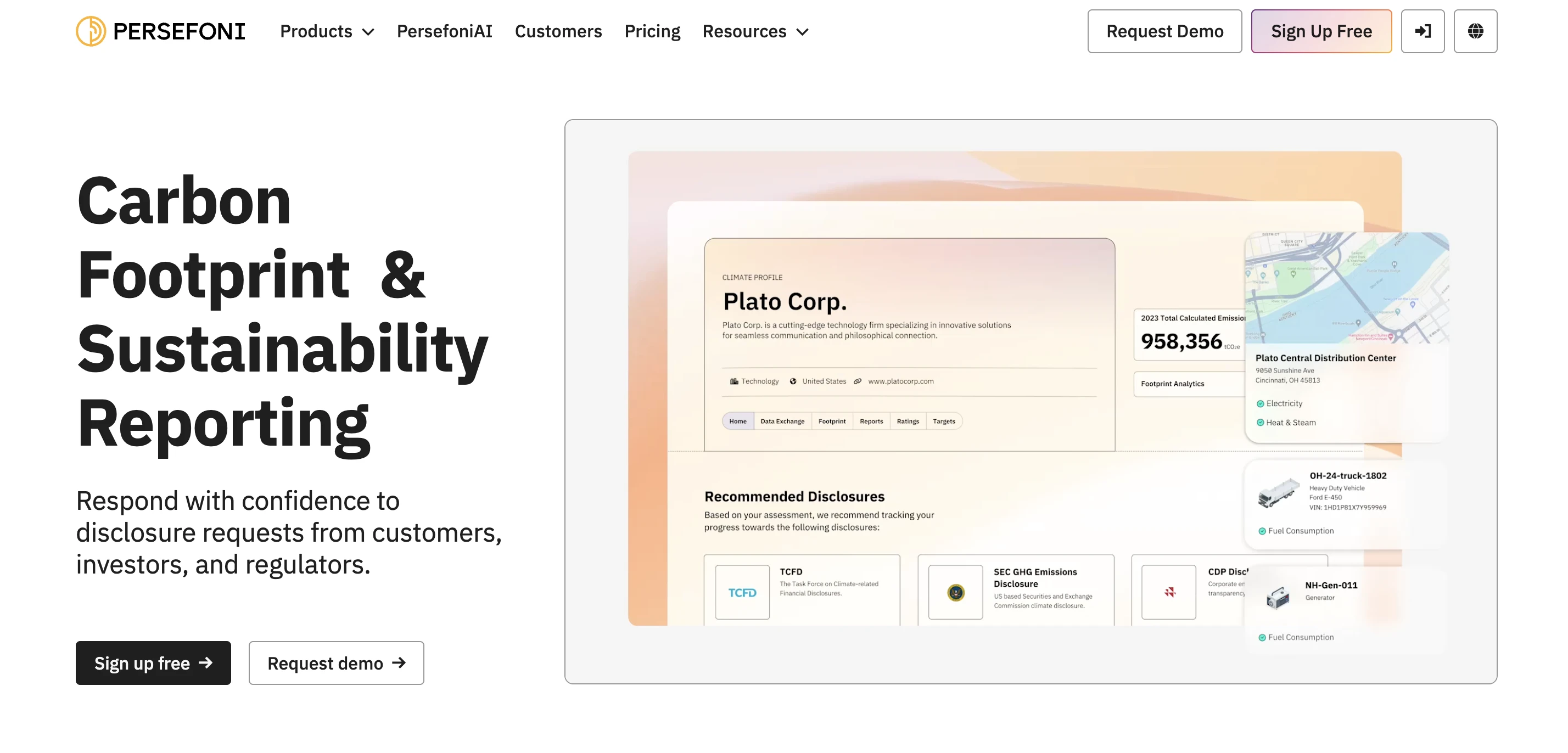
Persefoni is a carbon accounting and climate disclosure platform designed for enterprises and financial institutions. It focuses on producing investor-grade emissions data aligned with financial reporting requirements.
Key features
- Carbon Accounting and Calculation Engine
- Financial-grade emissions reporting and audit support
- Specific functionality for banks and investors to measure and manage the emissions of their portfolios
AI capabilities
- Persefoni Copilot
- AI-powered emission factor mapping
- AI-driven anomaly detection
Best for
Enterprises and financial institutions that require carbon accounting aligned with financial reporting and regulatory disclosures
KEY ESG
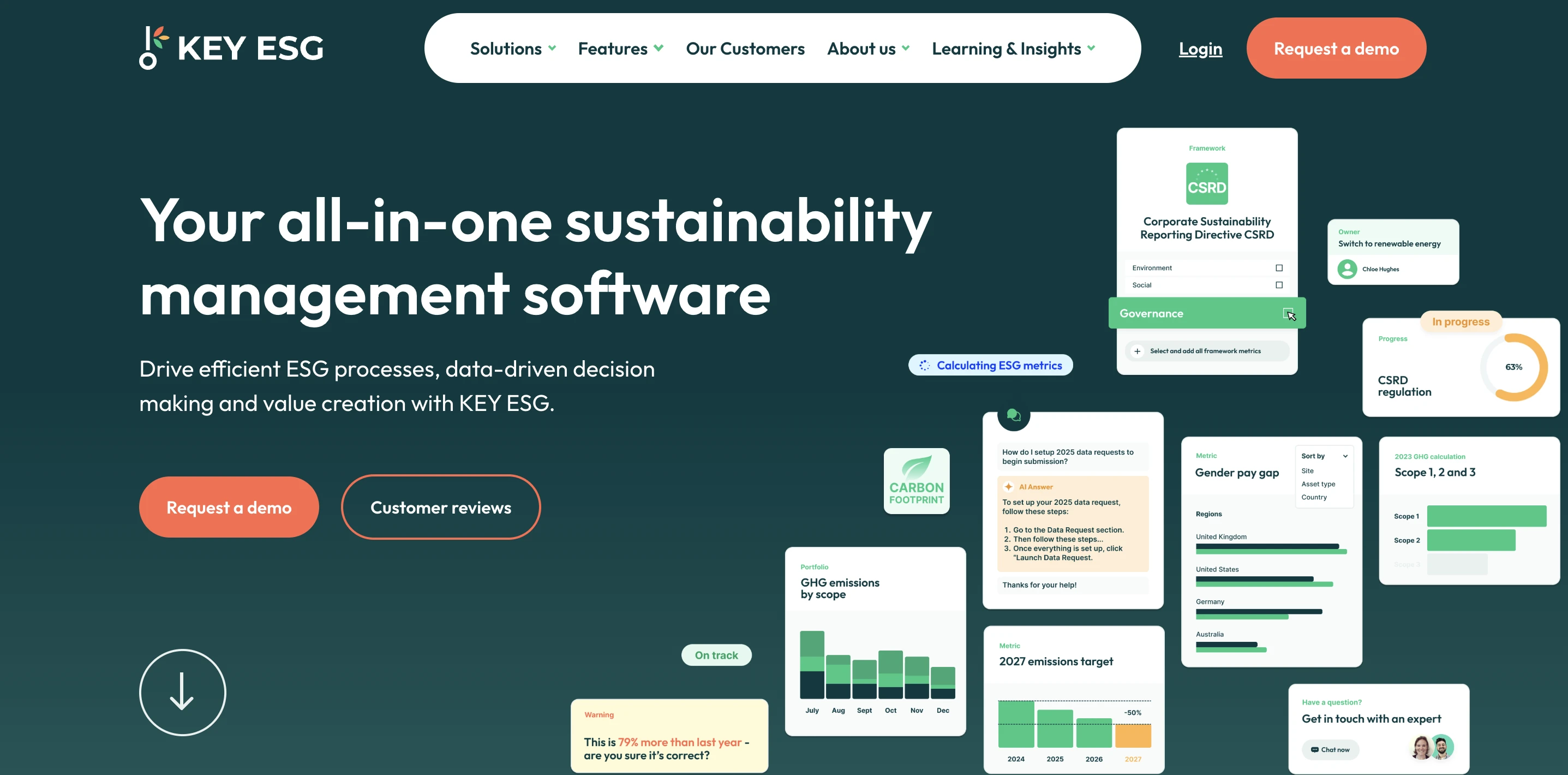
KEY ESG is a sustainability management platform designed for enterprises and investment firms to collect, manage, and report ESG data across entities and portfolios.
It supports both company-level operations and portfolio-level oversight within a single system, helping organisations maintain consistency across reporting frameworks and business units.
Key features
- Centralised sustainability data model across entities, sites, and portfolio companies
- KPI tracking aligned with CSRD, IFRS S1/S2, TCFD, and other frameworks
- Full Scope 1, 2, and 3 carbon accounting across all categories
- Workflow management with approvals, validation, and evidence tracking
- Portfolio-level ESG performance monitoring alongside company-level reporting
- Multi-framework reporting from a single, consistent dataset
AI capabilities
- AI policy generation: auto-generates policy descriptions from uploaded documents
- AI auto-fill: auto-completes qualitative data collection questions from attached documents
- AI root cause analysis: identifies the cause of YoY variance in GHG Scope 1/2/3 data when a validation rule is failing
- MCP connector: connects AI agents such as Claude or ChatGPT directly to live KEY ESG data, enabling use cases including LP and vendor questionnaire answering and carbon emissions root cause analysis
Best for
Enterprises and investment firms that need a structured, audit-ready system for sustainability data, carbon accounting, and multi-framework reporting across operations or portfolios
Watershed
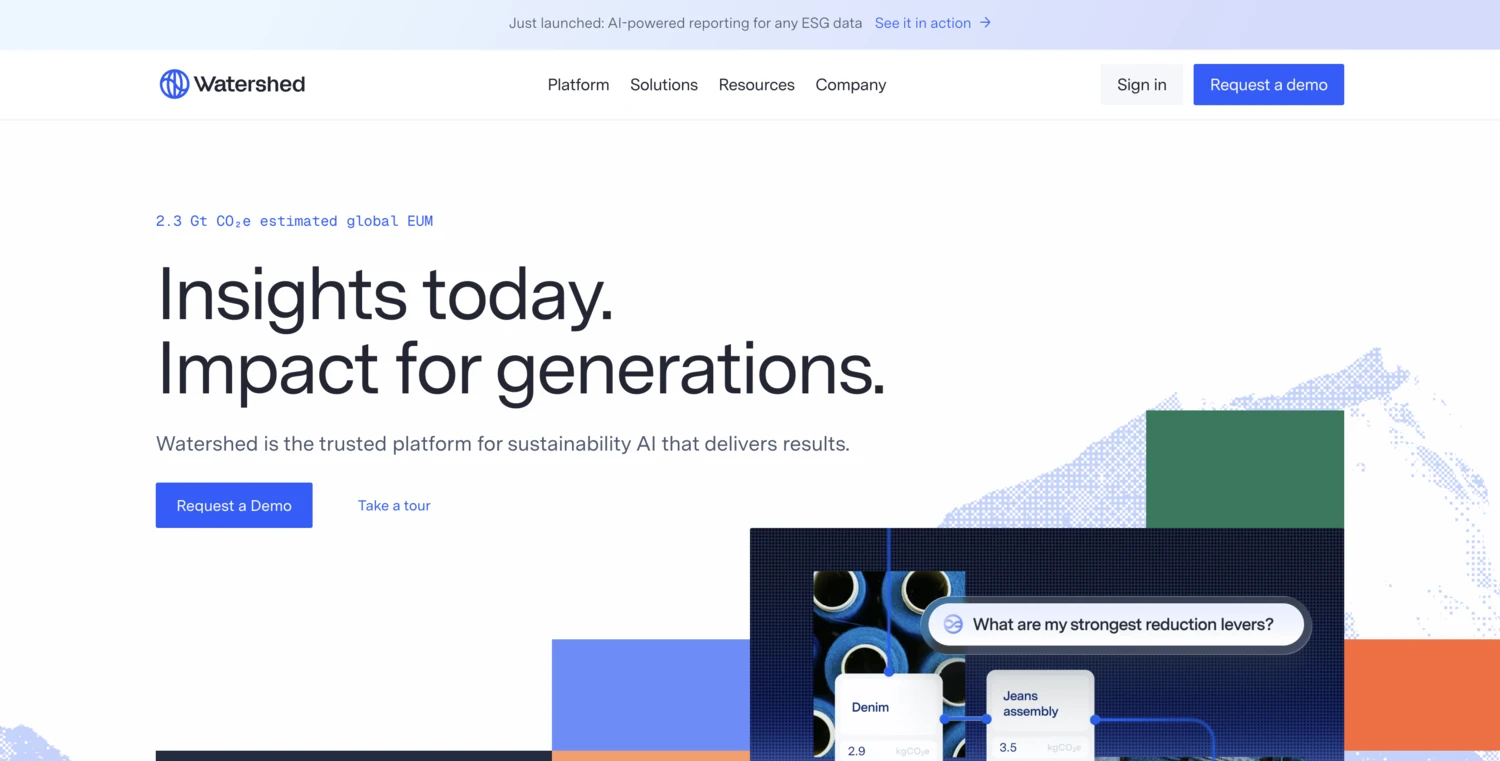
Watershed is a carbon management platform focused on helping enterprises measure, report, and reduce emissions across their operations and supply chains. It is widely used by large organisations managing complex sustainability programmes.
Key features
- Scope 1, 2, and 3 emissions measurement
- Supplier engagement and data collection tools
- Carbon reduction planning and tracking
- Reporting aligned with major disclosure frameworks
AI capabilities
- Sustainability-Grounded AI trained on specialised climate and ESG data for better accuracy
- Comprehensive ESG Measurement with AI-powered data collection
Best for
Enterprises looking to manage carbon emissions across operations and supply chains, with a focus on reduction planning
Sweep
Sweep is an ESG and carbon management platform that enables organisations to collect, manage, and report sustainability data across teams and business units. It is particularly strong in collaborative data collection.
Key features
- ESG and carbon data collection across departments
- Scope 1, 2, and 3 emissions tracking
- Collaboration tools for distributed data input
- Reporting aligned with frameworks such as CSRD
AI capabilities
- Automated data collection and management to collect and centralise ESG data from various internal and external sources
- Leverages agentic AI to automate carbon accounting, ESG reporting, and value chain engagement
Best for
Organisations that need to coordinate sustainability data collection across multiple teams and geographies
Normative
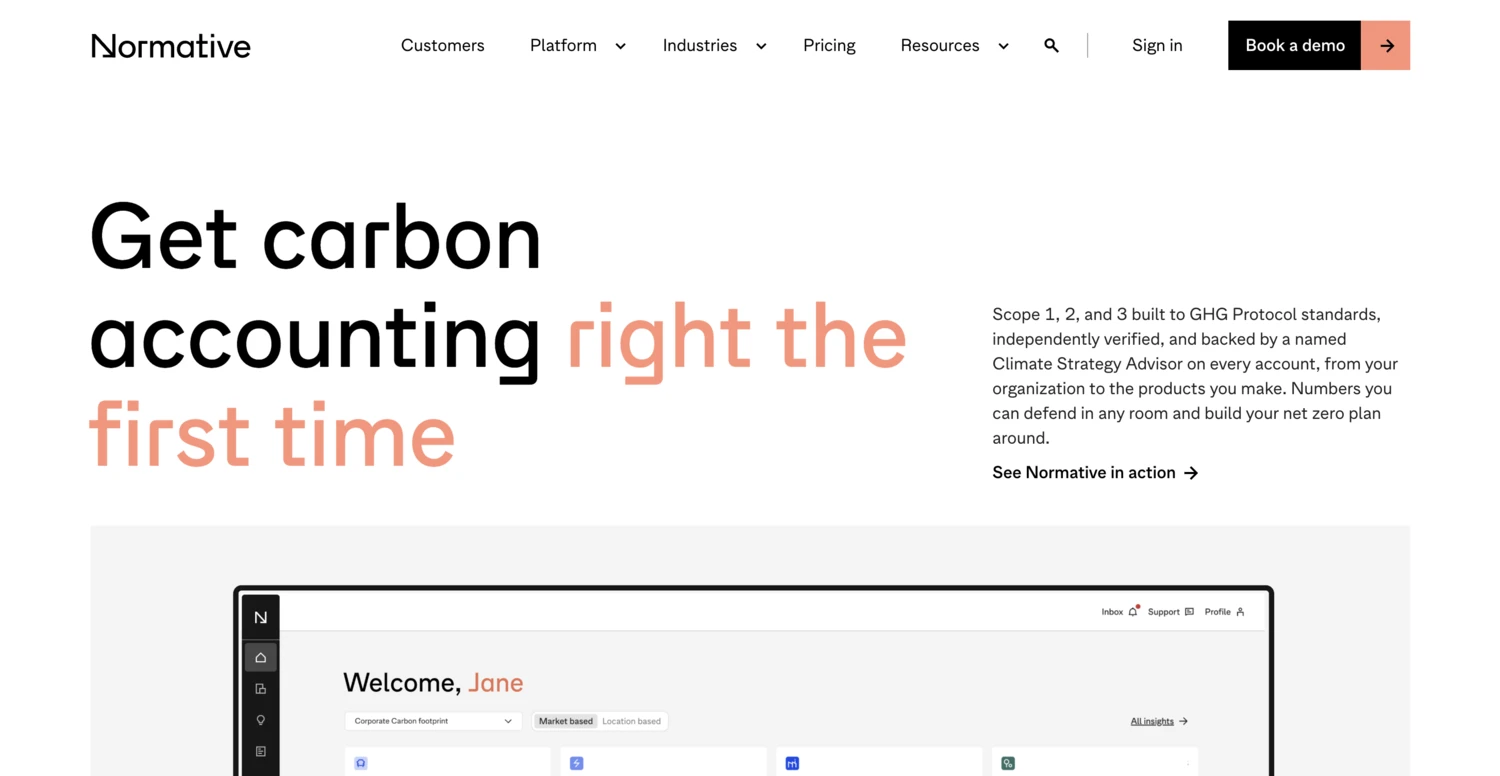
Normative is a carbon accounting platform focused on high-quality emissions measurement, with a strong emphasis on Scope 3 and science-based methodologies.
Key features
- Detailed Scope 1, 2, and 3 emissions calculations
- Supplier-level emissions modelling
- Alignment with recognised climate standards
- Support for emissions reduction planning
AI capabilities
- Automated carbon accounting (Scope 1, 2, & 3)
- AI scans for anomalies and data quality validation
- Scenario modeling and reduction planning
Best for
Organisations that require detailed, high-accuracy emissions data, particularly for Scope 3 categories
SAP Sustainability Control Tower
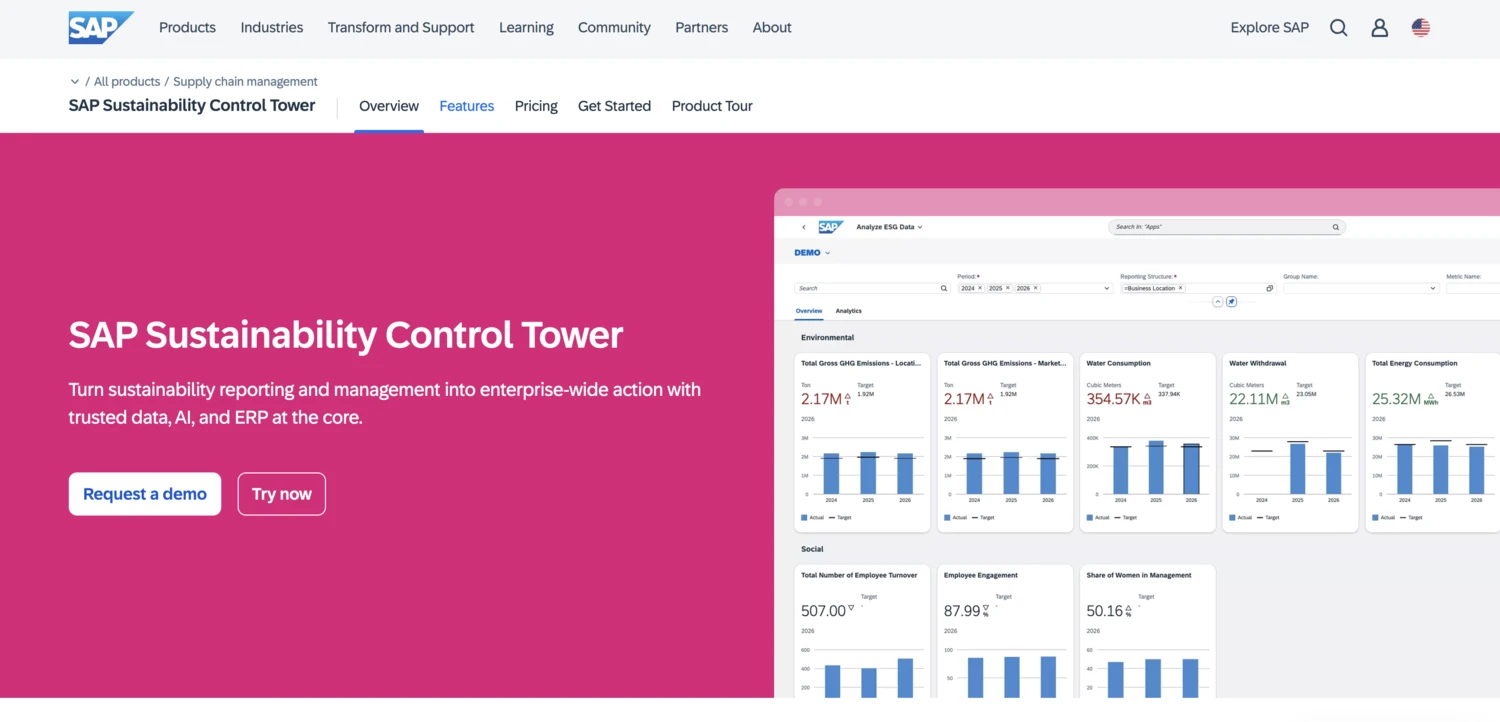
SAP Sustainability Control Tower is an enterprise sustainability management solution integrated within the SAP ecosystem. It enables organisations to manage ESG data alongside financial and operational data.
Key features
- Integration with SAP ERP and business systems
- ESG data collection and performance tracking
- Reporting aligned with regulatory and internal requirements
- Dashboarding across sustainability and business metrics
AI capabilities
- AI-assisted ESG report generation
- Automated emission factor mapping
- Uses AI to help with data validation and metric tracking
Best for
Large enterprises already using SAP that want to integrate sustainability data into their existing financial and operational systems
How to choose the right sustainability software
The right sustainability software depends on your organisation’s structure, reporting requirements, and data maturity. AI capabilities can support efficiency and insight, but the underlying system and data model remain the most important factors.
- Match the platform to your primary use case. Some tools focus on carbon accounting, while others support broader sustainability management across ESG topics and frameworks.
- Assess how data is structured and managed. Look for a consistent data model that supports multiple entities, business units, or portfolio companies without duplicating effort.
- Check alignment with reporting requirements. Ensure the platform supports frameworks such as CSRD and VSME, IFRS S1/S2, SFDR, TCFD, CDP, GRI, Invest Europe, EDCI and California Climate Laws.
- Evaluate auditability and control. Data should be traceable, with clear methodologies, validation processes, and supporting evidence.
- Understand how AI is applied. Focus on whether AI improves data quality, consistency, and insight generation, rather than treating it as a standalone feature.
Choosing the right platform is less about individual features and more about whether it provides a structured, reliable foundation for managing sustainability data over time.
The role of AI in sustainability software
AI is becoming part of sustainability software, but its value depends on how it is applied.
AI on its own doesn’t solve the underlying challenge. Sustainable performance measurement still depends on having a consistent data model, clear methodologies, and the ability to align KPIs across frameworks and entities.
Platforms that combine structured sustainability management with targeted use of AI are better positioned to support reliable, audit-ready reporting and ongoing performance tracking.
If you’re looking to standardise sustainability data, align KPIs across frameworks, and improve audit readiness, request a demo of KEY ESG to see how a structured system, with AI capabilities, can support performance measurement and reporting.
As sustainability reporting requirements expand and investor expectations increase, organisations are dealing with a growing volume and complexity of ESG data.
This is driving the adoption of AI within sustainability software, as teams look for more efficient ways to process and analyse information across their business.
At the same time, software vendors are increasingly positioning their platforms as “AI-powered.” In practice, the role of AI varies significantly. In some tools, it is used for data extraction or automation. In others, it supports emissions modelling, data validation, or performance analysis.
This guide reviews six sustainability software platforms that use AI to improve the collection, processing, and reporting of sustainability data. The focus is not on AI as a standalone feature, but on how it contributes to structured, reliable, and decision-useful sustainability management.
What to look for in AI-powered sustainability software
AI is becoming part of many sustainability platforms, but its value depends on how it is applied within the overall system. What matters is whether it improves data quality, consistency, and usability, rather than whether it is a feature.
When evaluating sustainability software, there are several areas to assess.
- Where AI is applied in the workflow. Look at whether AI is used for data collection, validation, emissions estimation, or performance analysis. The most useful applications are those that improve accuracy and reduce manual effort in core processes.
- Transparency and auditability. AI-supported outputs should remain explainable and traceable. It should be clear how calculations are performed, which data sources are used, and how results can be validated.
- Alignment with reporting frameworks. The platform should support multiple frameworks, and outputs should be structured in a way that can be reused across disclosures.
- Depth of carbon accounting capabilities. Strong platforms provide full Scope 1, 2, and 3 coverage, including detailed emissions calculations and access to recognised emission factor databases.
- Scalability across entities or portfolios. The system should support multiple business units, geographies, or portfolio companies, while maintaining consistent methodologies and data structures.
These criteria help distinguish between platforms that use AI as a surface-level feature and those that apply it to improve how sustainability performance is measured and managed.
Best AI-powered sustainability software
The list below focuses on tools that support data quality, emissions calculation, and performance analysis within a structured reporting system.
Each platform has been selected based on how it applies AI across the sustainability workflow, its ability to support recognised frameworks such as CSRD and IFRS, and its suitability for enterprise or investment firm use cases.
Persefoni
Persefoni is a carbon accounting and climate disclosure platform designed for enterprises and financial institutions. It focuses on producing investor-grade emissions data aligned with financial reporting requirements.
Key features
- Carbon Accounting and Calculation Engine
- Financial-grade emissions reporting and audit support
- Specific functionality for banks and investors to measure and manage the emissions of their portfolios
AI capabilities
- Persefoni Copilot
- AI-powered emission factor mapping
- AI-driven anomaly detection
Best for
Enterprises and financial institutions that require carbon accounting aligned with financial reporting and regulatory disclosures
KEY ESG
KEY ESG is a sustainability management platform designed for enterprises and investment firms to collect, manage, and report ESG data across entities and portfolios.
It supports both company-level operations and portfolio-level oversight within a single system, helping organisations maintain consistency across reporting frameworks and business units.
Key features
- Centralised sustainability data model across entities, sites, and portfolio companies
- KPI tracking aligned with CSRD, IFRS S1/S2, TCFD, and other frameworks
- Full Scope 1, 2, and 3 carbon accounting across all categories
- Workflow management with approvals, validation, and evidence tracking
- Portfolio-level ESG performance monitoring alongside company-level reporting
- Multi-framework reporting from a single, consistent dataset
AI capabilities
- AI policy generation: auto-generates policy descriptions from uploaded documents
- AI auto-fill: auto-completes qualitative data collection questions from attached documents
- AI root cause analysis: identifies the cause of YoY variance in GHG Scope 1/2/3 data when a validation rule is failing
- MCP connector: connects AI agents such as Claude or ChatGPT directly to live KEY ESG data, enabling use cases including LP and vendor questionnaire answering and carbon emissions root cause analysis
Best for
Enterprises and investment firms that need a structured, audit-ready system for sustainability data, carbon accounting, and multi-framework reporting across operations or portfolios
Watershed
Watershed is a carbon management platform focused on helping enterprises measure, report, and reduce emissions across their operations and supply chains. It is widely used by large organisations managing complex sustainability programmes.
Key features
- Scope 1, 2, and 3 emissions measurement
- Supplier engagement and data collection tools
- Carbon reduction planning and tracking
- Reporting aligned with major disclosure frameworks
AI capabilities
- Sustainability-Grounded AI trained on specialised climate and ESG data for better accuracy
- Comprehensive ESG Measurement with AI-powered data collection
Best for
Enterprises looking to manage carbon emissions across operations and supply chains, with a focus on reduction planning
Sweep
Sweep is an ESG and carbon management platform that enables organisations to collect, manage, and report sustainability data across teams and business units. It is particularly strong in collaborative data collection.
Key features
- ESG and carbon data collection across departments
- Scope 1, 2, and 3 emissions tracking
- Collaboration tools for distributed data input
- Reporting aligned with frameworks such as CSRD
AI capabilities
- Automated data collection and management to collect and centralise ESG data from various internal and external sources
- Leverages agentic AI to automate carbon accounting, ESG reporting, and value chain engagement
Best for
Organisations that need to coordinate sustainability data collection across multiple teams and geographies
Normative
Normative is a carbon accounting platform focused on high-quality emissions measurement, with a strong emphasis on Scope 3 and science-based methodologies.
Key features
- Detailed Scope 1, 2, and 3 emissions calculations
- Supplier-level emissions modelling
- Alignment with recognised climate standards
- Support for emissions reduction planning
AI capabilities
- Automated carbon accounting (Scope 1, 2, & 3)
- AI scans for anomalies and data quality validation
- Scenario modeling and reduction planning
Best for
Organisations that require detailed, high-accuracy emissions data, particularly for Scope 3 categories
SAP Sustainability Control Tower
SAP Sustainability Control Tower is an enterprise sustainability management solution integrated within the SAP ecosystem. It enables organisations to manage ESG data alongside financial and operational data.
Key features
- Integration with SAP ERP and business systems
- ESG data collection and performance tracking
- Reporting aligned with regulatory and internal requirements
- Dashboarding across sustainability and business metrics
AI capabilities
- AI-assisted ESG report generation
- Automated emission factor mapping
- Uses AI to help with data validation and metric tracking
Best for
Large enterprises already using SAP that want to integrate sustainability data into their existing financial and operational systems
How to choose the right sustainability software
The right sustainability software depends on your organisation’s structure, reporting requirements, and data maturity. AI capabilities can support efficiency and insight, but the underlying system and data model remain the most important factors.
- Match the platform to your primary use case. Some tools focus on carbon accounting, while others support broader sustainability management across ESG topics and frameworks.
- Assess how data is structured and managed. Look for a consistent data model that supports multiple entities, business units, or portfolio companies without duplicating effort.
- Check alignment with reporting requirements. Ensure the platform supports frameworks such as CSRD and VSME, IFRS S1/S2, SFDR, TCFD, CDP, GRI, Invest Europe, EDCI and California Climate Laws.
- Evaluate auditability and control. Data should be traceable, with clear methodologies, validation processes, and supporting evidence.
- Understand how AI is applied. Focus on whether AI improves data quality, consistency, and insight generation, rather than treating it as a standalone feature.
Choosing the right platform is less about individual features and more about whether it provides a structured, reliable foundation for managing sustainability data over time.
The role of AI in sustainability software
AI is becoming part of sustainability software, but its value depends on how it is applied.
AI on its own doesn’t solve the underlying challenge. Sustainable performance measurement still depends on having a consistent data model, clear methodologies, and the ability to align KPIs across frameworks and entities.
Platforms that combine structured sustainability management with targeted use of AI are better positioned to support reliable, audit-ready reporting and ongoing performance tracking.
If you’re looking to standardise sustainability data, align KPIs across frameworks, and improve audit readiness, request a demo of KEY ESG to see how a structured system, with AI capabilities, can support performance measurement and reporting.