Sustainability management software has become a core part of enterprise governance.
As regulatory expectations expand and assurance requirements increase, organisations are moving away from fragmented spreadsheets and point solutions toward structured systems that centralise data collection, carbon accounting and disclosure management.
KEY ESG is one option within this enterprise category, designed to support structured sustainability management at scale.
This guide outlines where KEY ESG fits in the market and highlights five alternative platforms frequently considered by large organisations.
Where KEY ESG fits in the enterprise sustainability landscape
KEY ESG is a sustainability management software platform built for medium- and large-sized enterprises that require structured governance across operations, carbon accounting, and regulatory reporting.
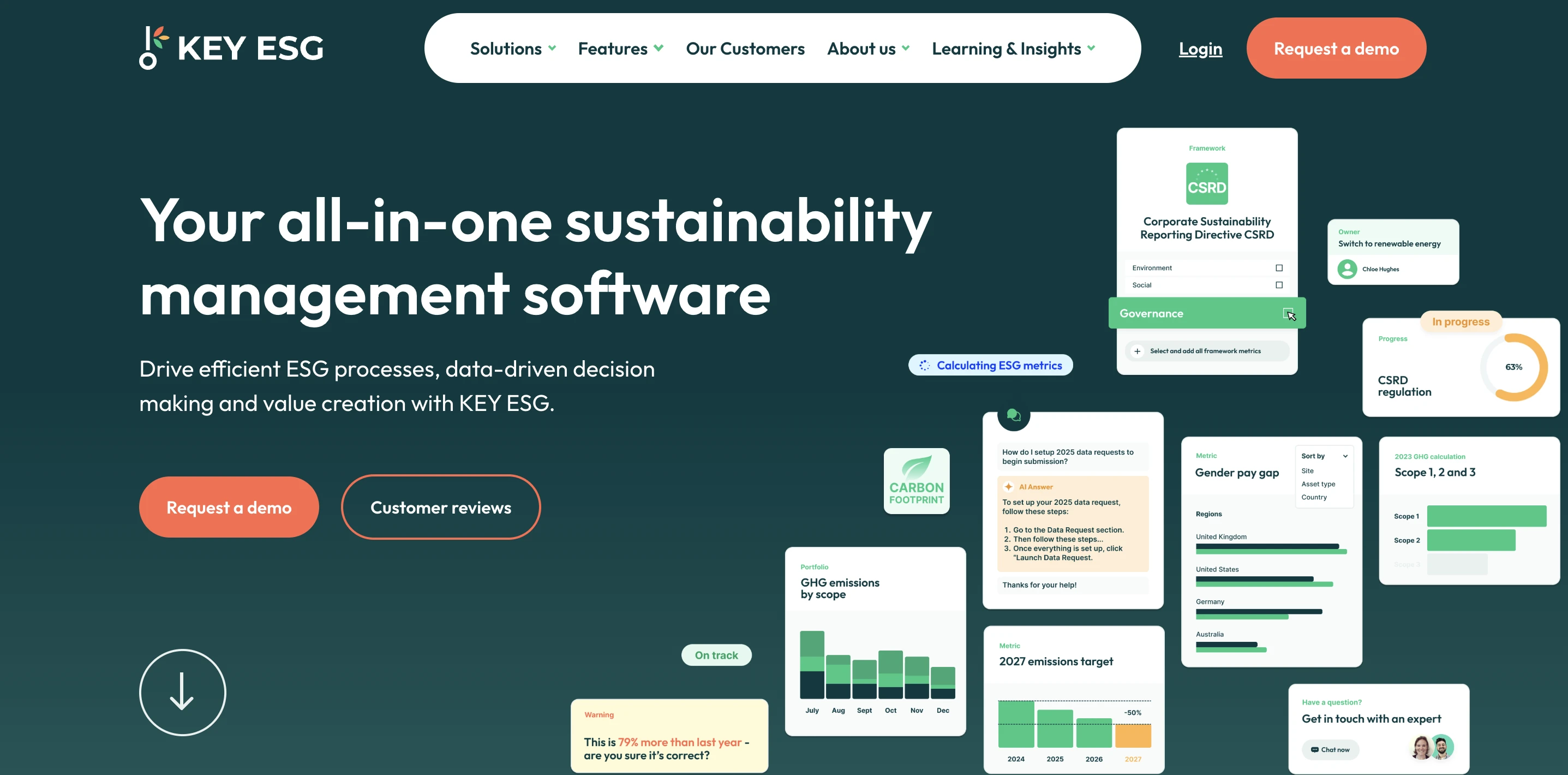
The platform is designed around a unified data model that enables organisations to manage sustainability information from a single controlled dataset. This architecture supports multi-framework reporting across CSRD, VSME, IFRS S1/S2, SFDR, TCFD, California Climate Laws, EDCI, GRI, CDP and Invest Europe.
KEY ESG incorporates full Scope 1, 2 and 3 carbon accounting across all 15 Scope 3 categories in line with the GHG Protocol. Carbon data, operational metrics and regulatory disclosures are managed within the same governance environment, supported by approval workflows, evidence management and audit trails.
For fund managers, the same system supports portfolio-level oversight alongside company-level operations, enabling consolidated sustainability reporting across multiple entities without maintaining separate tools. For corporate enterprises, it provides internal ownership across finance, compliance, operations and sustainability teams, reducing reliance on consultant-led consolidation while maintaining enterprise-grade control.
When enterprises compare sustainability management platforms
As sustainability reporting matures, enterprise organisations periodically reassess how effectively their systems support governance, scalability and regulatory alignment.
This review is often prompted by the implementation of CSRD and IFRS S1 and S2, the expansion of sustainability data across subsidiaries and operating units, rising assurance expectations and increased executive oversight of sustainability disclosures.
In this context, sustainability software must function as an enterprise governance system rather than a disclosure interface. Evaluation typically centres on data architecture, carbon coverage, workflow control, audit readiness and cross-functional coordination.
5 alternatives to KEY ESG
Enterprises comparing sustainability platforms frequently assess how different systems prioritise finance integration, operational oversight, governance controls and carbon depth. The following platforms are commonly evaluated alongside KEY ESG in enterprise environments.
1. Workiva
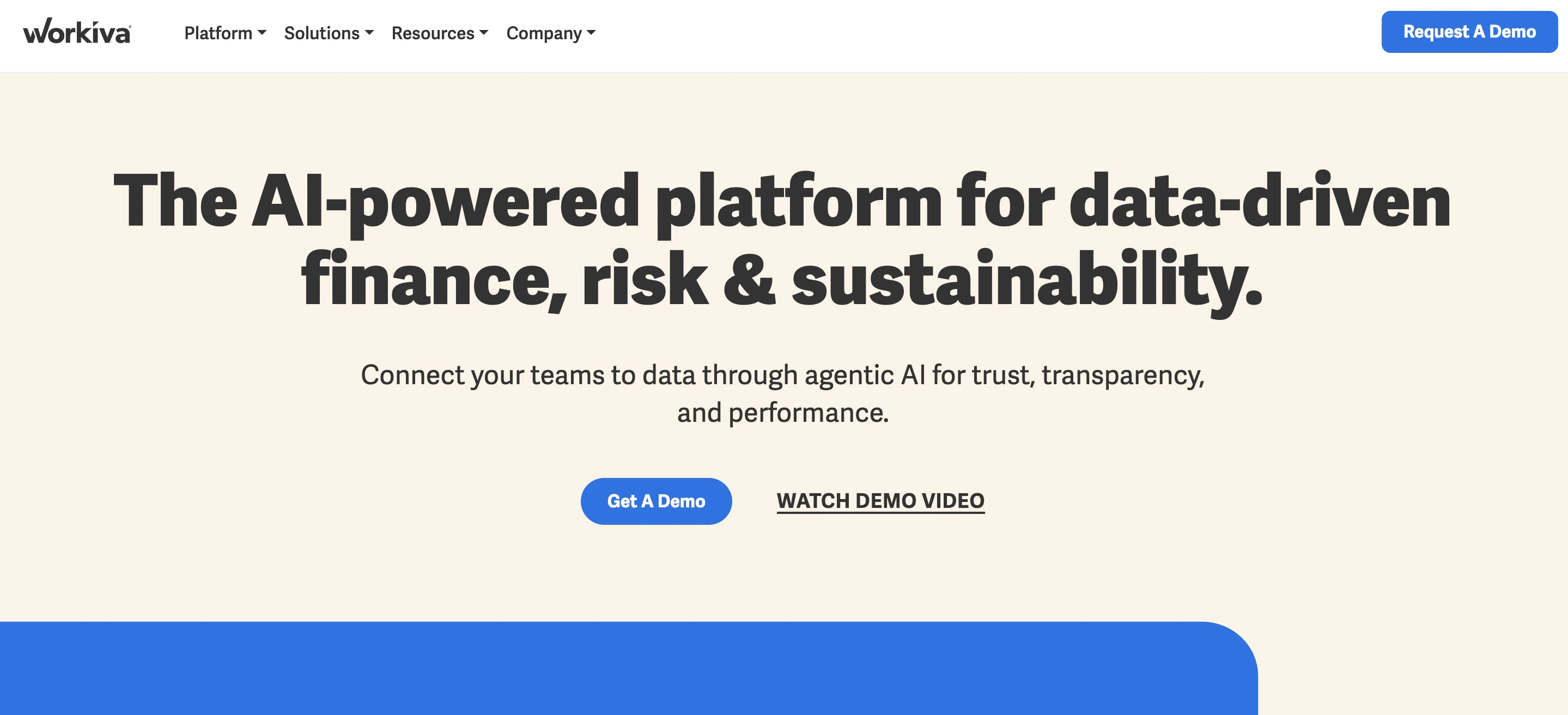
Workiva is widely recognised for financial and regulatory reporting, with sustainability capabilities integrated into its broader reporting platform. Organisations already operating within Workiva’s financial environment may consider extending its use into sustainability disclosures.
Services offered:
- ESG and sustainability reporting
- Integration with financial disclosures
- Structured document management
- Cross-team collaboration tools
Key strengths:
- Alignment between finance and sustainability reporting processes
- Established enterprise footprint
- Suitable for organisations embedding sustainability within financial governance structures
A great consideration for: Enterprises prioritising close integration between financial reporting and sustainability disclosures.
2. Sphera
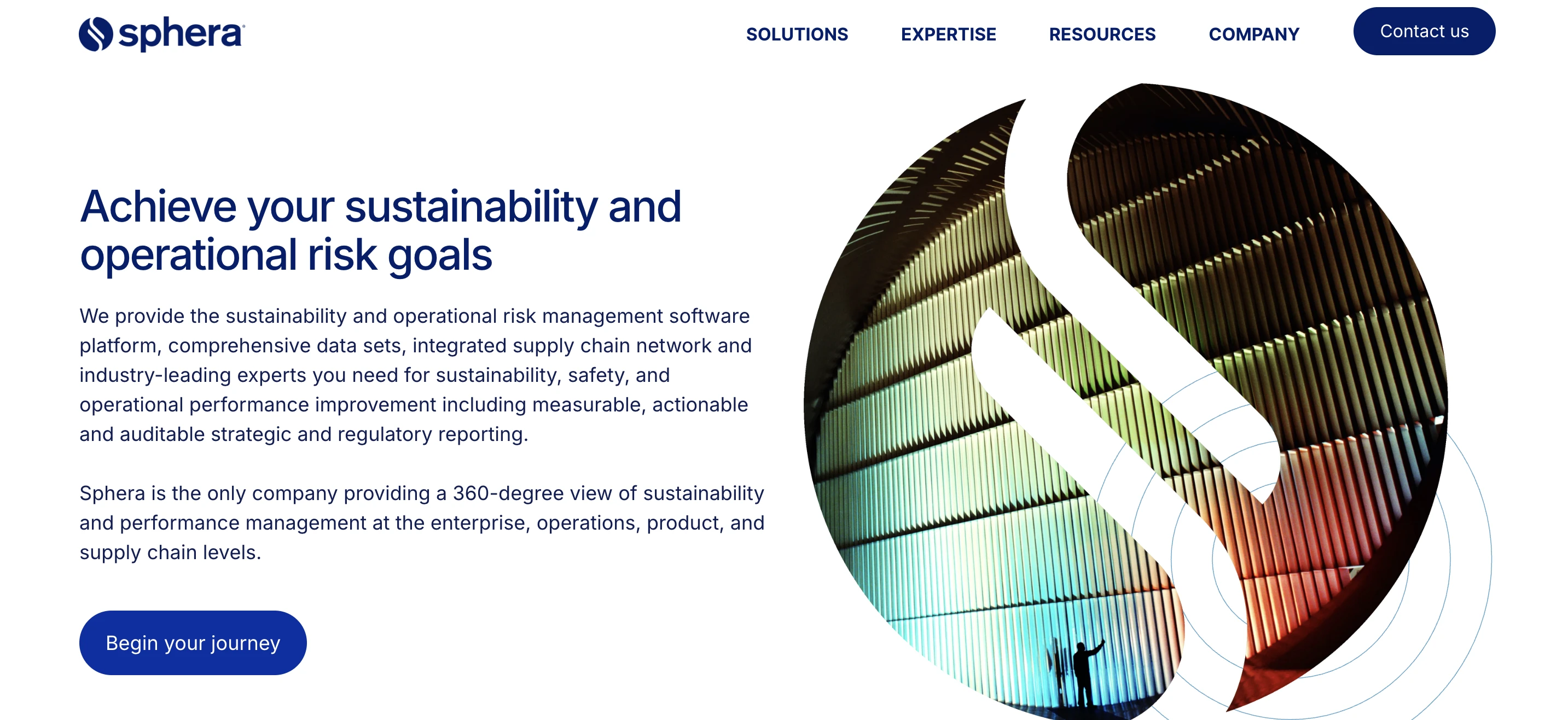
Sphera provides enterprise software that connects sustainability oversight with operational risk, environmental performance and safety management. Its positioning is particularly relevant for asset-intensive and regulated industries.
Services offered:
- Environmental, health and safety (EHS) management
- Operational risk oversight
- Sustainability reporting support
- Product and supply chain performance visibility
Key strengths:
- Integration of sustainability with operational and risk management processes
- Strong presence in industrial sectors
- Suitable for complex, multi-site enterprises
A great consideration for: Organisations requiring alignment between operational performance, environmental oversight and sustainability governance.
3. Diligent ESG
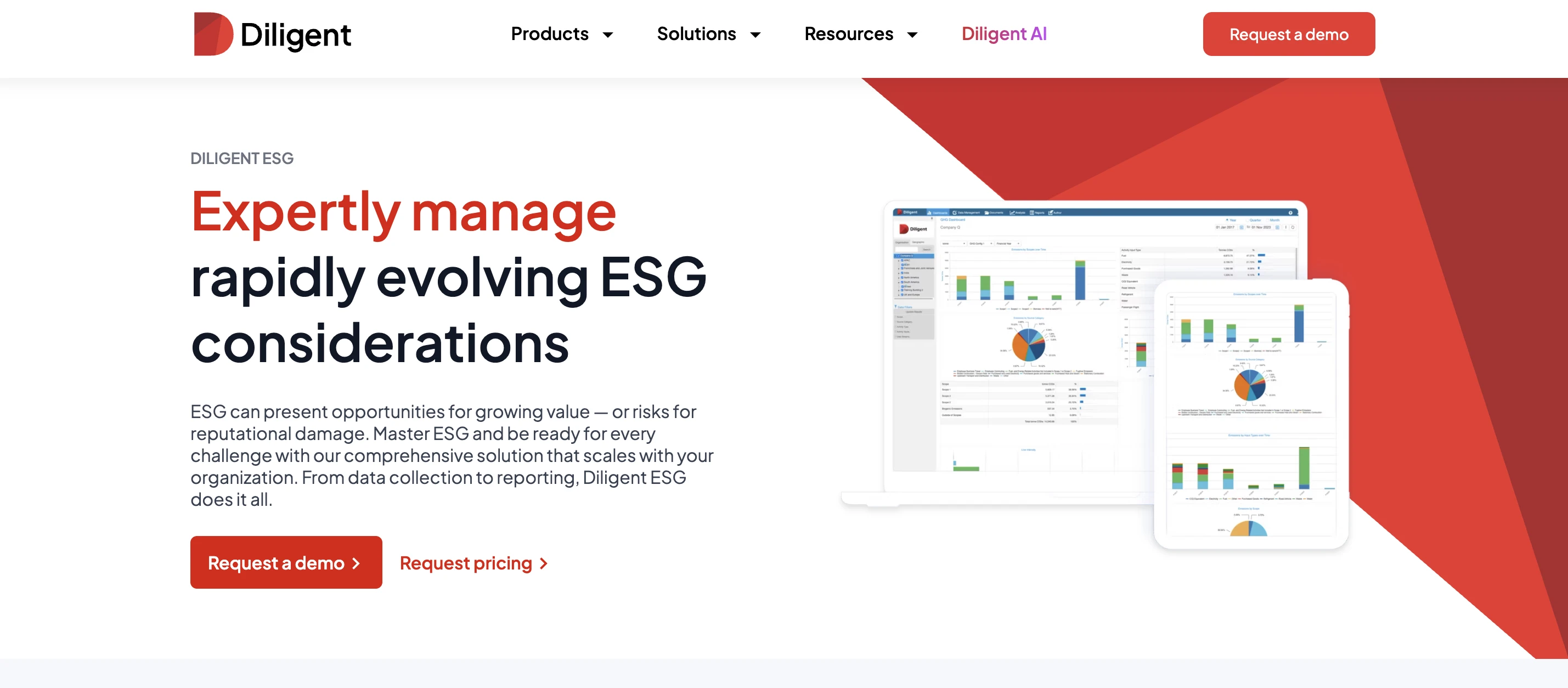
Diligent ESG forms part of a broader governance, risk and compliance ecosystem. It is often considered by enterprises seeking strong board-level visibility of sustainability performance.
Services offered:
- ESG data collection and reporting
- Board-level dashboards and executive reporting tools
- Integration with governance workflows
Key strengths:
- Governance-focused architecture
- Suitable for regulated and publicly listed organisations
- Alignment between ESG reporting and executive oversight
A great consideration for: Enterprises prioritising board-level governance integration of sustainability data.
4. Novisto
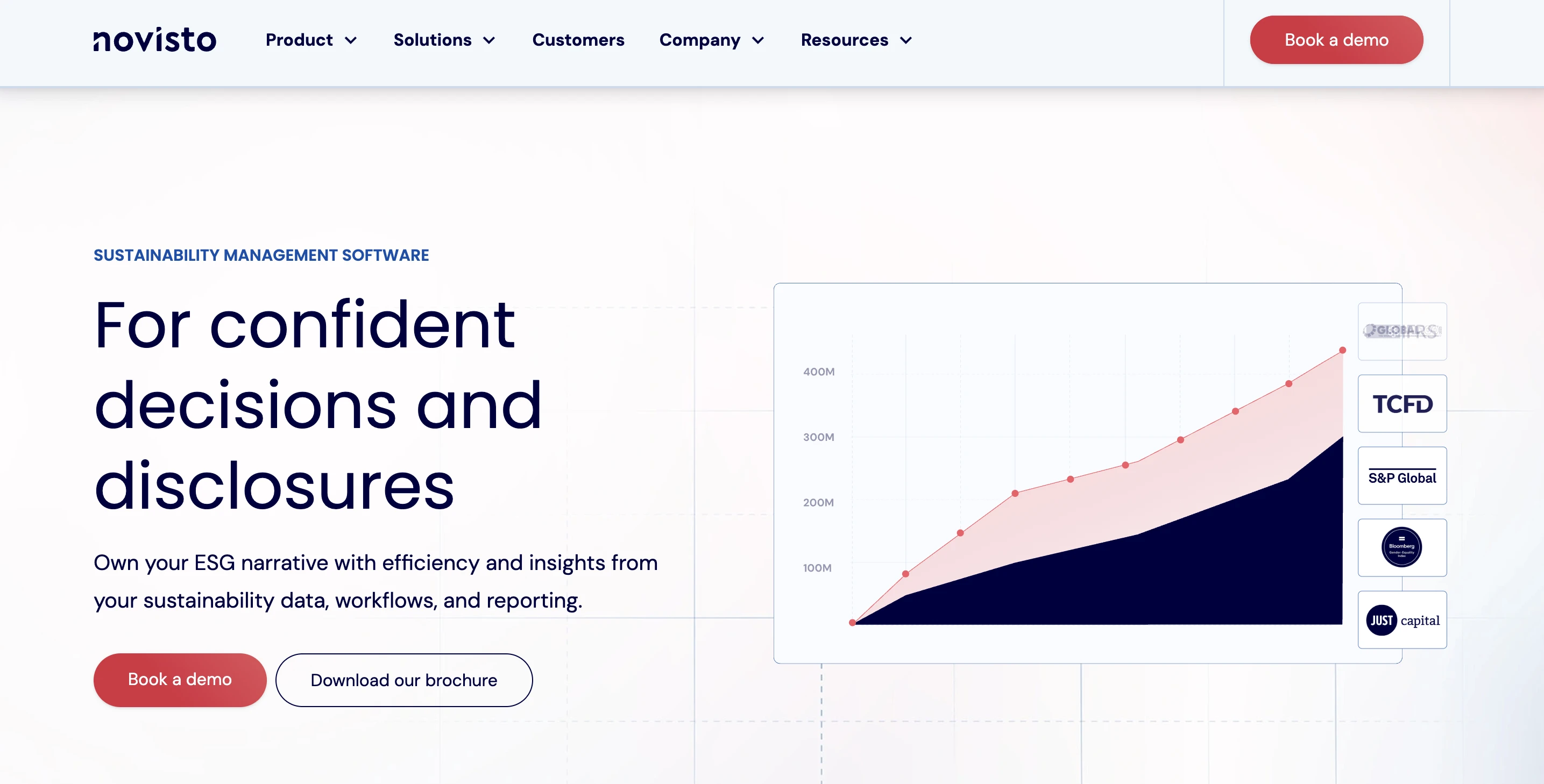
Novisto focuses on structured ESG data management and disclosure coordination. Its positioning centres on helping organisations manage sustainability information efficiently across multiple reporting frameworks.
Services offered:
- ESG data collection and consolidation
- Multi-framework reporting alignment
- Structured workflow management
- Disclosure coordination tools
Key strengths:
- Strong emphasis on ESG data architecture
- Designed to support regulatory reporting maturity
- Suitable for organisations centralising disclosure management processes
A great consideration for: Enterprises focused on structured ESG data governance and disclosure coordination.
5. Persefoni
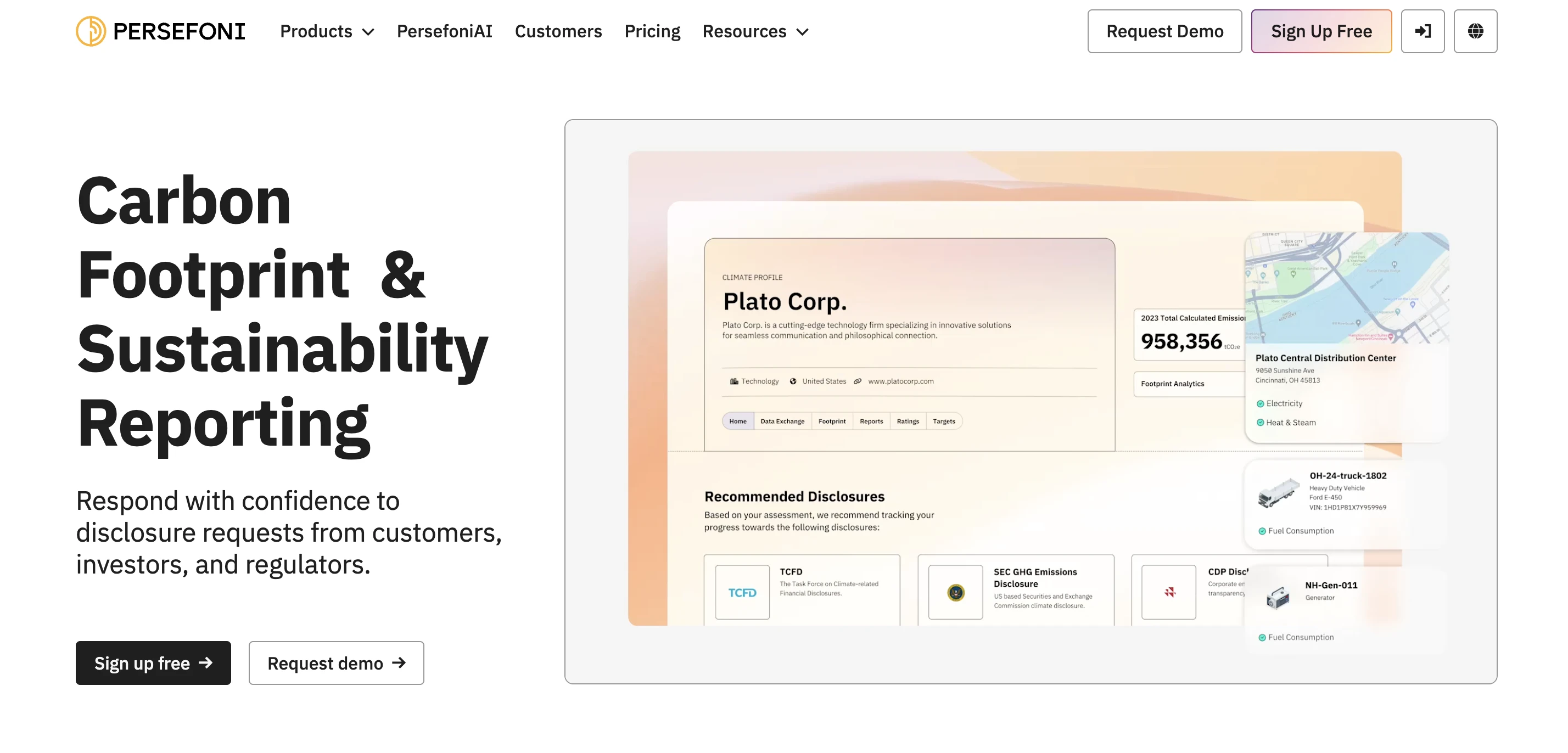
Persefoni is a carbon accounting and climate disclosure platform with enterprise-level capabilities. It is frequently evaluated by organisations where emissions reporting is a primary driver of sustainability strategy.
Services offered:
- Scope 1, 2 and 3 emissions accounting
- Climate disclosure reporting
- Emissions data management tools
Key strengths:
- Deep focus on carbon measurement and transparency
- Enterprise-grade emissions calculation infrastructure
- Suitable for organisations prioritising climate disclosures
A great consideration for: Enterprises where carbon accounting forms the central component of sustainability reporting.
How to evaluate sustainability management software for enterprise use
Selecting sustainability management software is a structural decision that shapes how data is governed across subsidiaries, functions and reporting frameworks.
Here are eight important considerations.
1. Unified data architecture
A sustainability platform should maintain a single, controlled dataset that underpins all disclosures and performance metrics. A unified data model reduces duplication, strengthens consistency and enables organisations to map information across multiple frameworks without maintaining parallel processes.
2. Comprehensive carbon integration
Enterprises with complex value chains require full Scope 1, 2 and 3 emissions coverage aligned with the GHG Protocol. Visibility across all 15 Scope 3 categories, supported by documented emission factors and transparent calculation methodologies, strengthens regulatory alignment and assurance readiness.
3. Multi-framework reporting capability
Large organisations frequently report under CSRD, IFRS S1 and S2, GRI and other standards simultaneously. Systems that support mapping one dataset across multiple frameworks reduce operational complexity and improve disclosure consistency across reports.
4. Governance controls and audit readiness
Sustainability data is increasingly subject to assurance and regulatory scrutiny. Platforms should provide structured approval workflows, change tracking, evidence storage and clear audit trails to support internal accountability and external review processes.
5. Cross-functional collaboration
Sustainability management spans finance, compliance, operations and procurement teams. The platform should enable coordinated workflows, role-based access controls and central oversight without creating fragmented reporting environments.
6. Organisational scalability
Medium and large enterprises operate across multiple entities, sites and jurisdictions. The system must support distributed data ownership while maintaining group-level visibility and control across complex organisational structures.
7. Inbound and outbound integrations
Enterprise sustainability systems must integrate with existing ERP, finance, procurement, HR and data platforms. Automated inbound data flows reduce manual collection effort, while outbound integrations ensure sustainability metrics can feed reporting tools, investor communications and regulatory submissions without duplication.
8. AI-powered data validation
As sustainability datasets grow in volume and complexity, automated validation becomes essential. AI-powered checks can identify anomalies, flag inconsistencies and support data quality controls while maintaining transparency and human oversight. This strengthens confidence in reported metrics and reduces audit risk.
Final thoughts
Sustainability management software varies in emphasis, from finance-led reporting integration to operational risk oversight and carbon-focused platforms. Enterprise organisations and investment managers evaluating systems should consider how effectively a platform supports unified data governance, comprehensive carbon accounting and multi-framework reporting at scale.
KEY ESG is designed as a sustainability-native enterprise system that combines full Scope 1–3 carbon accounting with a unified data model and structured governance workflows. This approach supports internal ownership of sustainability management across subsidiaries, regulatory standards and reporting cycles.
If your organisation is reviewing sustainability management software, assessing how your platform supports enterprise governance, carbon integration and regulatory alignment is a practical next step.
Request a demo to see how KEY ESG enables structured, audit-ready sustainability management at enterprise scale.
Sustainability management software has become a core part of enterprise governance.
As regulatory expectations expand and assurance requirements increase, organisations are moving away from fragmented spreadsheets and point solutions toward structured systems that centralise data collection, carbon accounting and disclosure management.
KEY ESG is one option within this enterprise category, designed to support structured sustainability management at scale.
This guide outlines where KEY ESG fits in the market and highlights five alternative platforms frequently considered by large organisations.
Where KEY ESG fits in the enterprise sustainability landscape
KEY ESG is a sustainability management software platform built for medium- and large-sized enterprises that require structured governance across operations, carbon accounting, and regulatory reporting.
The platform is designed around a unified data model that enables organisations to manage sustainability information from a single controlled dataset. This architecture supports multi-framework reporting across CSRD, VSME, IFRS S1/S2, SFDR, TCFD, California Climate Laws, EDCI, GRI, CDP and Invest Europe.
KEY ESG incorporates full Scope 1, 2 and 3 carbon accounting across all 15 Scope 3 categories in line with the GHG Protocol. Carbon data, operational metrics and regulatory disclosures are managed within the same governance environment, supported by approval workflows, evidence management and audit trails.
For fund managers, the same system supports portfolio-level oversight alongside company-level operations, enabling consolidated sustainability reporting across multiple entities without maintaining separate tools. For corporate enterprises, it provides internal ownership across finance, compliance, operations and sustainability teams, reducing reliance on consultant-led consolidation while maintaining enterprise-grade control.
When enterprises compare sustainability management platforms
As sustainability reporting matures, enterprise organisations periodically reassess how effectively their systems support governance, scalability and regulatory alignment.
This review is often prompted by the implementation of CSRD and IFRS S1 and S2, the expansion of sustainability data across subsidiaries and operating units, rising assurance expectations and increased executive oversight of sustainability disclosures.
In this context, sustainability software must function as an enterprise governance system rather than a disclosure interface. Evaluation typically centres on data architecture, carbon coverage, workflow control, audit readiness and cross-functional coordination.
5 alternatives to KEY ESG
Enterprises comparing sustainability platforms frequently assess how different systems prioritise finance integration, operational oversight, governance controls and carbon depth. The following platforms are commonly evaluated alongside KEY ESG in enterprise environments.
1. Workiva
Workiva is widely recognised for financial and regulatory reporting, with sustainability capabilities integrated into its broader reporting platform. Organisations already operating within Workiva’s financial environment may consider extending its use into sustainability disclosures.
Services offered:
- ESG and sustainability reporting
- Integration with financial disclosures
- Structured document management
- Cross-team collaboration tools
Key strengths:
- Alignment between finance and sustainability reporting processes
- Established enterprise footprint
- Suitable for organisations embedding sustainability within financial governance structures
A great consideration for: Enterprises prioritising close integration between financial reporting and sustainability disclosures.
2. Sphera
Sphera provides enterprise software that connects sustainability oversight with operational risk, environmental performance and safety management. Its positioning is particularly relevant for asset-intensive and regulated industries.
Services offered:
- Environmental, health and safety (EHS) management
- Operational risk oversight
- Sustainability reporting support
- Product and supply chain performance visibility
Key strengths:
- Integration of sustainability with operational and risk management processes
- Strong presence in industrial sectors
- Suitable for complex, multi-site enterprises
A great consideration for: Organisations requiring alignment between operational performance, environmental oversight and sustainability governance.
3. Diligent ESG
Diligent ESG forms part of a broader governance, risk and compliance ecosystem. It is often considered by enterprises seeking strong board-level visibility of sustainability performance.
Services offered:
- ESG data collection and reporting
- Board-level dashboards and executive reporting tools
- Integration with governance workflows
Key strengths:
- Governance-focused architecture
- Suitable for regulated and publicly listed organisations
- Alignment between ESG reporting and executive oversight
A great consideration for: Enterprises prioritising board-level governance integration of sustainability data.
4. Novisto
Novisto focuses on structured ESG data management and disclosure coordination. Its positioning centres on helping organisations manage sustainability information efficiently across multiple reporting frameworks.
Services offered:
- ESG data collection and consolidation
- Multi-framework reporting alignment
- Structured workflow management
- Disclosure coordination tools
Key strengths:
- Strong emphasis on ESG data architecture
- Designed to support regulatory reporting maturity
- Suitable for organisations centralising disclosure management processes
A great consideration for: Enterprises focused on structured ESG data governance and disclosure coordination.
5. Persefoni
Persefoni is a carbon accounting and climate disclosure platform with enterprise-level capabilities. It is frequently evaluated by organisations where emissions reporting is a primary driver of sustainability strategy.
Services offered:
- Scope 1, 2 and 3 emissions accounting
- Climate disclosure reporting
- Emissions data management tools
Key strengths:
- Deep focus on carbon measurement and transparency
- Enterprise-grade emissions calculation infrastructure
- Suitable for organisations prioritising climate disclosures
A great consideration for: Enterprises where carbon accounting forms the central component of sustainability reporting.
How to evaluate sustainability management software for enterprise use
Selecting sustainability management software is a structural decision that shapes how data is governed across subsidiaries, functions and reporting frameworks.
Here are eight important considerations.
1. Unified data architecture
A sustainability platform should maintain a single, controlled dataset that underpins all disclosures and performance metrics. A unified data model reduces duplication, strengthens consistency and enables organisations to map information across multiple frameworks without maintaining parallel processes.
2. Comprehensive carbon integration
Enterprises with complex value chains require full Scope 1, 2 and 3 emissions coverage aligned with the GHG Protocol. Visibility across all 15 Scope 3 categories, supported by documented emission factors and transparent calculation methodologies, strengthens regulatory alignment and assurance readiness.
3. Multi-framework reporting capability
Large organisations frequently report under CSRD, IFRS S1 and S2, GRI and other standards simultaneously. Systems that support mapping one dataset across multiple frameworks reduce operational complexity and improve disclosure consistency across reports.
4. Governance controls and audit readiness
Sustainability data is increasingly subject to assurance and regulatory scrutiny. Platforms should provide structured approval workflows, change tracking, evidence storage and clear audit trails to support internal accountability and external review processes.
5. Cross-functional collaboration
Sustainability management spans finance, compliance, operations and procurement teams. The platform should enable coordinated workflows, role-based access controls and central oversight without creating fragmented reporting environments.
6. Organisational scalability
Medium and large enterprises operate across multiple entities, sites and jurisdictions. The system must support distributed data ownership while maintaining group-level visibility and control across complex organisational structures.
7. Inbound and outbound integrations
Enterprise sustainability systems must integrate with existing ERP, finance, procurement, HR and data platforms. Automated inbound data flows reduce manual collection effort, while outbound integrations ensure sustainability metrics can feed reporting tools, investor communications and regulatory submissions without duplication.
8. AI-powered data validation
As sustainability datasets grow in volume and complexity, automated validation becomes essential. AI-powered checks can identify anomalies, flag inconsistencies and support data quality controls while maintaining transparency and human oversight. This strengthens confidence in reported metrics and reduces audit risk.
Final thoughts
Sustainability management software varies in emphasis, from finance-led reporting integration to operational risk oversight and carbon-focused platforms. Enterprise organisations and investment managers evaluating systems should consider how effectively a platform supports unified data governance, comprehensive carbon accounting and multi-framework reporting at scale.
KEY ESG is designed as a sustainability-native enterprise system that combines full Scope 1–3 carbon accounting with a unified data model and structured governance workflows. This approach supports internal ownership of sustainability management across subsidiaries, regulatory standards and reporting cycles.
If your organisation is reviewing sustainability management software, assessing how your platform supports enterprise governance, carbon integration and regulatory alignment is a practical next step.
Request a demo to see how KEY ESG enables structured, audit-ready sustainability management at enterprise scale.